
Introduction
Choosing between a China-based ATV parts supplier and a local source is rarely a simple price comparison. Unit cost, minimum order quantities, tooling, freight, tariffs, lead times, and defect risk can shift the real savings dramatically depending on the part category and your demand profile. This article outlines how to compare total landed cost with less visible factors such as inventory exposure, quality control workload, and supply chain flexibility. By the end, you’ll have a practical framework for deciding when offshore sourcing delivers a genuine cost advantage and when local suppliers create better value despite higher quoted prices.
How should buyers frame the China ATV parts supplier vs
Procurement professionals evaluating ATV parts sourcing face a complex optimization problem. The decision between a China ATV parts supplier and a local manufacturer extends far beyond the quoted unit price. Establishing a rigorous analytical framework is essential to navigate total cost of ownership, supply chain resilience, and quality assurance in the powersports industry.
How should procurement teams define ATV parts categories and demand
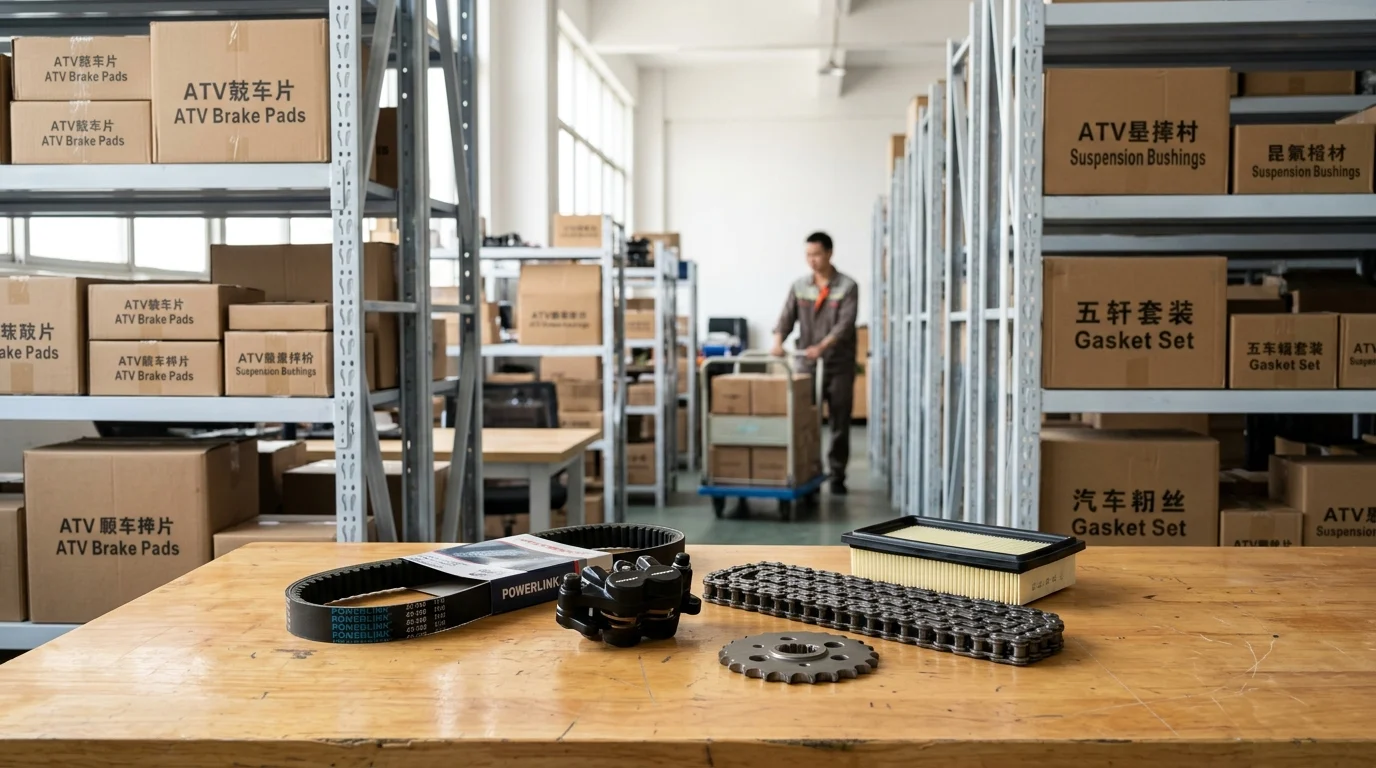
Categorizing ATV components is the foundational step in sourcing strategy. Procurement teams must segment parts based on manufacturing complexity, intellectual property sensitivity, and demand volatility. High-turnover consumables like brake pads, air filters, and standard bearings require different supply chain velocities compared to precision-machined engine internals or proprietary suspension linkages.
Demand forecasting also dictates viability. A China-based supplier typically mandates Minimum Order Quantities (MOQs) exceeding 500 to 1,000 units to amortize setup costs effectively. In contrast, local suppliers might accept production runs of 50 to 100 units, making them highly suitable for specialized aftermarket modifications, beta testing, or highly volatile demand profiles.
Which cost elements beyond unit price matter most
Beyond the ex-works unit price, total landed cost calculations must incorporate non-recurring engineering (NRE) fees, tooling amortization, and geopolitical tariffs. For instance, injection molding dies or aluminum extrusion tooling sourced overseas can cost 60% to 80% less than domestic equivalents, drastically lowering the barrier to entry for custom plastics.
However, buyers must offset these initial capital expenditure savings against recurring operational expenses. Section 301 tariffs can add up to 25% to the import cost of Chinese-manufactured goods into the US. Additionally, buyers must account for currency exchange fluctuations, third-party quality inspection fees, and the cost of capital tied up in longer transit times.
How should buyers evaluate material specifications and tolerances
Material integrity and dimensional accuracy are non-negotiable in off-road vehicle applications, where components endure extreme stress, vibration, and thermal cycling. Buyers must specify exact material grades, such as 7075-T6 aluminum rather than generic alloys, and define acceptable tolerances, which often reach ±0.01mm for critical powertrain components.
Evaluating a supplier's ability to consistently meet these specifications requires auditing their metallurgical testing capabilities. Procurement teams should require in-house spectrometer testing and ensure the supplier provides verifiable material test reports (MTRs) for every batch, rather than relying solely on unverified sub-tier supplier certificates.
How do China ATV parts suppliers and local suppliers compare
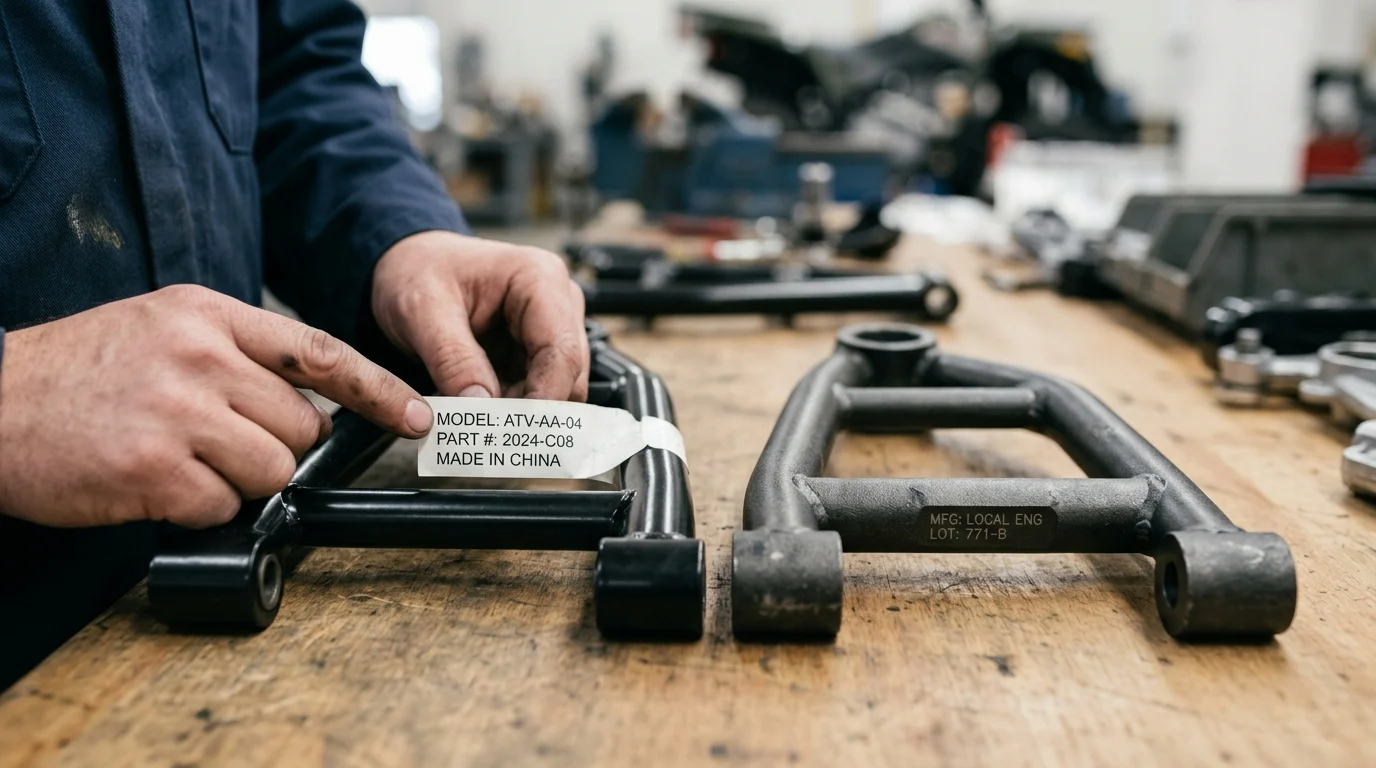
Directly comparing overseas and domestic manufacturing requires standardizing the variables that impact both the balance sheet and the production schedule. A side-by-side analysis reveals stark contrasts in capital requirements, scalability, and lead times.
Which comparison table should include unit cost, tooling, and MOQ
To objectify the sourcing decision, procurement teams should utilize a standardized matrix that captures the primary financial and temporal commitments required by each region. The data below represents typical baseline metrics for custom ATV components such as machined hubs or injection-molded fairings.
| Metric | China Supplier | Local Supplier (US/EU) |
|---|---|---|
| Unit Cost Index | 1.0x (Base) | 1.5x – 2.5x |
| Custom Tooling (Average) | $3,500 – $8,000 | $15,000 – $35,000 |
| Standard MOQ | 500 – 1,000 units | 50 – 200 units |
| Production Lead Time | 30 – 45 days | 15 – 30 days |
| Re-order Lead Time | 20 – 30 days | 10 – 20 days |
This baseline illustrates the fundamental trade-off: overseas sourcing demands higher volume commitments and patience, while local sourcing commands a premium for agility and lower barriers to entry.
When does a China supplier offer a clear advantage
A China ATV parts supplier offers an undeniable advantage when scaling high-volume, labor-intensive assemblies or parts requiring heavy capital expenditure in tooling. Wire harnesses, complex molded plastics, and cast aluminum engine cases benefit massively from the region's established powersports manufacturing ecosystem.
When annual volumes exceed 5,000 units, the economies of scale heavily favor overseas production. The ability to amortize a $5,000 tooling cost over 10,000 units adds merely $0.50 to the unit cost, whereas domestic tooling at $25,000 would add $2.50 per unit, rapidly eroding profit margins on mid-tier ATV models.
When does a local supplier offer a clear advantage
Local suppliers present a clear advantage when dealing with highly proprietary, IP-sensitive components, or heavy, bulky parts where freight costs negate unit price savings. Fabricated steel ATV frames or oversized roll cages often cost more to ship across the ocean than they do to manufacture domestically.
Furthermore, for rapid prototyping, beta testing new suspension geometries, or servicing premium racing segments where consumers will pay a premium for CNC-machined billet parts, local suppliers excel. Their ability to iterate a design and deliver a functional prototype within 7 to 14 days is a critical competitive advantage that overseas suppliers cannot match due to transit physics.
What logistics, compliance, and supply chain risks affect total savings
The theoretical savings of a lower unit price can quickly evaporate if supply chain friction is not managed. Logistics, regulatory compliance, and communication hurdles represent the most significant hidden costs in international sourcing.
How do freight, duties, Incoterms, and inventory carrying costs change economics
Freight volatility plays a massive role in the profitability of imported ATV parts. While an ocean container might cost $4,500 during stable periods, market disruptions can spike 40ft High Cube container rates past $10,000, severely impacting the margins on low-value, high-volume parts like plastic fenders.
Incoterms dictate who bears these risks. Operating on FOB (Free On Board) terms requires the buyer to manage ocean freight and insurance, whereas DDP (Delivered Duty Paid) places the burden on the supplier but often at a markup. Additionally, the 35 to 50 days of ocean transit requires companies to hold 18% to 25% more buffer inventory, tying up working capital and increasing inventory carrying costs.
Which regulatory, product safety, traceability, and documentation issues matter
The powersports industry is heavily regulated, and non-compliance can result in catastrophic recalls or import seizures. Exhaust systems and fuel components must meet EPA and CARB emissions standards, while brake lines and lighting must adhere to DOT (Department of Transportation) regulations.
Overseas suppliers must demonstrate rigorous traceability. ISO 9001 or IATF 16949 certifications are essential. Procurement teams must establish an Acceptable Quality Limit (AQL), typically setting a strict 1.0% to 1.5% threshold for major defects. Failure to maintain comprehensive documentation and batch traceability can render a company legally vulnerable in the event of a product liability claim.
How can buyers assess responsiveness, communication, and replacement lead times
Communication friction is an inevitable byproduct of a 12-to-15-hour time zone difference. Buyers must assess a supplier's responsiveness during the RFQ phase as a leading indicator of future performance. Delayed responses to engineering queries can stall production schedules by weeks.
Replacement lead times for defective batches are a critical risk factor. If a local supplier delivers a non-conforming batch of control arms, replacements can be machined and shipped in 5 days. If a China-based supplier makes the same error, the combination of remanufacturing and ocean transit can result in a 60-day stockout unless the supplier agrees to absorb the premium cost of expedited air freight.
How should companies calculate landed cost and qualify suppliers
Supplier qualification must transition from qualitative judgments to quantitative modeling. By building a comprehensive landed cost model and executing a phased qualification process, buyers can systematically strip risk out of the supply chain.
What data points belong in a landed cost model
A robust landed cost model captures every expense incurred from the factory floor to the destination warehouse bay. Omitting secondary costs like drayage or customs brokerage fees can skew the analysis by 5% to 10%.
| Cost Component | China Supplier (Import) | Local Supplier (Domestic) |
|---|---|---|
| EXW Unit Price (Shock Absorber) | $22.50 | $41.00 |
| Ocean/Ground Freight | $4.10 | $1.80 |
| Import Duties (25% Tariff) | $5.62 | $0.00 |
| Customs, Port Fees & Drayage | $0.85 | $0.00 |
| QA & Buffer Inventory Holding | $2.40 | $0.60 |
| Total Landed Cost | $35.47 | $43.40 |
In this model, an initial 45% unit price advantage is compressed to an 18% landed cost advantage. Procurement teams must decide if this 18% margin warrants the added supply chain complexity and lead time.
What step-by-step sourcing process should teams use for RFQs and samples
Qualifying a new supplier requires a rigorous, phased approach. Teams should initiate the process with a detailed RFQ that includes 2D drawings, 3D CAD models, material specs, and estimated annual volumes to gauge the supplier's technical comprehension.
Following RFQ approval, buyers must mandate a First Article Inspection (FAI) and utilize the Production Part Approval Process (PPAP). This involves a three-step sampling phase: off-tool samples to verify dimensional accuracy, off-process samples to verify manufacturing cycle times, and a pilot run of 50 to 100 units to validate consistent quality before authorizing mass production.
How can dual sourcing, contract terms, and quality agreements reduce risk
Relying entirely on a single overseas factory introduces unacceptable risk. Implementing a dual-sourcing strategy—allocating 70% of the volume to a low-cost China supplier and 30% to a responsive local manufacturer—creates a resilient hybrid supply chain.
Risk is further mitigated through stringent contract terms. Negotiating Net-60 payment terms improves cash flow, though many overseas suppliers initially demand 30% advance and 70% prior to shipment. Establishing a formal Quality Agreement that legally binds the supplier to specific defect penalties and defines who bears the cost of third-party sorting or air-freighting replacement parts is vital for long-term stability.
What sourcing model is best for different ATV parts buying
There is no universal solution for ATV parts sourcing; optimal strategies are entirely dependent on the buyer's business model, product lifecycle stage, and capital structure. Aligning the sourcing model with specific commercial scenarios is the final step in procurement optimization.
When is local sourcing better for urgent replenishment and low volume orders
Local sourcing dominates in Just-in-Time (JIT) manufacturing environments and for urgent aftermarket replenishment. When a specific ATV model experiences an unexpected surge in demand for replacement tie-rods, waiting 45 days for an ocean shipment results in lost sales and damaged brand reputation.
Furthermore, for low-volume, highly customized parts—such as long-travel suspension kits for niche racing applications where annual volumes rarely exceed 250 units—local CNC machine shops offer superior ROI. The avoidance of high tooling costs and the ability to pivot designs mid-season outweigh the higher per-unit manufacturing costs.
When is China sourcing better for stable demand and cost reduction
Conversely, China sourcing is the strategic imperative for mature products with stable, predictable demand profiles. Consumable components like drive belts, standard bearings, and universal joint crosses benefit immensely from the region's massive production capacity.
When historical data allows for accurate 12-month demand forecasting and annual volumes surpass 5,000 units, buyers can optimize ocean freight container utilization. In these scenarios, procurement teams can confidently target cost reductions of 25% to 40% without jeopardizing stock availability, provided they maintain appropriate domestic safety stock.
What decision framework should distributors, repair networks, and OEM buyers use
Different industry players must adopt distinct frameworks. Wholesale distributors, whose business models rely heavily on margin maximization and extensive inventory catalogs, should bias their sourcing heavily toward China for the bulk of their fast-moving SKUs.
Repair networks and dealerships prioritize speed and vehicle uptime; their procurement frameworks should rely on local or regional distribution hubs to guarantee 48-hour part availability. Meanwhile, OEMs (Original Equipment Manufacturers) must utilize a hybrid framework: sourcing core proprietary technologies and heavy chassis components locally to protect IP and minimize freight, while outsourcing peripheral plastics, electrical harnesses, and standard hardware to overseas partners.
Key Takeaways
- The most important conclusions and rationale for China ATV parts supplier vs local
- Specs, compliance, and risk checks worth validating before you commit
- Practical next steps and caveats readers can apply immediately
Frequently Asked Questions
When does a China ATV parts supplier usually save more?
China often saves more on annual volumes above 5,000 units, especially for molded plastics, wire harnesses, and cast parts with significant tooling costs.
When is a local ATV parts supplier the better value?
Local suppliers are often better for low-volume runs, urgent replenishment, prototype parts, or products with volatile demand because MOQs and lead times are lower.
What costs should buyers compare beyond the quoted unit price?
Compare tooling, MOQ, tariffs, freight, inspection fees, exchange-rate risk, and inventory carrying cost. Landed cost matters more than ex-works price.
How can buyers reduce quality risk when sourcing ATV parts from China?
Specify exact materials and tolerances, require batch MTRs, confirm in-house testing like spectrometer checks, and use third-party inspections before shipment.
What MOQ difference should buyers expect between China and local suppliers?
China suppliers commonly require 500 to 1,000 units, while local suppliers may accept 50 to 200. That difference strongly affects cash flow and demand flexibility.