
Introduction
By 2026, industrial bearing demand will be shaped less by broad growth estimates and more by shifts in automation, electrification, renewable energy buildout, and regional manufacturing capacity. For OEM buyers, that means pricing, lead times, and supplier availability will depend on specific product categories and end-use sectors rather than a single market trend. This article outlines the key demand signals, supply-side constraints, and sourcing risks likely to define the bearing industry forecast for 2026, so procurement teams can plan inventory, evaluate suppliers, and reduce exposure to disruptions before they affect production schedules.
Why the 2026 Bearing Market Forecast Matters
The global industrial bearing market is undergoing a structural transformation as it approaches 2026. Driven by the rapid expansion of industrial automation, electrified powertrains, and renewable energy infrastructure, the market is projected to surpass a valuation of $55 billion. For original equipment manufacturer (OEM) buyers, understanding the macroeconomic and sector-specific catalysts behind this growth is critical for securing supply chain resilience.
Navigating the 2026 bearing industry forecast requires a departure from reactive purchasing. Buyers must analyze leading indicators, from raw material futures to regional capacity utilization, to anticipate bottlenecks before they impact production lines.
How OEM buyers should interpret 2026 demand signals
OEM procurement teams must look beyond aggregate compound annual growth rates (CAGR), which are projected to hover around 5.2% globally, and focus on granular demand signals. Lead times remain the most reliable indicator of market tightness. Entering 2026, standard catalog SKUs are stabilizing at 14 to 18 weeks, whereas custom large-bore or high-precision aerospace bearings are seeing lead times stretch beyond 32 weeks.
To interpret these signals accurately, buyers should monitor the ratio of book-to-bill orders among tier-1 bearing manufacturers. A sustained ratio above 1.05 indicates impending capacity constraints, signaling that OEMs should extend their rolling forecasts and secure inventory buffers for critical part numbers.
Which end-use sectors will shape bearing demand
Sector-specific momentum will dictate which bearing categories experience the most acute supply constraints. The wind energy sector, specifically the deployment of offshore turbines exceeding 2 megawatts (MW), is consuming a massive share of global large-diameter spherical roller and slewing ring bearing capacity.
Simultaneously, the robotics and semiconductor manufacturing sectors are driving exponential demand for thin-section and harmonic drive bearings. These high-precision components require specialized grinding and metrology, limiting the pool of qualified suppliers. OEMs operating outside these high-growth sectors must recognize that their tier-1 suppliers may reallocate manufacturing capacity toward these higher-margin, high-growth industries, necessitating secondary sourcing strategies.
Market Scope and Product Segments
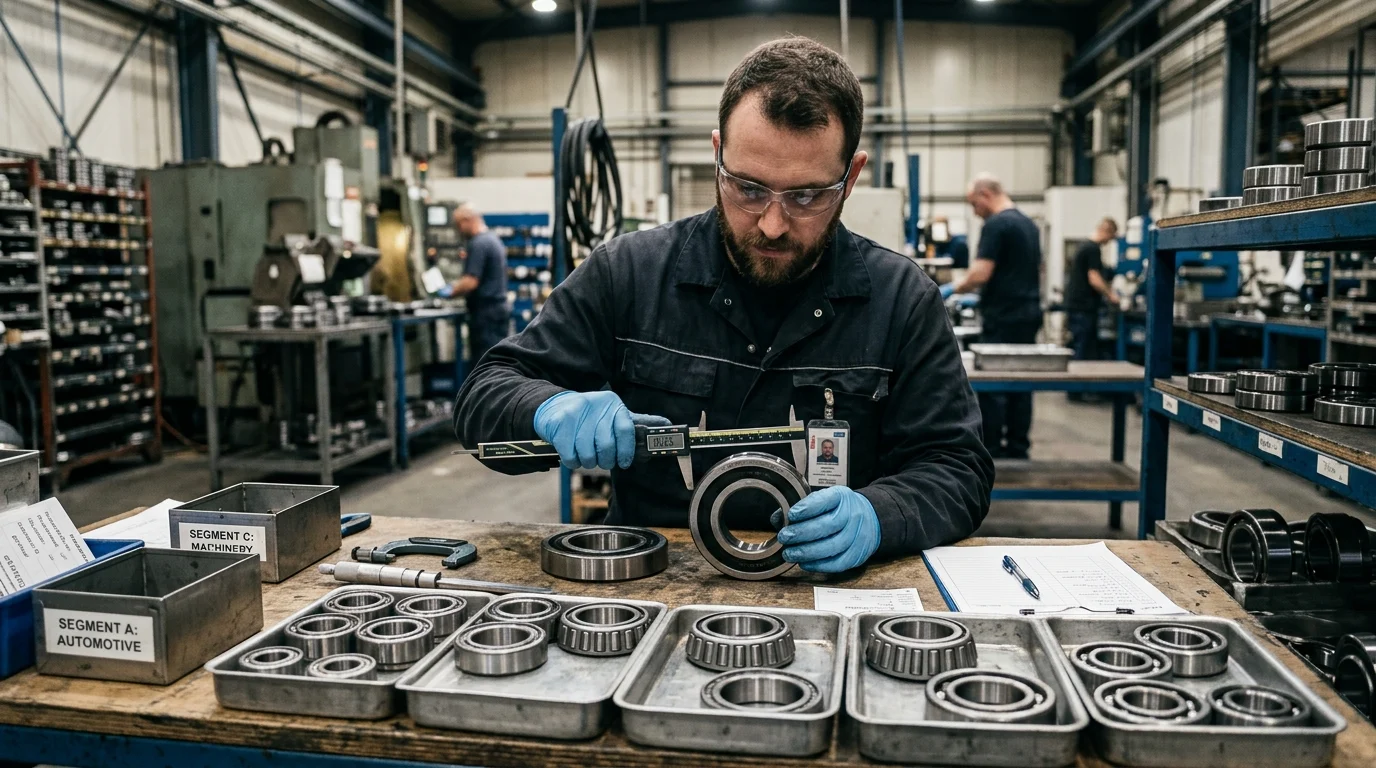
The industrial bearing landscape encompasses a vast array of rolling-element technologies, each engineered to manage specific load profiles, speeds, and environmental conditions. As OEMs finalize their 2026 bills of materials, a rigorous understanding of market segmentation and product specifications is essential to avoid over-engineering or premature field failures.
How industrial bearings are segmented
Industrial bearings are broadly bifurcated into ball bearings and roller bearings, which are further segmented by their rolling element geometry and race configuration. Deep groove and angular contact ball bearings dominate high-speed, low-to-medium load applications, representing the highest volume segment of the market.
Roller bearings, including cylindrical, tapered, and spherical variants, feature line contact rather than point contact. This geometry provides significantly higher radial and axial load capacities, making them the standard for heavy machinery, mining equipment, and commercial vehicle axles. Niche segments, such as mounted bearing units and plain bearings, serve specialized applications requiring self-alignment or lubrication-free operation.
Which product trade-offs buyers should compare
Selecting the optimal bearing involves navigating strict engineering trade-offs between load capacity, rotational speed, and friction-induced heat generation. OEM buyers must collaborate with design engineers to ensure the selected component aligns with the application’s duty cycle.
| Bearing Category | Primary Load Capability | Relative Speed Limit (RPM) | Typical Friction Level |
|---|---|---|---|
| Deep Groove Ball | Radial (Moderate Axial) | Very High (>20,000) | Very Low |
| Angular Contact Ball | Combined Radial/Axial | High (Up to 15,000) | Low |
| Tapered Roller | Heavy Combined | Moderate (<5,000) | Moderate |
| Spherical Roller | Heavy Radial (Misalignment) | Low to Moderate | High |
As illustrated, prioritizing extreme load capacity inherently limits maximum operational speeds due to increased surface contact and thermal expansion. Buyers must evaluate these trade-offs to prevent specifying a costly high-speed bearing for a low-RPM, heavy-load application.
What specification variables matter in 2026
In 2026, specification variables extend beyond basic dimensions to include metallurgical purity, surface treatments, and internal clearances. Precision grades, defined by Annular Bearing Engineering Committee (ABEC) or ISO standards, are critical; an ABEC 7 or 9 specification is mandatory for machine tool spindles, while an ABEC 1 suffices for standard conveyors.
Material selection remains a primary cost and performance driver. Standard industrial bearings rely on AISI 52100 high-carbon chrome steel, which offers exceptional fatigue life. However, applications exposed to corrosive environments demand 440C stainless steel or advanced ceramic hybrid configurations (such as silicon nitride balls). Furthermore, dynamic load ratings (C) and the calculated L10 life—the theoretical lifespan at which 90% of a bearing population will survive under a specific load—must be strictly validated against the OEM’s warranty periods.
Supply, Pricing, and Regional Dynamics
The cost structure and availability of industrial bearings in 2026 are heavily influenced by global macroeconomic variables. OEM buyers must navigate a volatile landscape of raw material fluctuations, shifting regional manufacturing footprints, and evolving distribution models.
How steel, energy, labor, and capacity affect pricing
Bearing pricing is inextricably linked to raw material indices, energy markets, and labor rates. High-grade bearing steel accounts for approximately 40% to 55% of the total cost of goods sold (COGS) for standard bearings. Consequently, fluctuations in hot rolled coil and scrap steel indices directly impact unit pricing.
Energy costs also play a pivotal role, particularly for energy-intensive forging and heat-treatment processes. In regions where energy prices remain volatile, suppliers are increasingly implementing dynamic energy surcharges. Furthermore, as automation increases, labor costs are stabilizing as a percentage of COGS, but the shortage of skilled CNC machinists and metallurgists limits the rate at which suppliers can scale capacity utilization beyond the industry average of 75% to 80%.
How sourcing conditions differ across Asia, Europe, and North America
Sourcing conditions vary dramatically across major manufacturing hubs, requiring OEMs to adopt a localized or “China Plus One” strategy. Asia, particularly China and India, continues to dominate the production of high-volume, ABEC 1-3 bearings. However, minimum order quantities (MOQs) in these regions often exceed 10,000 units, and geopolitical tensions pose ongoing tariff risks.
European manufacturers maintain a competitive advantage in highly engineered, large-diameter bearings and customized slewing rings, though they face higher baseline operational costs. In North America, nearshoring initiatives are accelerating. OEMs are increasingly sourcing from Mexico and the United States to compress supply chains, reducing standard ocean freight transit times of 45 days down to cross-border truck transits of just 7 to 14 days, thereby fundamentally lowering inventory carrying costs.
Which distribution and channel shifts are emerging
The channel strategy for bearing procurement is shifting as OEMs seek greater supply chain visibility. While direct-to-OEM purchasing remains dominant for high-volume automotive and industrial equipment manufacturers, authorized industrial distributors are capturing market share by offering advanced value-added services.
Vendor-managed inventory (VMI) and just-in-time (JIT) programs are becoming standard requirements in 2026 procurement contracts. Distributors are leveraging digital twin technology and predictive analytics to manage OEM inventory, often requiring buyers to commit to 90-day to 120-day firm rolling forecasts in exchange for guaranteed safety stock and fixed pricing parameters.
Compliance, Quality, and Total Cost
Quality assurance and regulatory compliance are non-negotiable pillars of bearing procurement. A sub-standard bearing can lead to catastrophic equipment failure, making the initial purchase price irrelevant compared to the total cost of ownership (TCO) and potential liability.
What compliance and documentation buyers should expect
OEMs must mandate comprehensive documentation to verify supplier capabilities and material provenance. At a minimum, facilities must hold ISO 9001:2015 certification, while those supplying the automotive or commercial vehicle sectors must adhere to the stringent IATF 16949 standard.
Material traceability is equally critical. Buyers should require material test reports (MTRs) for every production lot to confirm metallurgical integrity. For standard 52100 bearing steel, the carbon content must strictly fall between 0.95% and 1.10% to ensure proper hardening during heat treatment. Additionally, defense and aerospace OEMs must ensure strict compliance with DFARS (Defense Federal Acquisition Regulation Supplement) regarding specialty metals sourcing.
How to compare suppliers using total cost of ownership
Evaluating bearing suppliers solely on unit acquisition price is a flawed strategy. Procurement teams must adopt a Total Cost of Ownership (TCO) framework, recognizing that the initial purchase price often represents only 15% to 20% of the component’s true lifecycle cost.
| TCO Component | Estimated % of Total Cost | Primary Drivers and Considerations |
|---|---|---|
| Acquisition Cost | 15% – 20% | Raw materials, manufacturing, margins, tariffs |
| Logistics & Inventory | 10% – 15% | Freight, warehousing, carrying costs, VMI fees |
| Installation & Maintenance | 25% – 35% | Labor rates, lubrication schedules, specialized tooling |
| Downtime & Replacement | 35% – 45% | Production losses, warranty claims, secondary damage |
By quantifying these components, buyers can justify paying a 10% to 15% premium for a higher-tier bearing if it successfully doubles the mean time between failures (MTBF) and significantly reduces warranty claims and unplanned downtime.
Which qualification steps reduce supply risk
To mitigate supply risk, OEMs must implement a rigorous supplier qualification protocol before awarding production contracts. This process typically utilizes the Production Part Approval Process (PPAP), with Level 3 documentation being the industry benchmark for new bearing qualifications.
During qualification, buyers should audit the supplier’s metrology labs, heat-treatment controls, and statistical process control (SPC) data. A robust supplier should demonstrate the ability to maintain defect rates below 50 Parts Per Million (PPM). Conducting initial sample runs and accelerated life testing ensures that the bearings meet the dynamic load ratings and fatigue life required by the OEM’s engineering specifications.
Actions for OEM Buyers in 2026
As the 2026 bearing market presents both capacity constraints and technological advancements, OEM buyers must transition from transactional purchasing to strategic category management. Taking decisive action today will safeguard production schedules and optimize cost structures.
Which procurement actions to prioritize now
The primary action for 2026 is securing capacity through Long-Term Agreements (LTAs). Buyers should negotiate 12-to-24-month contracts that include transparent raw material escalation and de-escalation clauses, tying price adjustments to public steel and energy indices rather than accepting arbitrary price hikes.
Additionally, procurement teams must prioritize supply base diversification. Implementing an “N+1” sourcing strategy—where a primary supplier is supported by a fully qualified secondary supplier in a different geographic region—protects against localized disruptions. Buyers should also actively audit their tier-1 suppliers’ sub-tier networks to identify hidden dependencies on single-source raw material providers.
How to balance standardization and application-specific design
A critical lever for cost reduction and supply chain resilience is balancing standardization with application-specific engineering. Procurement teams should collaborate with internal engineering departments to conduct a comprehensive portfolio rationalization, aiming to reduce custom bearing SKUs by 15% to 20%.
Whenever feasible, OEMs should specify commercial off-the-shelf (COTS) bearings for non-critical axes, taking advantage of distributor inventory and economies of scale. Customization—such as proprietary internal clearances, specialized sealing arrangements, or high-temperature synthetic greases capable of operating continuously at 150°C—should be strictly reserved for critical-path applications where standard catalog bearings cannot meet the performance mandate.
Key Takeaways
- The most important conclusions and rationale for bearing industry forecast 2026
- Specs, compliance, and risk checks worth validating before you commit
- Practical next steps and caveats readers can apply immediately
Frequently Asked Questions
Why does the 2026 bearing forecast matter for OEM buyers?
It helps buyers plan before shortages hit. With global growth near 5.2% and supply shifting to wind, robotics, and semiconductors, early sourcing reduces line-down risk and price spikes.
What lead times should OEM buyers expect in 2026?
Standard catalog bearings are stabilizing around 14–18 weeks. Custom large-bore and high-precision bearings can exceed 32 weeks, so place forecasts and purchase orders earlier for critical SKUs.
Which sectors are likely to tighten bearing supply most in 2026?
Offshore wind, robotics, and semiconductor equipment. These sectors are absorbing large-diameter, thin-section, and harmonic drive bearing capacity, which can reduce availability for other OEM programs.
How can buyers spot upcoming capacity constraints?
Track supplier lead times and book-to-bill ratios. If book-to-bill stays above 1.05, expect tightening capacity and consider buffer stock or secondary sourcing for high-risk part numbers.
How should OEM teams choose between ball and roller bearings?
Match the bearing to load and speed. Ball bearings suit higher-speed, lighter-load applications; roller bearings fit heavier loads but usually run slower and generate more friction.