
Introduction
In deep groove ball bearings, the 58-64 HRC hardness range is more than a material spec: it sets the balance between load-carrying strength, wear resistance, and toughness that machine life depends on. If hardness falls below this window, raceways and balls are more likely to deform under contact stress; if it rises too high, brittleness and crack risk increase. This article explains why that range is used, how it affects rolling contact fatigue, dimensional stability, and failure modes, and what it means for selecting bearings that last longer under real operating loads.
Why 58-64 HRC Matters in Deep Groove Ball Bearings
In the design and application of deep groove ball bearings, material hardness is a critical determinant of rolling contact fatigue life, dynamic load capacity, and dimensional stability. The industry standard for high-carbon chromium bearing steel, such as SAE 52100 or 100Cr6, dictates a finished hardness within the 58 to 64 Rockwell C (HRC) scale. Operating outside this specific metallurgical window drastically alters the tribological characteristics of the bearing components.
Understanding the metallurgical physics behind the 58-64 HRC specification allows mechanical engineers to predict how raceways and rolling elements will respond to Hertzian contact stresses. Hardness directly correlates to the material’s yield strength; therefore, controlling this parameter is essential for preventing premature subsurface spalling and plastic deformation under heavy radial or axial loads.
Recommended hardness range
The universally accepted hardness range for through-hardened deep groove ball bearings is 58 to 64 HRC. This specific bandwidth provides the optimal ratio of mechanical strength to material toughness required for rolling element bearings. Below 58 HRC, the bearing steel lacks the compressive yield strength necessary to support high contact pressures, leading to Brinelling (permanent plastic indentation) when subjected to static or dynamic shock loads.
Conversely, pushing hardness beyond 64 HRC introduces excessive brittleness. While extreme hardness maximizes theoretical wear resistance, it significantly reduces the steel’s fracture toughness. In practical applications, bearings exceeding 64 HRC are highly susceptible to catastrophic cracking under minor impact loads or slight shaft misalignments. Therefore, the 58-64 HRC window is strictly enforced by international manufacturing standards such as ISO 15 and ABMA guidelines.
Where this range fits in commercial bearings
Within the broader 58-64 HRC specification, standard commercial deep groove ball bearings typically target a narrower operational band of 60 to 62 HRC. This sub-range serves as the baseline for general-purpose applications, including electric motors, pumps, and automotive transmissions, where a balance of long fatigue life and moderate shock resistance is required.
However, commercial bearings designed for specialized environments often utilize the extremes of this range. For instance, bearings engineered for high-temperature applications (up to 200°C) undergo specialized dimensional stabilization tempering. This process sacrifices some surface hardness, often bringing the final specification down to 58-59 HRC, in exchange for preventing metallurgical phase transformations that would otherwise cause the bearing rings to expand and seize during operation.
How 58-64 HRC Balances Wear and Performance

The precise hardness value within the 58-64 HRC spectrum dictates how a deep groove ball bearing handles the opposing forces of abrasive wear and mechanical shock. Engineers must balance the need for a hard, wear-resistant raceway against the necessity for a tough, crack-resistant core. Modifying the target HRC by even two points fundamentally shifts the bearing’s failure mode from gradual wear to sudden fracture, or vice versa.
Comparing 58 HRC, 60-62 HRC, and 64 HRC
Evaluating the performance across different hardness tiers reveals distinct operational advantages and vulnerabilities. At the lower end, 58 HRC offers superior ductility, making it suitable for applications experiencing frequent vibrations or minor housing deflections. At the center, 60-62 HRC provides the standard fatigue limit utilized in standard L10 life calculations. At the upper limit, 64 HRC offers maximum resistance to surface distress but requires near-perfect alignment and shock-free conditions.
| Hardness Band | Primary Characteristic | Impact Tolerance | Optimal Application Environment |
|---|---|---|---|
| 58-59 HRC | High Toughness / Stability | High (up to 50 Gs shock) | High-temperature equipment, heavy crushers |
| 60-62 HRC | Balanced Fatigue Life | Moderate | Electric motors, precision gearboxes |
| 63-64 HRC | Maximum Wear Resistance | Low (Prone to micro-cracking) | Ultra-clean, high-speed machine tool spindles |
Effects of lubrication, contamination, and speed
Hardness interacts directly with the elastohydrodynamic lubrication (EHL) film thickness. When the lubrication parameter (kappa) falls below 1.0, metal-to-metal contact occurs. In these boundary lubrication scenarios, bearings hardened to 62-64 HRC resist adhesive wear and surface micro-spalling significantly better than those at 58 HRC.
Contamination further complicates this dynamic. Hard particulate ingress, such as silica dust (which measures approximately 800 HV on the Vickers scale), will easily indent a 58 HRC raceway, creating stress risers that initiate fatigue flaking. While 64 HRC steel is more resistant to this initial indentation, any dents that do occur are more likely to spawn rapid crack propagation due to the material’s inherent brittleness at that hardness level.
Hardness trade-off summary
The fundamental trade-off in bearing hardness specification is the inverse relationship between dynamic load capacity and impact toughness. Maximizing HRC extends the theoretical L10 life in clean, perfectly lubricated environments by preventing subsurface shear stress failures. However, this optimization reduces the bearing’s tolerance for real-world application flaws.
Ultimately, selecting a hardness closer to 64 HRC is a gamble on maintaining pristine operating conditions. For heavy industrial applications where contamination, marginal lubrication, and sudden load spikes are inevitable, sacrificing peak wear resistance for the shock-absorbing ductility of 58-60 HRC often results in a higher mean time between failures (MTBF).
What Determines Bearing Hardness
The final hardness of a deep groove ball bearing is not an inherent property of the raw steel, but rather the result of precise metallurgical manipulation. Achieving the stringent 58-64 HRC requirement relies on a tightly controlled sequence of thermal processing, strict quality assurance protocols, and the mitigation of microstructural anomalies during mass production.
Material and heat treatment
Through-hardened 52100 bearing steel achieves its final mechanical properties via martensitic quenching and tempering. The raw steel is first austenitized at temperatures between 830°C and 870°C to dissolve carbides into the iron matrix. It is then rapidly quenched in oil or salt baths to form hard, brittle martensite, which typically measures around 64-66 HRC straight out of the quench.
To render the material usable, a subsequent tempering cycle is applied at 150°C to 200°C. This tempering process relieves internal residual stresses and slightly reduces the hardness to the target 58-64 HRC range, thereby restoring the necessary fracture toughness required for dynamic rolling applications.
Inspection and compliance checks
Verifying that a bearing meets the specified HRC requires rigorous inspection methodologies. Manufacturers utilize Rockwell C scale testing in accordance with ASTM E18 standards on the cross-sections of bearing rings. Because the raceway surface geometry can interfere with macro-hardness probes, Vickers microhardness (HV) testing is frequently employed to map the hardness gradient just below the contact surface.
For high-volume production, non-destructive electromagnetic eddy current testing is utilized to sort batches. This ensures that 100% of the production run falls within the specified tolerance—often restricted to a tight ±1 HRC variance for high-precision aerospace and medical bearings—preventing soft or brittle anomalies from reaching the end user.
Manufacturing variation risks
The primary manufacturing risk in achieving stable hardness is the presence of retained austenite. During the quenching phase, not all austenite transforms into martensite. Premium bearing manufacturers strive to keep retained austenite levels below 10%.
If retained austenite levels exceed this threshold, the untransformed microstructure can spontaneously convert to martensite during field operation, especially under heavy loads or elevated temperatures. This delayed transformation causes volumetric expansion (up to 0.001 mm/mm), which reduces the bearing’s internal radial clearance, increases friction, and ultimately causes catastrophic thermal seizure.
How to Evaluate and Select the Right Hardness
Procurement and engineering teams must evaluate bearing hardness not as a generic pass/fail specification, but as a tunable parameter that must align with the specific demands of the machinery. Specifying the correct HRC requires analyzing load profiles, environmental conditions, and supplier documentation to ensure the bearing will achieve its calculated lifecycle.
Matching hardness to application needs
Matching hardness to application needs requires a thorough understanding of the operational envelope. For high-speed applications like electric vehicle motors operating at 10,000+ RPM, specifying a tight 60-62 HRC ensures the raceways can withstand the high-frequency cyclic loading without early fatigue spalling.
Conversely, agricultural machinery and vibratory screens subject the bearings to severe shock loads and frame deflection. In these scenarios, specifying a hardness at the lower end of the spectrum, around 58-60 HRC, provides the necessary ductility to absorb impact energy without initiating through-cracks in the inner or outer rings.
When higher hardness improves service life
Higher hardness (62-64 HRC) directly translates to improved service life only when the application provides adequate elastohydrodynamic lubrication and strict contamination control. In these idealized environments, the bearing’s life is dictated purely by subsurface fatigue limits, which scale linearly with material hardness.
Standard ISO 281 L10 life equations assume a nominal hardness of 58 HRC as the baseline for dynamic load ratings. For every single point of HRC drop below 58, the bearing’s effective dynamic load capacity decreases by approximately 10%. Therefore, maintaining hardness above this critical threshold is paramount for maximizing the service life of heavily loaded shafts.
Comparing supplier data and test reports
When evaluating bearing sources, engineers must scrutinize the 3.1 material test certificates provided by suppliers. These documents should explicitly state the heat treatment parameters, final HRC ranges, and retained austenite percentages. Discrepancies between the stated HRC and the actual batch performance often point to poor atmospheric control during the heat treatment process.
| Inspection Parameter | Target Value / Range | Applicable Standard | Failure Risk if Non-Compliant |
|---|---|---|---|
| Macro-Hardness | 58 – 64 HRC | ASTM E18 | Brinelling (if low), Cracking (if high) |
| Retained Austenite | < 10% volume | ASTM E975 | Dimensional instability, loss of clearance |
| Microstructure | Fine Tempered Martensite | ISO 683-17 | Premature rolling contact fatigue |
Decision Framework for Specification
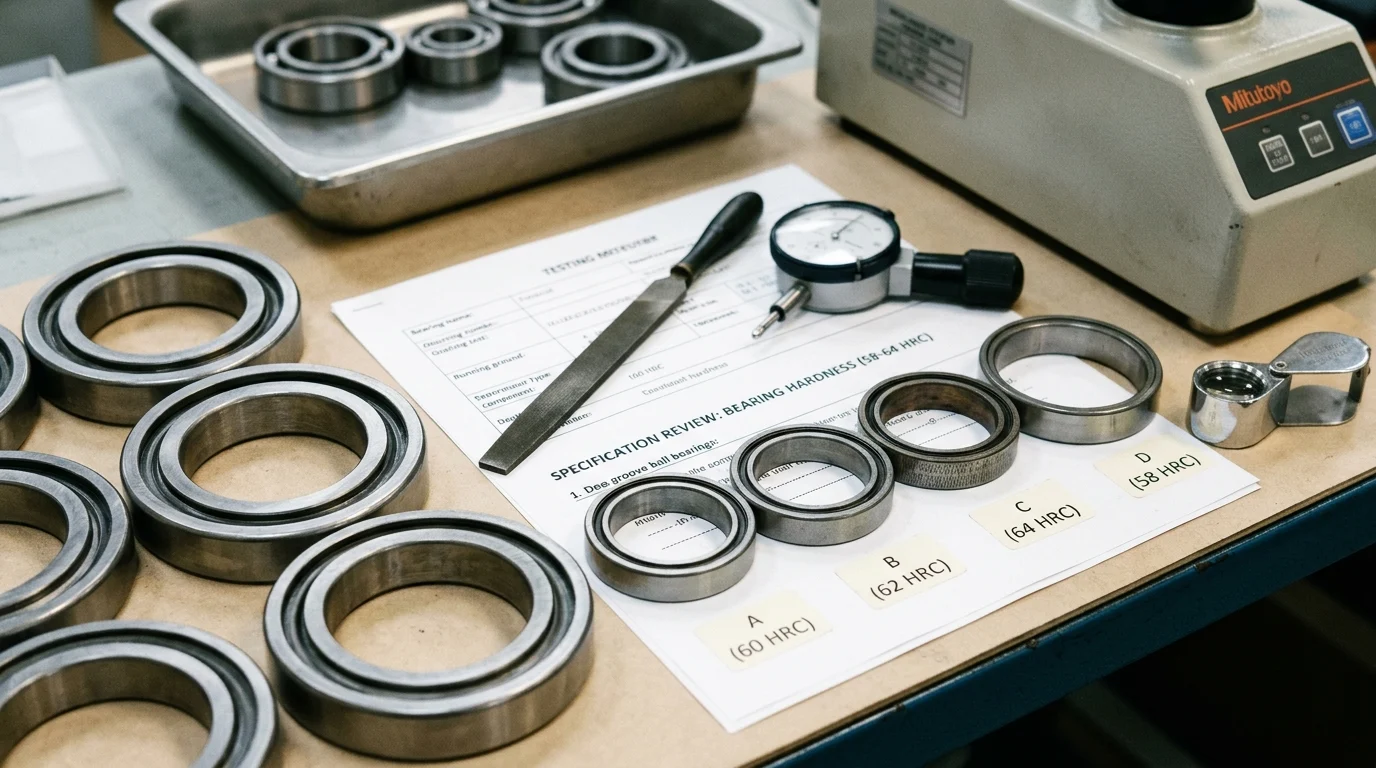
Establishing a standardized decision framework for bearing hardness simplifies the specification process and mitigates the risk of catastrophic machine failure. By systematically analyzing the mechanical and environmental variables, engineers can confidently narrow down the 58-64 HRC window to the exact specification required for their proprietary equipment.
Key selection criteria
The decision matrix for selecting bearing hardness hinges on three primary criteria: operational temperature, shock load magnitude, and expected lubrication quality. If continuous operating temperatures exceed 150°C, the specification must default to 58-59 HRC to accommodate the necessary dimensional stabilization tempering.
If the application involves heavy shock loads (exceeding 30% of the static load rating), the hardness should similarly be restricted to the lower half of the spectrum (58-61 HRC). Only when speeds are exceptionally high, loads are smooth, and lubrication is pristine should engineers specify the upper limits of 62-64 HRC to maximize fatigue life.
Practical takeaway
For the vast majority of industrial and commercial applications, specifying a standard target of 60-62 HRC provides the optimal balance of longevity, wear resistance, and toughness. This range covers approximately 90% of standard deep groove ball bearing use cases, from precision automation equipment to standard industrial pumps.
Procurement teams should avoid the misconception that ‘harder is always better.’ Instead, they should require suppliers to provide tight tolerance controls (e.g., ±1.5 HRC within a single batch) rather than pushing for maximum peak hardness. Consistency in the heat treatment process ultimately yields more predictable maintenance schedules and a lower total cost of ownership for the machinery.
Key Takeaways
- The most important conclusions and rationale for Deep Groove Ball Bearings
- Specs, compliance, and risk checks worth validating before you commit
- Practical next steps and caveats readers can apply immediately
Frequently Asked Questions
Why is 58-64 HRC considered the standard hardness for deep groove ball bearings?
This range balances fatigue strength, wear resistance, and toughness. Below 58 HRC, rings can dent or deform more easily; above 64 HRC, brittleness rises and cracking risk increases.
Which hardness is best for general-purpose industrial bearings?
For most motors, pumps, and gearboxes, 60-62 HRC is the common target. It offers a practical balance of long service life, stable running, and moderate shock resistance.
When should a 58-59 HRC bearing be selected?
Choose 58-59 HRC for higher-temperature or vibration-prone equipment. It gives better toughness and dimensional stability, which helps reduce cracking or seizure risk in harsher conditions.
Does higher hardness always mean longer machine life?
No. Harder bearings resist wear better, but excessive hardness can reduce impact tolerance. Machine life improves most when hardness matches load, speed, alignment, lubrication, and operating temperature.
How can buyers source the right deep groove ball bearing hardness from VETOR GROUP?
Share your application details like load, speed, temperature, and lubrication. VETOR GROUP can recommend a suitable hardness range and support OEM bearing solutions with factory-based quality control and export service.