Introduction
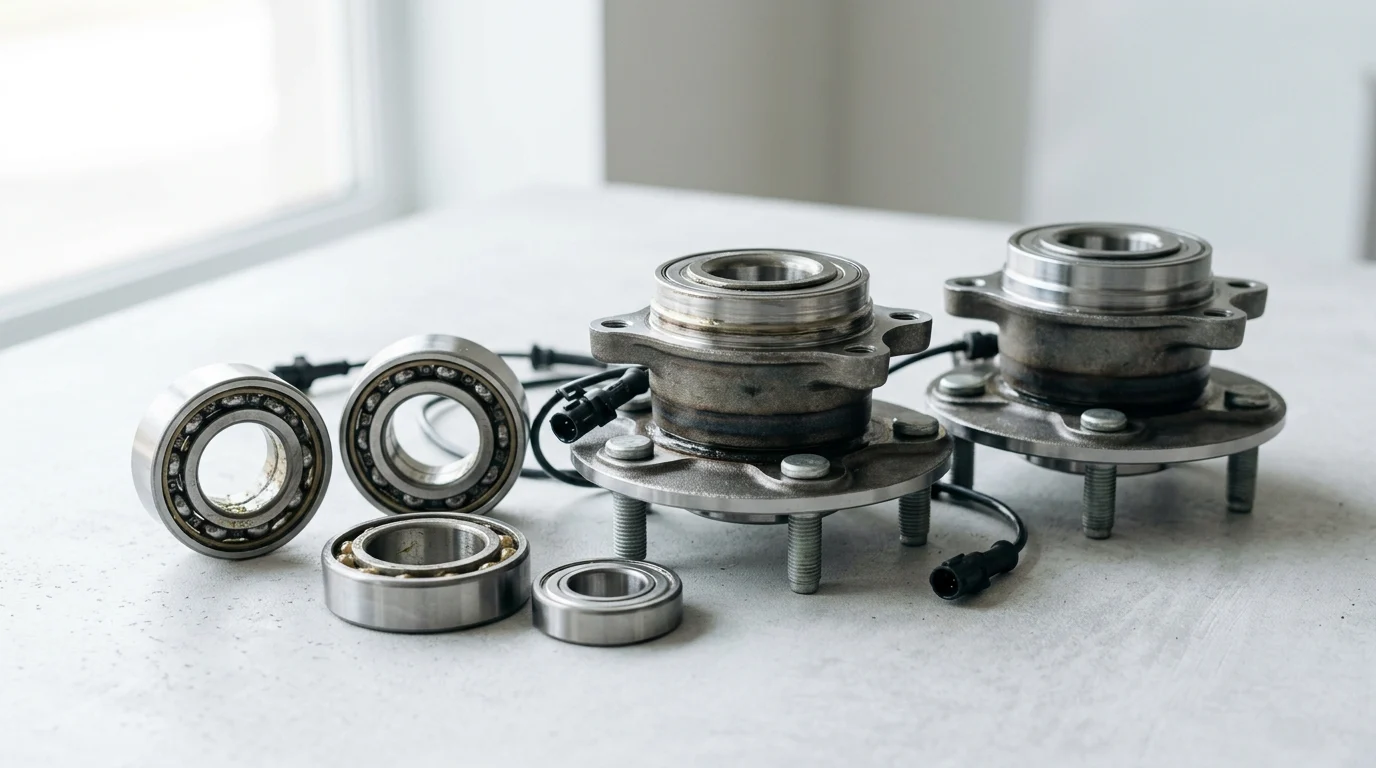
Selecting auto bearings is not just a catalog exercise; it affects durability, NVH performance, warranty risk, and total vehicle cost. The right choice depends on where the bearing will be used, the loads and speeds it must handle, the lubrication strategy, and whether the target is an OEM production program or an aftermarket replacement. These requirements often differ in tolerance control, validation depth, traceability, and price sensitivity. This article outlines the key criteria for comparing bearing options, explains how OEM and aftermarket expectations diverge, and helps readers make specification and sourcing decisions that support reliable performance without unnecessary cost.
Why Auto Bearing Selection Matters
The specification and procurement of auto bearings dictate the functional longevity and operational smoothness of modern vehicle platforms. From powertrain assemblies to wheel hubs, bearing failure directly compromises vehicle safety, system efficiency, and overall brand reputation.
Engineering and procurement teams must align on precise operational parameters to prevent premature wear. A rigorous approach to component selection ensures that both factory-floor integrations and aftermarket replacements meet stringent dynamic and static load requirements without inflating production costs.
Impact on Warranty, NVH, and Reliability
Strict management of Noise, Vibration, and Harshness (NVH) is paramount in modern automotive engineering. A bearing operating outside specified tolerances generates microscopic vibrations that amplify through the chassis, drastically reducing passenger comfort. Automotive manufacturers typically enforce stringent defect rate thresholds to mitigate this, frequently demanding fewer than 50 Parts Per Million (PPM) for critical rotating components.
Consequently, warranty claim costs associated with premature bearing failure can scale exponentially. A single defective bearing costing a few dollars can result in hundreds of dollars in warranty labor and collateral system damage, making upfront reliability validation a financial imperative for OEMs.
OEM vs Aftermarket Requirements
Sourcing parameters diverge significantly depending on the target market. Original Equipment Manufacturers (OEMs) design for the entire vehicle lifecycle, often requiring auto bearings validated for 300,000 kilometers or more under complex dynamic loads and extreme temperature fluctuations.
In contrast, the aftermarket spans a broader spectrum of quality tiers. Premium aftermarket components attempt to match OEM specifications, while value-tier replacements may be engineered for a reduced service life of 100,000 to 150,000 kilometers. These aftermarket variants often utilize different material grades or alternative sealing technologies to achieve competitive price points suitable for aging vehicle fleets.
Technical Specifications to Compare
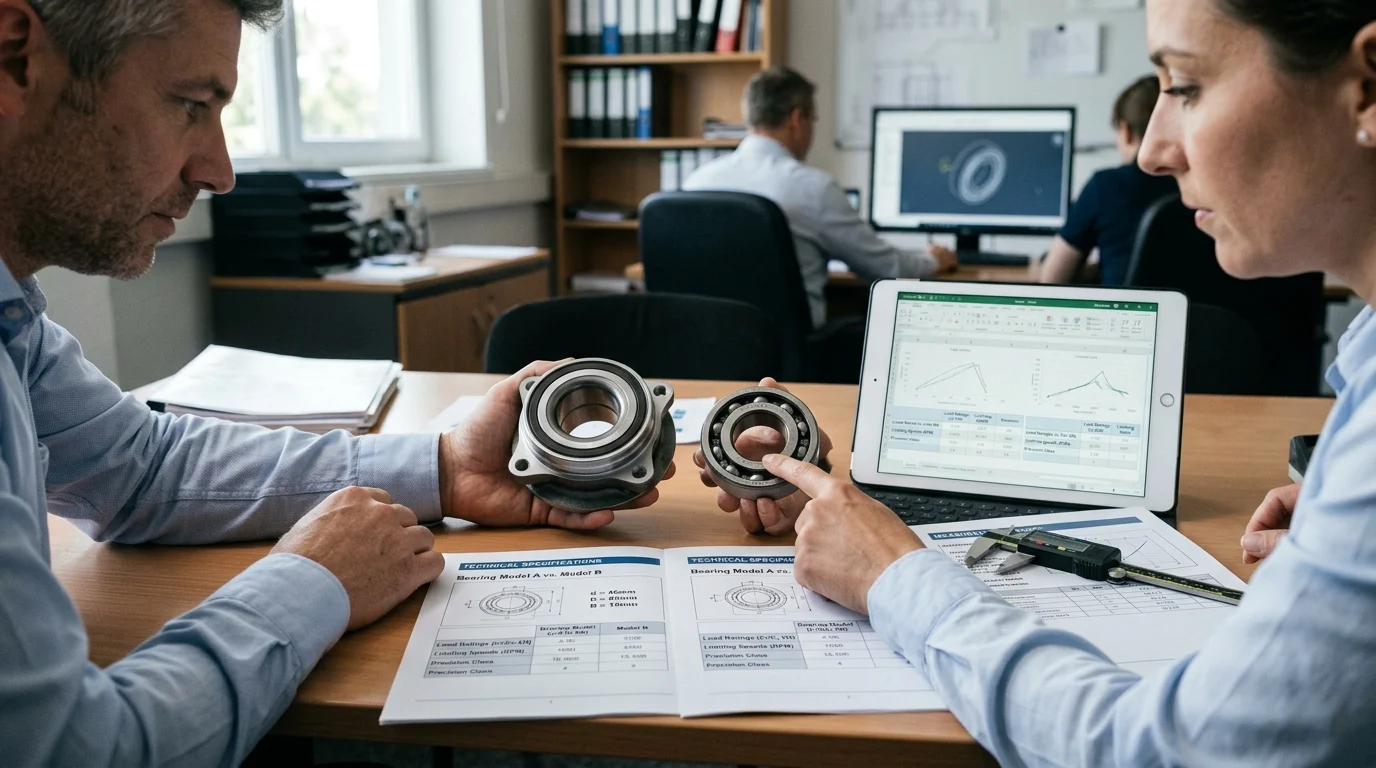
Engineering teams must evaluate a matrix of technical parameters to ensure the selected auto bearings align with the mechanical demands of the specific automotive application. Over-engineering leads to unnecessary weight and cost, while under-specifying guarantees catastrophic failure.
Load, Speed, Clearance, and Material
Critical specifications begin with static (C0) and dynamic (C) load ratings, which determine the component’s capacity to withstand stationary impacts and continuous operational forces, respectively. Operating speed, dictated by internal clearance classes and cage design, is equally critical. For instance, a C3 clearance class is frequently specified for engine environments to accommodate higher thermal expansion.
Material selection heavily influences fatigue life. High-carbon chromium bearing steel, specifically 100Cr6 (SAE 52100), remains the overarching industry standard. To ensure optimal wear resistance and structural integrity under immense pressure, this material typically requires a precise heat treatment resulting in a hardness of 58 to 64 HRC.
Bearing Types and Application Fit
The geometry of the rolling elements dictates application suitability. Deep groove ball bearings provide excellent high-speed capabilities but offer limited axial load capacity, making them the standard choice for alternators, tensioners, and air conditioning compressors.
Tapered roller bearings, conversely, manage combined radial and axial loads efficiently, which is the requisite profile for wheel hub assemblies and differential pinions. Cylindrical roller bearings are deployed where exceptionally high radial load capacity is required, such as in heavy-duty manual transmissions and automated gearboxes.
Fitment and Performance Comparison
To facilitate rapid comparison, procurement and engineering teams utilize fitment matrices that map bearing architecture against performance limits and typical integration zones.
| Bearing Type | Primary Load Direction | Max Speed Capability (RPM) | Typical Auto Application |
|---|---|---|---|
| Deep Groove Ball | Radial (Moderate Axial) | 10,000 – 20,000 | Alternators, Idler Pulleys |
| Tapered Roller | Combined Radial & Axial | 3,000 – 7,000 | Wheel Hub Assemblies |
| Cylindrical Roller | High Radial | 5,000 – 10,000 | Transmissions, Gearboxes |
| Angular Contact Ball | Combined (High Axial) | 8,000 – 15,000 | Clutches, Steering Columns |
How to Evaluate Suppliers
Identifying a capable manufacturer requires looking beyond unit pricing to assess the underlying quality management systems, production capabilities, and corporate stability of the supplier.
Qualifications, Process Control, and Traceability
Automotive supply chains operate under strict regulatory and quality frameworks. Suppliers must possess IATF 16949 certification, which mandates rigorous process control, risk management, and continuous improvement protocols tailored specifically for the automotive sector.
Evaluation audits should rigorously verify Statistical Process Control (SPC) data. Auditors look for a Process Capability Index (Cpk) of at least 1.33, though a Cpk greater than 1.67 is often required for critical internal dimensions. Furthermore, lot-level traceability via laser-etched matrix codes is essential for isolating production anomalies and executing targeted recalls if field defects are identified.
Private Label vs Tier Supplier vs Branded Sources
Procurement strategies differ fundamentally when engaging Tier 1 or Tier 2 suppliers versus aftermarket private label manufacturers. Direct-to-OEM Tier suppliers maintain extensive in-house R&D and testing facilities, ensuring exact design adherence. However, they typically enforce high Minimum Order Quantities (MOQs), often ranging from 10,000 to 50,000 units per custom production run.
Aftermarket private label sourcers often aggregate demand across multiple contract factories. This flexibility allows for significantly lower MOQs, sometimes as low as 500 to 1,000 units, which benefits niche replacement parts. However, this fragmented sourcing model requires heightened buyer vigilance regarding batch-to-batch consistency and raw material provenance.
Compliance, Testing, and Logistics
Transitioning an auto bearing from prototype approval to mass production introduces complex requirements for environmental durability testing and global supply chain management. Component survival depends heavily on validation and secure transit.
Standards, Validation, and Documentation
Components must undergo extensive validation against international standards, including ISO 281 for dynamic load and rating life calculations, and ISO 15 for dimensional tolerances. Environmental resilience is validated through harsh simulation protocols.
For example, wheel hub bearings exposed to road de-icing chemicals are routinely subjected to 500-hour to 1,000-hour salt spray tests. Additionally, aggressive mud slurry and high-temperature grease retention tests guarantee that seals perform under real-world automotive extremes. Comprehensive documentation, including certified Material Test Reports (MTRs), must accompany every production batch.
Packaging, Storage, and Supply Risk
Logistical execution is as critical as the manufacturing process itself. Because precision auto bearings are highly susceptible to oxidation and micro-pitting during transit, Volatile Corrosion Inhibitor (VCI) packaging and humidity-controlled storage environments are mandatory.
From a supply chain risk perspective, buyers must account for extended global transit times. Ocean freight from primary Asian manufacturing hubs to North American or European assembly plants typically mandates a 12-to-16-week lead time. This reality necessitates strategic inventory buffers and safety stock models to prevent catastrophic assembly line stoppages.
Decision Framework for Buyers
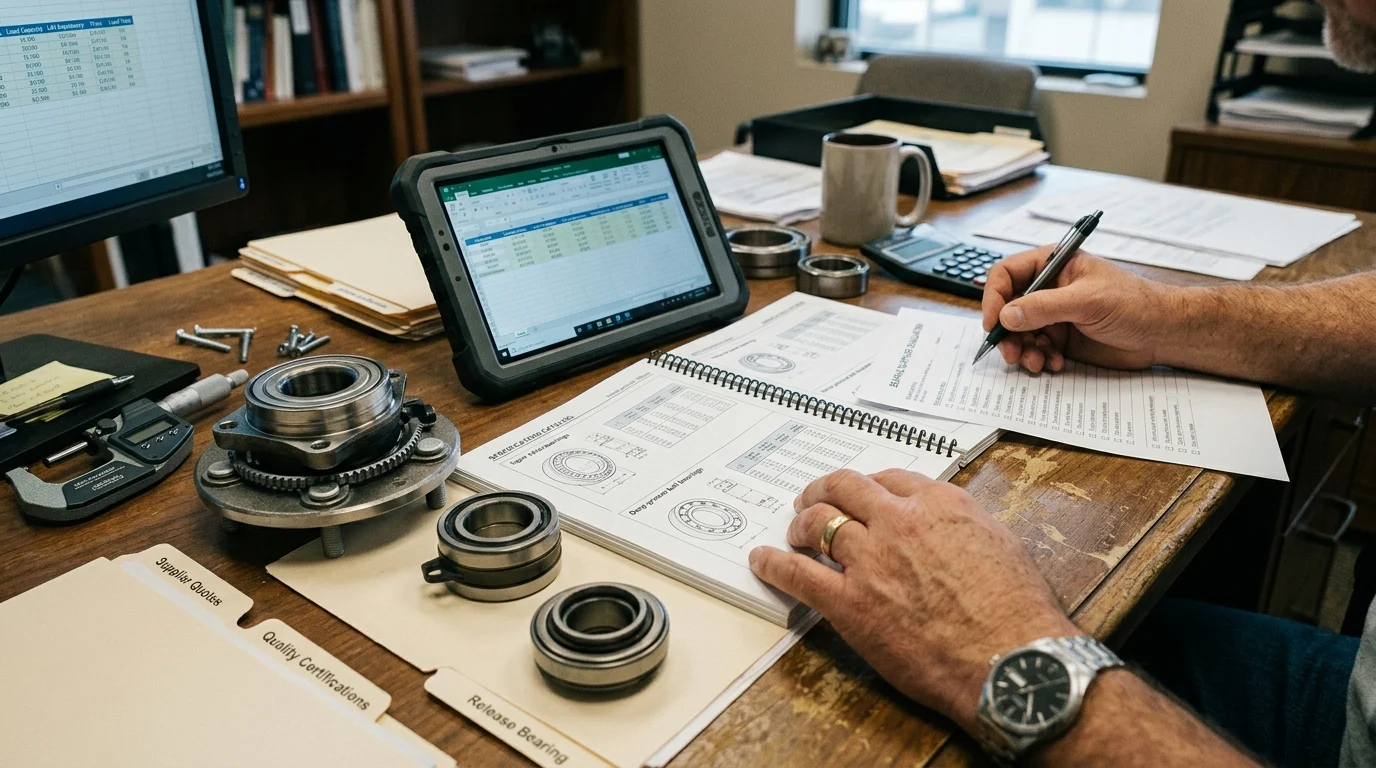
Establishing a standardized procurement framework minimizes subjective bias and aligns purchasing decisions with overarching engineering parameters and financial objectives.
Step-by-Step Selection Process
The selection process must be highly systematic. It begins with the engineering team defining the precise load, speed, and environmental duty cycles required for the vehicle platform. Sourcing teams then identify candidates through initial RFQs, immediately filtering out any suppliers lacking current IATF 16949 credentials.
The critical phase involves the Production Part Approval Process (PPAP). Most automotive OEMs and top-tier aftermarket brands require a Level 3 PPAP submission. This rigorous documentation package includes dimensional results, material certifications, process flow diagrams, and control plans, which must be fully approved before mass production is authorized.
Using a Cost, Quality, and Compliance Matrix
A weighted evaluation matrix allows buyers to accurately quantify trade-offs between competing suppliers. By assigning strict thresholds to cost, quality, and compliance metrics, organizations can objectively select the optimal bearing source.
| Evaluation Category | Suggested Weighting | Key Metrics Evaluated | Acceptable Thresholds |
|---|---|---|---|
| Quality & Process | 40% | Defect Rate, Cpk, Scrap Rate | < 50 PPM, Cpk > 1.33 |
| Cost Competitiveness | 30% | Unit Price, Tooling Cost, Terms | Within 5% of target benchmark |
| Compliance & Testing | 15% | IATF 16949, PPAP Level | Valid Certs, PPAP Level 3 Approved |
| Logistics & Capacity | 15% | Lead Time, OTD Rate, MOQ | OTD > 98%, 12-week max lead time |
Implementing this matrix ensures that procurement does not default to the lowest unit cost at the expense of necessary engineering tolerances or supply chain reliability.
Key Takeaways
- The most important conclusions and rationale for auto bearings
- Specs, compliance, and risk checks worth validating before you commit
- Practical next steps and caveats readers can apply immediately
Frequently Asked Questions
What is the main difference between OEM and aftermarket auto bearings?
OEM bearings are validated for longer life, tighter tolerances, and lower warranty risk. Aftermarket bearings vary by tier, so match quality level to vehicle age, duty cycle, and budget.
Which bearing type is best for wheel hub applications?
Tapered roller bearings are commonly preferred for wheel hubs because they handle combined radial and axial loads better than standard deep groove ball bearings.
How do I check if an auto bearing matches my application?
Confirm load rating, speed, clearance class, material, seal type, and exact dimensions. Also verify the bearing type fits the component, such as hub, alternator, or gearbox.
What supplier qualifications should buyers look for?
Prioritize manufacturers with automotive quality systems like IATF 16949, stable process control, full traceability, and consistent export experience for global OEM and aftermarket supply.
Why choose a factory-based supplier like VETOR GROUP?
A factory-based supplier can offer OEM customization, tighter quality control, competitive pricing, and faster delivery across compatible bearing models for global buyers.