
Introduction
Choosing between rubber sealed and metal shield bearings affects more than contamination control: it changes friction, speed capability, lubricant retention, and service life. Although both designs protect rolling elements and keep grease in place, they do so with different closure geometry and different tradeoffs. This article explains how each type works, where contact or non-contact behavior matters, and how those differences show up in heat generation, maintenance needs, and operating conditions. By the end, you should be able to match sealed or shielded bearings to your application instead of selecting by part suffix alone.
Rubber Sealed vs Metal Shield Bearings: Key Differences
Selecting the appropriate closure for rolling-element bearings is a fundamental engineering decision that dictates the component's operational lifespan, maintenance requirements, and overall kinematic efficiency. In standard deep groove ball bearings, closures are integrated during the manufacturing process to retain factory-filled lubricants and prevent the ingress of external contaminants. The two primary closure methodologies—rubber seals and metal shields—represent divergent approaches to balancing tribological protection against dynamic friction.
While both designs share the common goal of isolating the internal rolling elements from environmental hazards, their mechanical implementations create distinct performance envelopes. Engineers must evaluate these envelopes against the specific demands of the host machinery, recognizing that an incorrect specification can lead to premature lubricant degradation, catastrophic thermal events, or abrasive wear.
Seal vs shield design
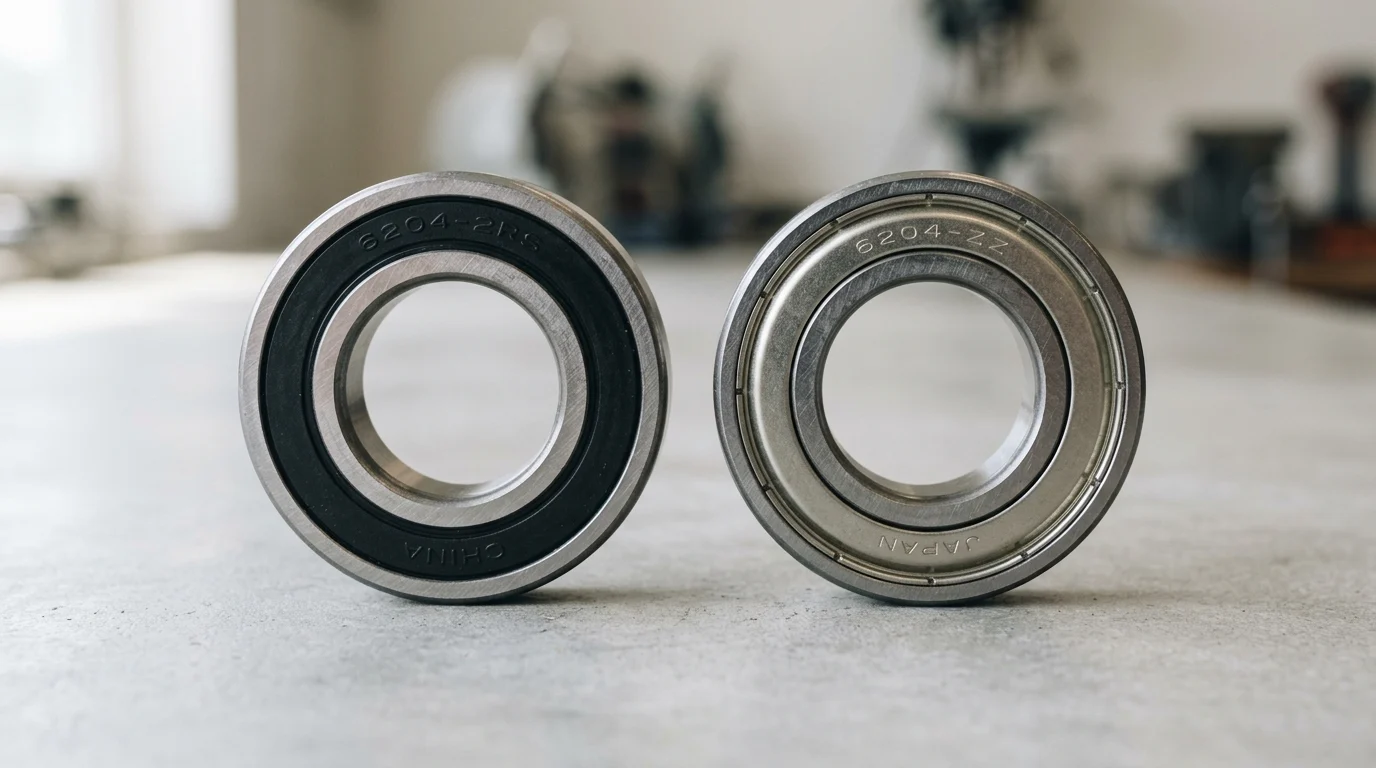
The structural architecture of a bearing closure defines its interaction with the inner ring. A metal shield, universally designated by suffixes such as ZZ or 2Z, consists of a thin profile of stamped carbon steel or stainless steel. This shield is crimped into a groove on the outer ring and extends toward the inner ring, leaving a precisely engineered micro-gap—typically ranging from 0.2 mm to 0.5 mm. Because the metal shield never touches the moving inner ring, it is classified as a non-contact closure.
Conversely, a standard rubber seal (commonly designated as 2RS) features a steel sheet insert bonded with an elastomer, most frequently Nitrile Butadiene Rubber (NBR). The elastomer extends beyond the steel insert to form a flexible lip that makes direct physical contact with a recess on the inner ring. This contact design creates a continuous physical barrier. Advanced variants may utilize fluoroelastomers (FKM) or polyacrylic rubber for specialized chemical resistance, though NBR remains the industry standard for general industrial applications.
Contamination and lubricant retention
Contamination control and lubricant retention are the primary metrics by which bearing closures are evaluated. Rubber seals offer superior ingress protection due to the physical interference fit of the elastomeric lip. This design effectively blocks moisture, washdown fluids, and fine particulate matter from reaching the raceways, while simultaneously preventing the internal grease charge from migrating out of the bearing cavity even under heavy vibration.
Metal shields rely on the labyrinth effect created by the tight clearance gap to deter contaminants. While highly effective at retaining high-viscosity greases and blocking larger debris (such as metal shavings or coarse dirt), the micro-gap cannot stop liquids, vapors, or micro-particulates. In environments subjected to high-pressure air or fluid sprays, the dynamic pressure can easily force contaminants past a metal shield, compromising the elastohydrodynamic lubrication film within the bearing.
Speed, friction, and maintenance trade-offs
The physical contact inherent to rubber seals introduces parasitic friction, which directly impacts the bearing's thermal dynamics and rotational limits. The drag generated by the sealing lip against the inner ring transforms kinetic energy into heat, effectively reducing the bearing's maximum limiting speed by 20% to 30% compared to an open or shielded equivalent. Standard NBR seals are typically rated for continuous operation between -40°C and +120°C; excessive rotational speeds can cause localized heating at the seal lip that exceeds this threshold, leading to elastomer embrittlement.
Metal shields, devoid of contact friction, allow the bearing to operate at its maximum theoretical speed, limited only by the cage design and the base oil viscosity of the grease. This makes shielded bearings virtually maintenance-free in clean, high-speed applications where thermal dissipation is critical.
| Feature | Rubber Sealed (Contact) | Metal Shielded (Non-Contact) |
|---|---|---|
| Friction Profile | High | Low |
| Limiting Speed | Reduced by 20-30% | Catalog Maximum |
| Fluid Resistance | High (Splash/Spray) | Minimal |
| Fine Dust Protection | Excellent | Poor to Moderate |
| Operating Temp (Standard) | -40°C to +120°C | -40°C to +120°C (Grease limited) |
Performance Comparison by Application
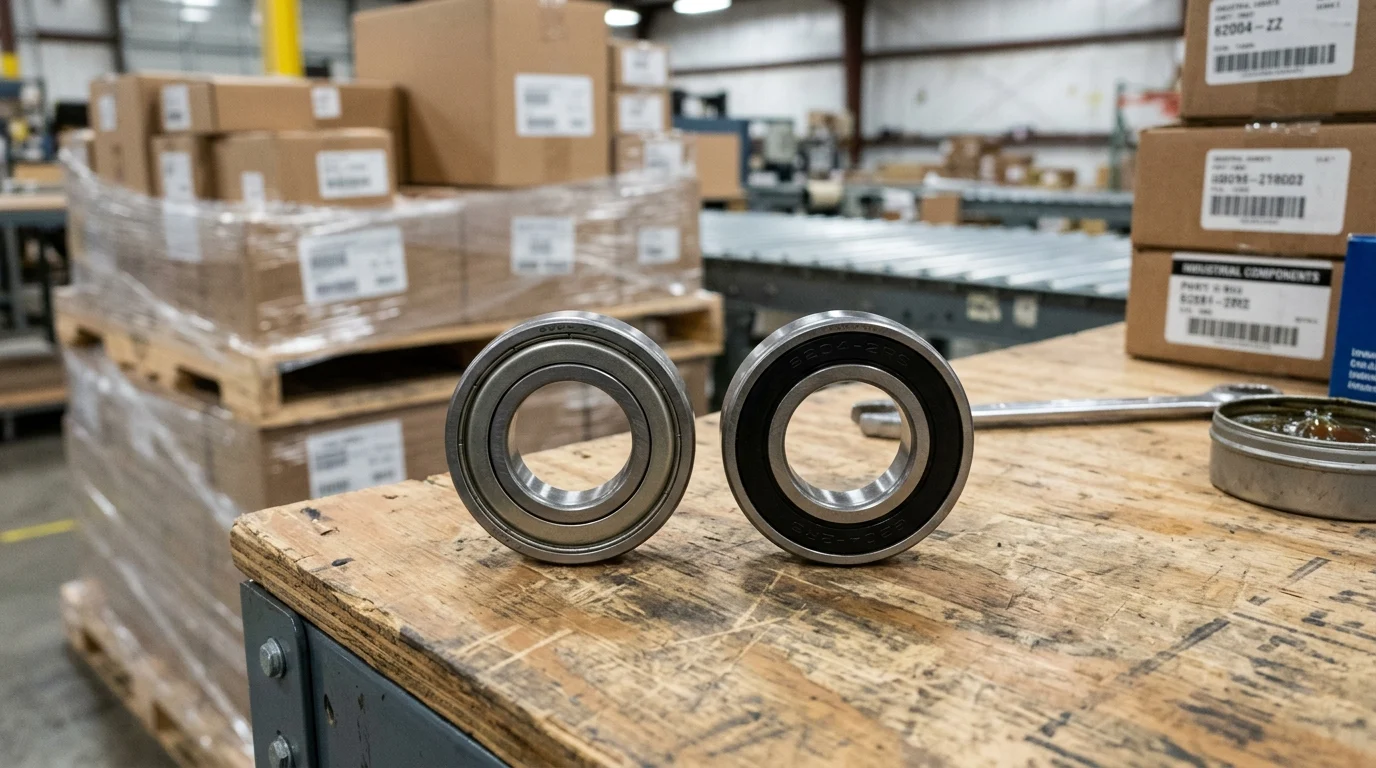
Operational environments dictate the tribological and mechanical demands placed on bearing closures. The decision between a rubber seal and a metal shield is rarely based on load capacity—as the internal geometry of the bearing remains identical—but rather on environmental profiling. By mapping the application's ambient conditions against the closure's performance characteristics, engineers can accurately predict lifecycle reliability.
Dusty, wet, and washdown environments
In environments characterized by heavy particulate contamination, high humidity, or direct fluid exposure, rubber sealed bearings are mandatory. Agricultural machinery, mining conveyors, and textile manufacturing equipment frequently expose bearings to abrasive dust that would rapidly bypass a metal shield. The contact seal maintains the integrity of the grease pack, preventing abrasive particles from forming a lapping compound within the raceways.
Food and beverage processing applications introduce the additional challenge of washdown protocols. Equipment is routinely subjected to high-pressure, high-temperature caustic cleaning solutions. While standard 2RS bearings can withstand incidental splashing, intensive washdown environments often require specialized food-grade rubber seals combined with secondary housing protections to prevent fluid ingress at pressures exceeding 1,000 PSI.
High-speed and low-friction use cases
Applications demanding rapid acceleration, sustained high RPMs, and minimal parasitic energy loss heavily favor metal shielded bearings. Machine tool spindles, electric motors, and high-performance power tools operate under kinematic conditions where contact friction would cause unacceptable thermal expansion. In these scenarios, the bearing's DmN value (the mean bearing diameter in millimeters multiplied by the rotational speed in RPM) becomes the critical specification metric.
A standard metal shielded deep groove ball bearing can safely accommodate DmN values exceeding 500,000. In contrast, applying a contact rubber seal to the same bearing might restrict the safe operating DmN to 300,000 or lower to prevent thermal degradation of the elastomer. Furthermore, the absence of seal drag in shielded bearings contributes to improved energy efficiency, a critical factor in battery-operated tools and high-efficiency industrial motors.
Common failure modes
Failure analysis of closed bearings frequently reveals misapplication of the closure type. When rubber sealed bearings fail in high-speed applications, root cause analysis typically highlights thermal hardening of the NBR lip. As the elastomer degrades and shrinks, the interference fit is lost, transforming the seal into a poor-performing shield that subsequently allows grease starvation and contaminant entry.
Conversely, metal shielded bearings deployed in heavily contaminated environments typically fail due to abrasive wear. Fine dust particles (measuring less than 50 microns) easily navigate the shield gap. Once inside, these particles disrupt the lubricant film thickness, leading to micro-spalling on the raceways, elevated vibration levels, and eventual catastrophic cage failure. Understanding these distinct failure modes is essential for implementing corrective engineering during equipment redesigns.
How to Choose the Right Bearing
Engineers must navigate a complex matrix of dimensional standards, tolerance classes, and proprietary manufacturer nomenclatures when specifying bearing closures. The selection process requires a holistic view of the mechanical system, balancing rotational speeds, operating temperatures, and contamination risks against commercial availability and supply chain reliability.
Specification and fit checks
When specifying bearing closures, it is critical to verify that the chosen sealing mechanism does not interfere with the surrounding housing or shaft geometry. Fortunately, per ISO 15 standards, the boundary dimensions (Outer Diameter, Inner Diameter, and Width) of standard deep groove ball bearings remain identical whether the bearing is open, shielded, or sealed. The modifications required to accommodate the closure are confined to the internal raceway grooves.
However, engineers must account for the internal radial clearance (e.g., C3, C4) in conjunction with the closure type. High-speed applications utilizing shielded bearings often require a C3 clearance to accommodate thermal expansion of the inner ring. Additionally, the fitment tolerances (ABEC or ISO classes) must align with the operational precision required; a high-precision ABEC 7 bearing is rarely equipped with standard contact seals due to the inherent friction disrupting micro-rotational accuracy.
Supplier quality and interchangeability
Global supply chains necessitate a thorough understanding of manufacturer-specific suffix designations, as a lack of standardization can lead to procurement errors. While 'ZZ' is near-universally recognized for double metal shields, rubber seal designations vary significantly. Sourcing high-quality bearings requires vetting suppliers for stringent quality control metrics, such as automated grease fill verification and acoustic testing, ensuring defect rates remain below 50 PPM (parts per million).
| Manufacturer | Rubber Seal (Contact) | Metal Shield | Light-Contact / Non-Contact Rubber |
|---|---|---|---|
| SKF | 2RS1, 2RSH | 2Z | 2RZ, 2RSL |
| NSK | DDU | ZZ | VV |
| NTN | LLU | ZZ | LLB |
| FAG / Schaeffler | 2RS, 2RSR | 2Z | 2BRS |
The table above illustrates the diverse nomenclature across tier-one manufacturers. Engineers must also be aware of non-contact rubber seals (e.g., SKF's 2RZ or NSK's VV), which offer a hybrid solution: the labyrinth design of a shield combined with the chemical resistance of an elastomer, providing intermediate speed and protection ratings.
When to choose sealed vs shielded bearings
The final specification decision rests on a hierarchical evaluation of operational constraints. If the application environment exposes the bearing to moisture, fluids, or heavy particulate matter, a rubber sealed bearing (2RS) is the mandatory baseline, provided the rotational speeds remain within the thermal limits of the elastomer. If speeds are excessive for a contact seal, secondary external sealing (such as V-rings or labyrinth housing seals) must be engineered into the assembly.
Metal shielded bearings (ZZ) should be the default specification for clean, dry environments where minimizing friction, maximizing RPM, and ensuring long-term thermal stability are the primary objectives. By strictly aligning the closure technology with the kinematic and environmental realities of the application, engineers can optimize both the performance and the lifecycle economics of the rotating equipment.
Key Takeaways
- The most important conclusions and rationale for rubber sealed vs metal shield bearing
- Specs, compliance, and risk checks worth validating before you commit
- Practical next steps and caveats readers can apply immediately
Frequently Asked Questions
What is the main difference between rubber sealed and metal shield bearings?
Rubber sealed bearings use a contact lip to block dirt and retain grease better. Metal shield bearings use a non-contact metal cover with a small gap, giving lower friction but less protection from moisture and fine dust.
When should I choose a rubber sealed bearing?
Choose 2RS rubber sealed bearings for dusty, wet, washdown, or vibration-prone equipment. They keep grease in and contaminants out better than shields, making them the safer option for harsh industrial environments.
When is a metal shield bearing the better choice?
Choose ZZ or 2Z shielded bearings for clean, high-speed applications where low friction and cooler running matter most. They work well when exposure to liquid, fine dust, and pressure spray is minimal.
Do rubber sealed bearings run slower than metal shield bearings?
Yes. The seal lip creates contact friction, so limiting speed is typically about 20% to 30% lower than a comparable shielded bearing. For maximum RPM, shielded bearings are usually the better choice.
Can metal shield bearings keep out water and very fine dust?
Not reliably. The shield’s clearance gap can block larger debris, but water, vapor, and micro-particles can pass through. For splash, spray, or fine dust, a rubber sealed bearing is usually the better option.