
Introduction
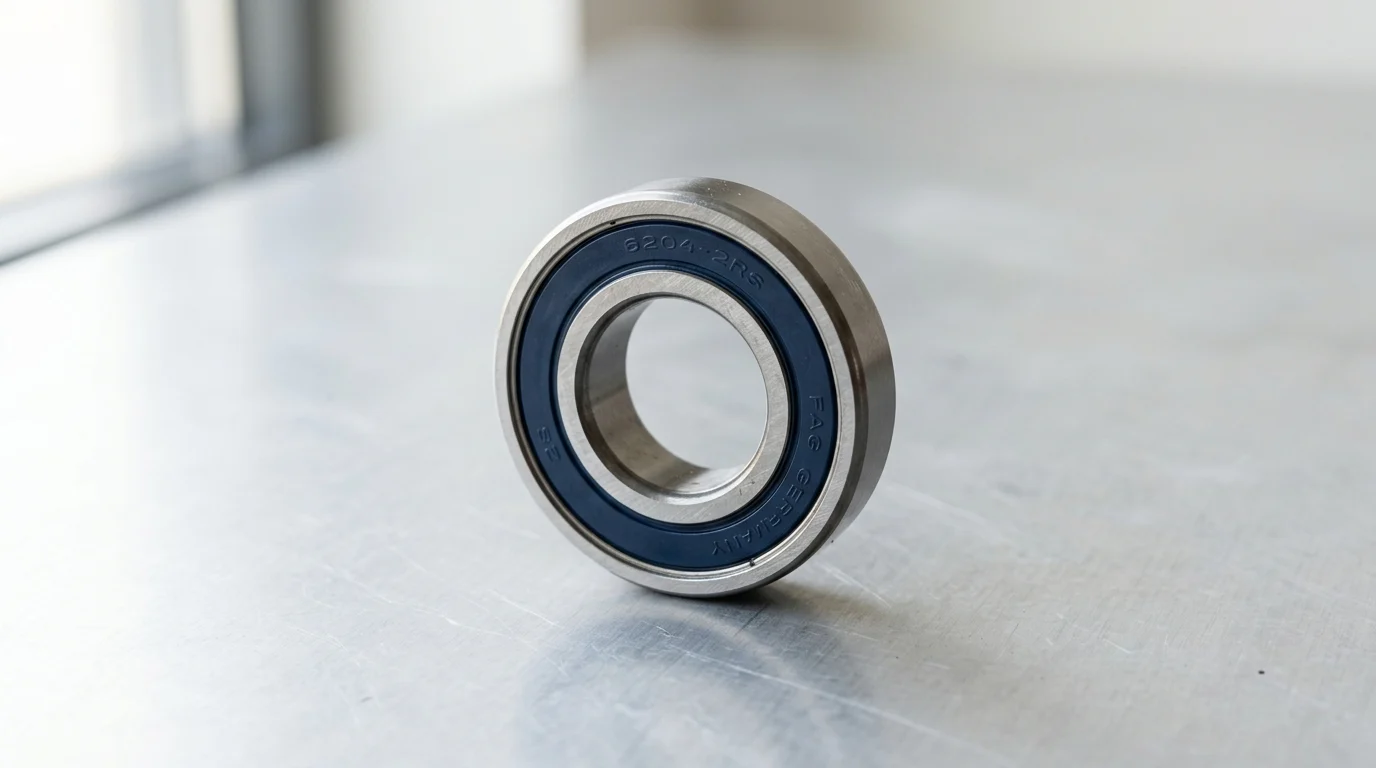
Wheel bearings are small components with a major role in motorcycle safety, stability, and running efficiency. When they wear out, the first clues may be subtle: a low rumble, looseness at the wheel, uneven handling, or vibration that grows with speed. Ignoring these signs can damage hubs, axles, seals, and tires, turning a relatively simple replacement into a costly repair. This guide explains how motorcycle wheel bearings work, how to recognize failure symptoms, what causes premature wear, and what to expect when inspecting or replacing them. It will help you decide when maintenance is urgent and how to approach the job with fewer risks.
Why Motorcycle Wheel Bearings Matter
Motorcycle wheel bearings serve as the critical interface between the static axle and the rotating wheel assembly, facilitating low-friction movement while supporting substantial dynamic loads. Operating in demanding environments, these components routinely endure rotational speeds exceeding 1,500 RPM at highway velocities, alongside radial shock loads that can surpass 500 kilograms during aggressive braking or uneven surface impacts. The structural integrity of these precision-engineered bearings directly dictates the operational safety and mechanical efficiency of the entire motorcycle chassis.
Impact on safety and wheel stability
The primary function of a wheel bearing is to maintain precise axial and radial alignment of the wheel hub. When bearing tolerances degrade, the resulting lateral play compromises the motorcycle’s gyroscopic stability. A deviation of even a fraction of a millimeter at the hub amplifies significantly at the tire perimeter, translating into high-speed weave, unpredictable camber thrust during cornering, and severe steering head vibration. In extreme failure scenarios, catastrophic bearing collapse can cause the wheel to lock or detach entirely, presenting an immediate and life-threatening hazard to the rider.
Effects on downtime and repair cost
Beyond safety concerns, neglected wheel bearings introduce severe economic consequences through cascading mechanical failures. A seized bearing typically spins the outer race within the softer aluminum wheel hub, obliterating the engineered interference fit. While a standard premium replacement bearing costs between $15 and $40, repairing a scored hub often requires specialized machining or complete wheel replacement, escalating repair costs to between $300 and $800. Furthermore, sudden bearing failure during transit guarantees immediate operational downtime, requiring costly emergency recovery services and disrupting fleet or personal travel schedules.
Types and Fitment of Motorcycle Wheel Bearings
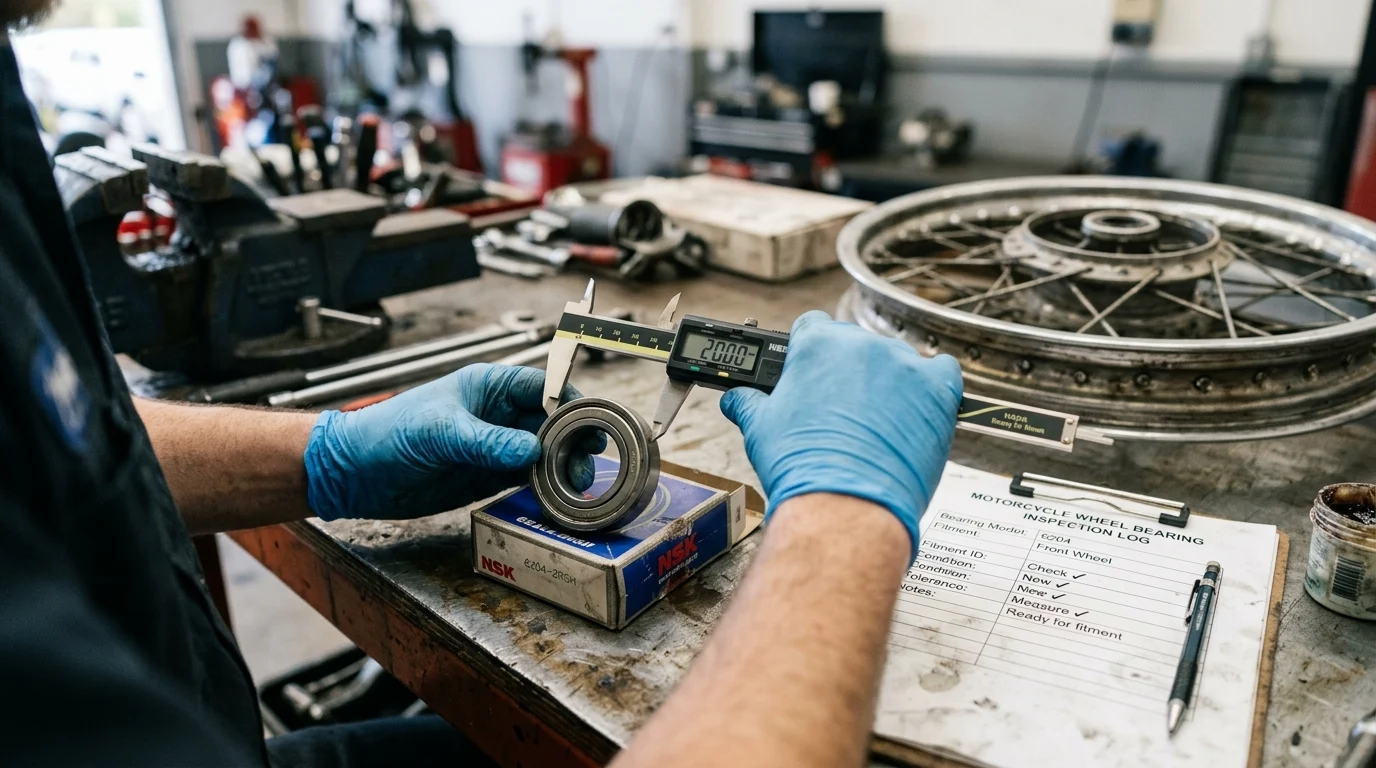
Selecting the appropriate wheel bearing requires an understanding of the mechanical loads specific to the motorcycle’s geometry and intended application. Manufacturers engineer bearing fitments based on exact dimensional profiles, load ratings, and environmental sealing requirements to ensure optimal longevity.
Ball, tapered roller, and sealed bearings
The vast majority of modern motorcycles utilize deep groove ball bearings, such as the ubiquitous 6000 and 6200 series, due to their excellent high-speed capabilities and capacity to handle both radial and moderate axial loads. Heavyweight cruisers and older touring motorcycles frequently employ tapered roller bearings, which offer superior load-bearing surface area for high-mass applications but require precise manual preload adjustment. Regardless of the rolling element geometry, contemporary wheel bearings are predominantly sealed units, designed to permanently retain lubrication while excluding moisture and particulate matter.
Materials, tolerances, and grease selection
Bearing performance relies heavily on metallurgical composition and manufacturing precision. Industry-standard motorcycle bearings are forged from high-carbon chromium steel (SAE 52100), providing optimal fatigue resistance. Precision is governed by the Annular Bearing Engineering Committee (ABEC) scale, with ABEC-3 or ABEC-5 tolerances being standard for high-performance motorcycle wheels. Lubrication is equally critical; premium units utilize advanced polyurea or lithium-complex greases capable of maintaining viscosity across an extreme operating temperature range of -40°C to 150°C.
| Seal Designation | Construction | Friction Level | Environmental Protection |
|---|---|---|---|
| Open | No seals | Minimal | None (Relies entirely on external hub seals) |
| ZZ / 2Z | Dual metal shields | Low | Deflects large debris; poor water resistance |
| 2RS / DDU | Dual rubber contact seals | Moderate | Excellent dust and water exclusion |
OEM vs aftermarket options
When procuring replacement bearings, technicians must evaluate Original Equipment Manufacturer (OEM) components against aftermarket alternatives. OEM bearings guarantee exact dimensional conformity and grease fill specifications engineered for the specific motorcycle model. However, high-tier aftermarket kits from specialized bearing manufacturers often provide equivalent or superior sealing technologies, such as triple-lip seals, at a more competitive price point. It is critical to avoid unbranded, low-cost bearings, which frequently suffer from inferior steel tempering and inadequate internal clearances. A C3 internal clearance is often required in wheel applications to safely accommodate thermal expansion during heavy braking.
Signs and Causes of Bearing Failure
Identifying the root causes and early indicators of bearing degradation is essential for preventative maintenance. Wheel bearings operate in a hostile environment, constantly exposed to kinetic stress, thermal cycling, and environmental contaminants that threaten their structural integrity.
Common symptoms of worn wheel bearings
Early-stage bearing failure manifests through subtle tactile and auditory cues. Riders may notice a low-frequency hum or growling noise that changes pitch with vehicle speed or lean angle. Tactile symptoms include a high-frequency vibration transmitted directly through the footpegs, swingarm, or handlebars. As degradation progresses, the wheel may exhibit lateral runout; any detectable side-to-side play exceeding 1.0mm to 2.0mm at the tire circumference is a definitive indicator of excessive internal bearing clearance, raceway spalling, or collapsed rolling elements.
Causes such as contamination, torque, and poor installation
Premature bearing failure is rarely a result of metallurgical fatigue; it is predominantly caused by external factors. Contamination is the leading culprit, often initiated by high-pressure washing that forces water past the protective contact seals, emulsifying the grease and causing rapid oxidation of the steel races. Incorrect installation practices, such as driving the bearing via the inner race, instantly brinell the raceways. Additionally, improper axle fastening—specifically applying torque exceeding the manufacturer’s specification, which can range from 90 to 120 Nm, without properly aligned internal spacers—imposes massive side loads that rapidly destroy the bearing’s rolling elements.
Inspection and diagnostic checks
Diagnostic procedures require isolating the wheel from the ground to eliminate tire friction. Technicians perform an unloaded spin test, listening for dry, grinding, or clicking sounds, often utilizing a mechanic’s stethoscope placed against the stationary axle spindle to amplify internal noise. The push-pull test involves grasping the wheel at the 3 o’clock and 9 o’clock positions and applying alternating lateral force to detect mechanical play. If any resistance, notchiness, or lateral movement is detected during these checks, the bearing assembly mandates immediate replacement.
How to Replace Motorcycle Wheel Bearings
Replacing motorcycle wheel bearings demands precise mechanical procedures and specialized tooling to ensure the integrity of both the new components and the wheel hub. Improper extraction or insertion techniques account for a significant percentage of premature bearing failures in the field.
Correct replacement process
The extraction and installation process must prioritize preserving the tight interference fit of the aluminum wheel hub. Because aluminum expands at a greater rate than steel, applying controlled thermal energy is a critical industry best practice. Heating the hub area to approximately 80°C to 100°C (175°F to 212°F) using an industrial heat gun expands the bore, significantly reducing the mechanical force required to extract the old bearing. Conversely, chilling the new replacement bearing in a freezer at -18°C (0°F) for several hours causes the steel to contract. Combining a heated hub with a chilled bearing often allows the new unit to drop perfectly into the bore with minimal to zero impact force required.
Tools and installation best practices
Proper tooling is non-negotiable for professional results. Extracting bearings from a blind hub requires an expanding collet blind bearing puller and a slide hammer to apply linear outward force without gouging the inner hub walls. During installation, technicians must use a dedicated bearing driver set. The driver must match the exact diameter of the bearing’s outer race. Applying any force to the inner race or the rubber seal will permanently damage the rolling elements and raceways before the bearing ever enters service. While a hydraulic shop press is the preferred installation method, a dead-blow hammer used with a precisely fitted driver is acceptable for field and bench repairs.
When to replace seals, spacers, and circlips
A bearing replacement should be treated as a comprehensive hub service rather than an isolated component swap. External dust seals must be replaced concurrently, as their sealing lips harden and degrade over time, losing their ability to protect the primary bearing seals from moisture. The internal distance tube (crush tube) and external wheel spacers must be micrometer-inspected. If the spacer surfaces mating with the dust seals exhibit grooving deeper than 0.1mm, they will fail to provide an adequate sealing surface and must be replaced. Furthermore, retaining circlips should be inspected for deformation and replaced if they lack sufficient spring tension to secure the bearing.
When to Reuse, Monitor, or Replace Bearings
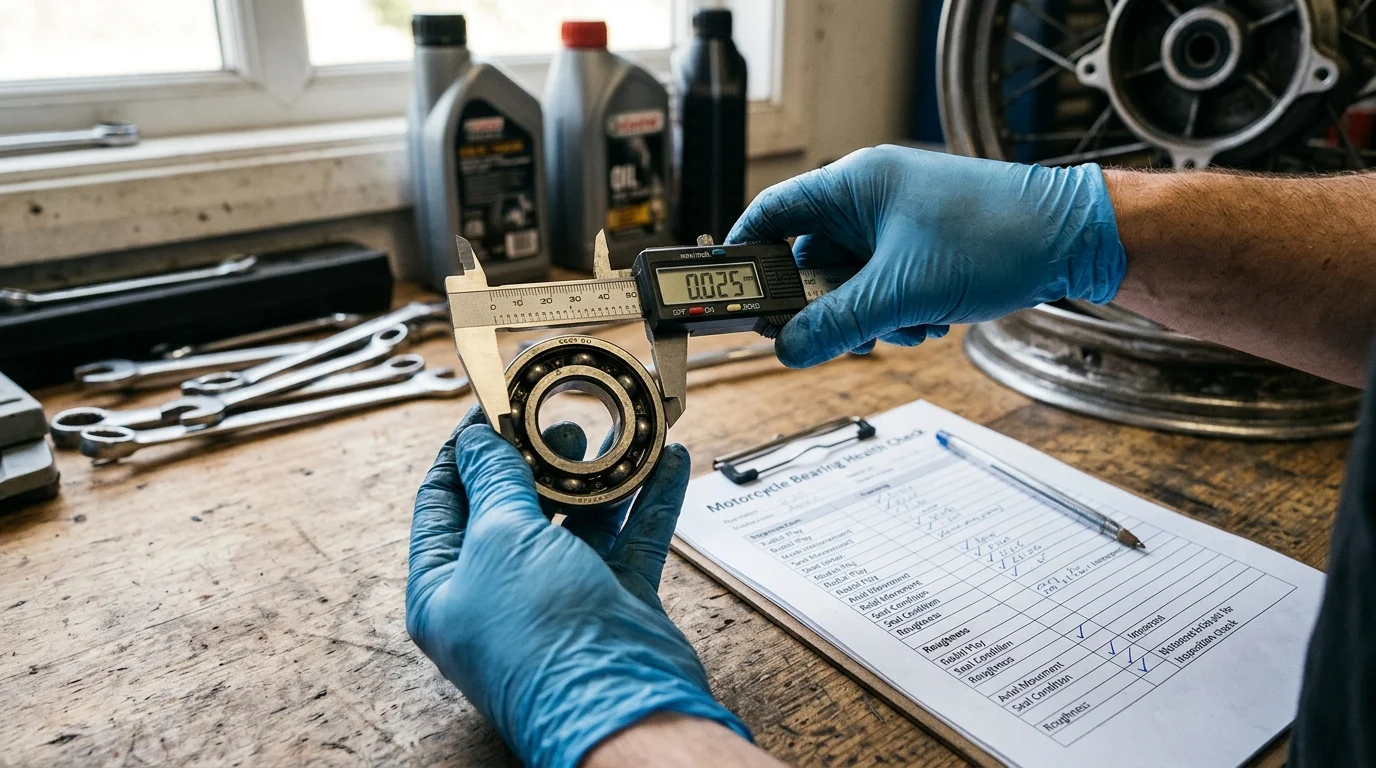
Determining the exact point at which a wheel bearing transitions from serviceable to compromised dictates the maintenance schedule. Proactive lifecycle management prevents catastrophic failures and optimizes long-term chassis reliability across the vehicle’s lifespan.
Decision criteria for service action
Service actions are governed by strict binary criteria: bearings are either perfectly smooth and tight, or they are failing; there is no acceptable middle ground for wear. Bearings that have been removed from a hub for any reason—such as during wheel powder coating or hub anodizing—must be discarded, as the extraction process inherently stresses the races and compromises structural integrity.
| Assessment Criteria | Observation | Required Service Action |
|---|---|---|
| Tactile Spin Test | Perfectly smooth, slight grease drag | Monitor / Reinstall wheel |
| Tactile Spin Test | Notchiness, rough spots, or free-spinning (no drag) | Replace immediately |
| Visual Inspection | Rust trails on axle or outer dust seal | Replace bearing and external seals |
| Lateral Play | Any detectable movement at the axle hub | Replace immediately |
Maintenance intervals and supplier selection
While bearing longevity varies wildly based on operating conditions, a baseline inspection interval of 10,000 miles (16,000 km) or annually is standard industry practice. In optimal highway conditions, premium sealed bearings frequently achieve operational lifespans ranging from 25,000 to 40,000 miles. However, off-road motorcycles or those subjected to frequent wet-weather commuting may require replacement intervals as short as 5,000 miles due to aggressive environmental contamination. When sourcing replacements, procurement should prioritize Tier-1 global bearing manufacturers—such as SKF, NTN, Koyo, or FAG—to ensure strict adherence to ABEC dimensional tolerances and robust grease fills that maximize the component’s functional lifecycle.
Key Takeaways
- The most important conclusions and rationale for Motorcycle Wheel Bearings
- Specs, compliance, and risk checks worth validating before you commit
- Practical next steps and caveats readers can apply immediately
Frequently Asked Questions
What are the first signs of a failing motorcycle wheel bearing?
Watch for wheel play, humming or grinding noise, rough wheel rotation, and vibration during riding. Check both front and rear wheels before damage spreads to the hub.
Which wheel bearing type is most common on modern motorcycles?
Most modern bikes use sealed deep groove ball bearings, often in 6000 or 6200 series sizes. For better water and dust protection, 2RS sealed versions are usually preferred.
Should I choose OEM or aftermarket motorcycle wheel bearings?
Choose OEM-fit or high-quality branded aftermarket bearings with correct dimensions, seals, and clearance. Avoid unbranded low-cost parts that may wear quickly or fit poorly.
Why is C3 clearance important for motorcycle wheel bearings?
C3 clearance gives extra internal space for heat expansion during riding and braking. Using the wrong clearance can increase friction, overheating, and premature bearing failure.
Can VETOR GROUP supply motorcycle wheel bearings for bulk orders?
Yes. VETOR GROUP provides factory-direct bearings and motorcycle parts with OEM customization, quality control, wide model compatibility, and global export support for B2B buyers.