
Choosing the wrong bearing for an electric motor application can cause premature failure, excessive noise, vibration, and energy losses. For global buyers sourcing bearings for home appliance manufacturers or industrial OEM customers, understanding the technical distinctions between bearing grades, noise ratings, and international certifications is essential to avoiding costly specification errors.
This article provides a structured framework for evaluating bearings used in electric motor and home appliance applications, covering material grades, noise standards, thermal performance, and the certification requirements that govern cross-border trade in bearing products.
Understanding Bearing Grades for Electric Motor Applications
What Is EMQ Bearing Grade?
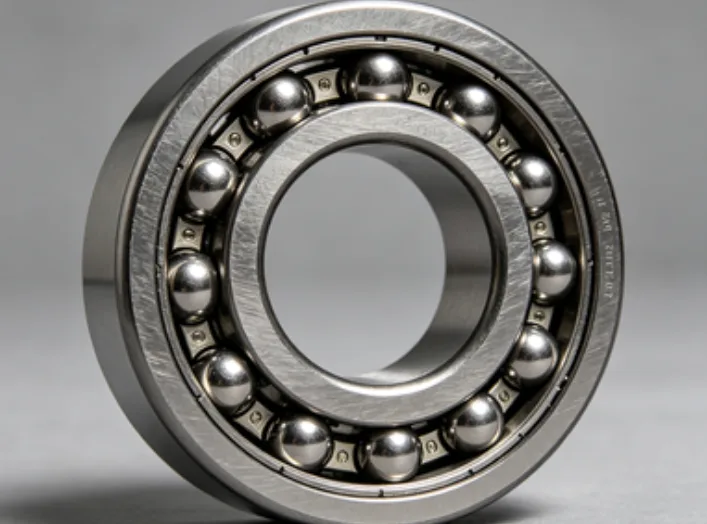
EMQ (Electric Motor Quality) refers to a bearing grade classification that signifies lower vibration, smoother running, and stricter dimensional tolerances than standard commercial-grade bearings. EMQ bearings are manufactured to tighter tolerances—typically P5 or P6 ABEC grades (as defined by the Annular Bearing Engineers’ Committee)—and undergo dynamic balancing to minimize residual vibration.
The key differentiators between standard commercial bearings and EMQ-grade bearings:
- Dimensional tolerance: EMQ bearings hold bore and outside diameter tolerances within 0.005 mm versus 0.01–0.02 mm for commercial grades.
- Vibration level: EMQ bearings are measured for vibration amplitude in microns per second (μm/s); values below 50 μm/s at 1,500 RPM are typical for EMQ designations.
- Noise requirement: EMQ bearings must meet defined A-weighted decibel (dBA) limits, particularly for direct-coupled motor applications where bearing noise is audible to end users.
- Material cleanliness: EMQ-grade bearings use cleaner steel compositions with lower inclusion content to reduce fatigue-initiation sites.
Buyers sourcing for European, Japanese, or North American home appliance OEM contracts should specify EMQ-grade as the default requirement. Commercial-grade bearings may satisfy price-sensitive markets in Southeast Asia, Africa, or South America, but specification failures in higher-regulation markets can result in costly product returns.
Deep Groove Ball Bearings in Electric Motor Applications
Why Deep Groove Ball Bearings Dominate Motor Applications
Deep groove ball bearings account for approximately 40% of all bearing sales globally, and the majority of these are installed in electric motor assemblies. Their design—a raceway with gothic arch cross-section capable of accommodating both radial and axial loads—suits the bidirectional mechanical stresses present in motor rotor support systems.
Critical advantages of deep groove ball bearings in motor applications:
- Axial load capacity: The deep raceway profile allows the bearing to handle axial loads up to 50% of its basic dynamic load rating, accommodating belt-drive pulley pull and thermal expansion forces.
- Speed capability: Limiting speeds for standard deep groove ball bearings range from 8,000 to 15,000 RPM depending on bearing size and lubrication, well within typical motor operating ranges.
- Simplicity of mounting: Both single-row and sealed variants require minimal axial location provisions, simplifying motor housing design and assembly.
Common Motor Bearing Sizes and Their Applications
| Frame Size | Bearing Bore (mm) | Common Application | Noise Level |
|---|---|---|---|
| 63–80 | 12–17 mm | Small fans, power tools | Low |
| 90–112 | 20–25 mm | Washing machine motors, vacuum cleaners | Low to Medium |
| 132–160 | 30–40 mm | Industrial pumps, HVAC fans | Medium |
| 180–225 | 45–60 mm | Large industrial motors, compressors | Medium to High |
Buyers should cross-reference IEC frame size standards when specifying bearings, as dimensional conventions vary slightly between regions (IEC vs. NEMA frame standards).
Noise Standards for Home Appliance Bearings
Why Noise Matters in Appliance Applications
Home appliances operate in close proximity to consumers. A washing machine or ceiling fan that emits excessive bearing noise signals poor quality to the end user and can be a basis for warranty claims. Major appliance brands have established internal noise specifications that their bearing suppliers must meet as a condition of supply.
The relevant acoustic measurement for bearing noise is A-weighted decibel level (dBA) measured at a defined distance (typically 1 meter) under standardized conditions. Typical limits:
- Quiet appliances (refrigerators, air purifiers): ≤ 25 dBA at 1 meter
- Standard appliances (washing machines, dishwashers): ≤ 35–40 dBA at 1 meter
- Industrial equipment (large fans, pumps): ≤ 50–60 dBA at 1 meter
Noise is generated by several mechanisms within a bearing: ball-pass frequency, cage resonance, and lubricant churn. EMQ-grade bearings address these through optimized cage design, precision ball roundness (Grade G3 or G5 tolerances), and controlled lubricant fill.
Factors Affecting Bearing Noise in Appliance Applications
Buyers specifying bearings for noise-sensitive appliances should evaluate four contributing factors:
- Ball grade and roundness deviation — Lower grade (G10 or G20) balls exhibit higher noise peaks during rotation.
- Lubricant type and fill level — Excess grease or inappropriate viscosity increases churning noise at high speeds.
- Mounting preload — Over-preloaded bearings generate higher friction noise; insufficient preload causes operational looseness and impact sounds.
- Environmental temperature — High ambient temperatures degrade lubricant viscosity, increasing friction noise.
When requesting samples from suppliers, buyers should request noise test reports (typically measured per ISO 15242 or equivalent standards) before committing to volume orders for noise-critical applications.
Thermal Performance and Lubrication Requirements
Operating Temperature Ranges
Bearing operating temperature directly affects lubricant viscosity and bearing service life. For electric motor applications, continuous operating temperatures typically range from −20°C to +120°C, with short-term peaks reaching 150°C during locked-rotor events or overload conditions.
Key thermal considerations for motor bearing selection:
- Standard greases (mineral oil-based lithium complex): Functional range −20°C to +120°C
- High-temperature greases (polyurea or perfluorinated): Functional range −30°C to +180°C
- Motor insulation class: For Class F insulation (rated 155°C), bearing selection should accommodate occasional temperature spikes without losing preload or experiencing seal degradation.
Lubrication Interval and Relubrication Strategy
Sealed deep groove ball bearings (designations: 2RS, 2Z, DDU) are pre-greased for life in most electric motor and home appliance applications. For open bearings in industrial motor applications, relubrication intervals depend on operating speed and temperature:
- Speed factor (n × dm): Product of RPM and mean bearing diameter (mm). Values below 300,000 typically allow 6–12 month relubrication intervals.
- Temperature factor: For every 15°C increase above 70°C, halve the relubrication interval.
- Contamination factor: In dusty or humid environments, reduce intervals by 50% compared to clean laboratory conditions.
Buyers sourcing for emerging markets with extreme climate conditions—high humidity in tropical regions, temperature extremes in Middle Eastern markets—should specify enhanced corrosion-resistant materials (stainless steel races, ceramic rolling elements) and high-performance seal designs.
International Certifications and Standards for Motor Bearings
ISO 9001 and IATF 16949
ISO 9001 (Quality Management Systems) is the baseline certification required for any serious bearing exporter. It ensures the supplier maintains documented quality processes, incoming inspection of raw materials, and traceability of production batches.
IATF 16949 (Automotive Quality Management) is increasingly required by bearing buyers serving automotive OEM assembly lines. While motor bearings are not themselves automotive safety components, the IATF certification signals a supplier’s capability to maintain the rigorous process control that major appliance manufacturers demand.
CE Marking and EU Market Entry
For bearings sold into European Union member states, compliance with applicable EU directives is mandatory. Key directives include:
- Machinery Directive 2006/42/EC — Bearings are considered “components” exempt from full CE marking, but the final machine incorporating them must carry CE marking.
- REACH Regulation (EC 1907/2006) — Restricts hazardous substances in materials; buyers should request REACH compliance declarations from Chinese bearing suppliers, particularly for coatings and lubricants.
- RoHS Directive (2011/65/EU) — Restricts lead, cadmium, hexavalent chromium, and other substances; most standard steel bearings with standard steel cages are compliant, but buyers should verify for specialty products.
North American Requirements
For the US and Canadian markets, buyers should ensure bearing suppliers can provide:
- PPAP (Production Part Approval Process) documentation for new part introductions, per AIAG standards.
- PPAP Level 3 submissions are commonly required by major appliance OEM supply chains.
- Conflict Minerals reporting (Dodd-Frank Act Section 1502) — Buyers importing into the US must ensure supplier disclosures regarding tantalum, tin, tungsten, and gold sourced from the Democratic Republic of Congo region.
EACU (Eurasian Conformity) for Russia and CIS Markets
For buyers serving Russian and CIS market customers, bearings must comply with EACU technical regulations. Documentation requirements include Russian-language product passports, conformity declarations, and type-approval certificates. EACU compliance is increasingly complex due to sanctions regimes—buyers should verify their supply chain can reliably deliver to this market.
How to Evaluate a Bearing Supplier for Motor and Appliance Applications
Technical Capability Assessment
Before qualifying a new bearing supplier for EMQ or industrial motor applications, buyers should conduct a structured evaluation:
- Request production process documentation — Verify the supplier operates automated assembly lines with in-process inspection (e.g., 100% noise testing for EMQ grades).
- Ask for sample test reports — Minimum: noise spectrum data, vibration amplitude measurements, and dimensional conformance certificates for the specific part numbers under consideration.
- Request PPAP or equivalent documentation — For new product introductions, a Level 3 PPAP package demonstrates the supplier’s understanding of OEM quality requirements.
- Audit the quality management system — ISO 9001 certification alone is insufficient; evaluate whether the supplier has experience supplying to recognized appliance or industrial motor brands.
- Verify laboratory capabilities — Suppliers with in-house noise testing, vibration analysis, and endurance testing facilities can provide faster qualification timelines and more responsive technical support.
Red Flags in Bearing Supplier Evaluations
Buyers should be cautious when:
- Suppliers quote EMQ-grade pricing but provide no noise test data.
- Dimensional certificates show tolerances outside ABEC P5/P6 without disclosure.
- Sample bearing cages use unrecycled virgin polymer rather than glass-fiber reinforced nylon (a cost-reduction indicator).
- Lead times are unrealistically short for custom specs (suggesting stock-pulling rather than production).
FAQ
What is the difference between EMQ grade and standard commercial grade bearings?
EMQ (Electric Motor Quality) bearings are manufactured to tighter dimensional tolerances (P5 or P6 ABEC grades), lower vibration levels, and stricter noise limits compared to standard commercial-grade bearings. EMQ grades are required by most major appliance and industrial motor OEM specifications. Commercial-grade bearings may be acceptable for non-critical applications where cost is the primary driver and noise/vibration specifications are not defined.
How do I measure bearing noise levels for appliance quality control?
Bearing noise is measured in A-weighted decibels (dBA) at a standardized distance (typically 1 meter) using ISO 15242 or equivalent testing protocols. Equipment includes an A-weighted sound level meter and a standardized mounting fixture that eliminates housing resonance from the measurement. Buyers should request noise test reports from suppliers as part of incoming inspection, particularly for EMQ-grade products serving quiet appliance lines.
What bearing certifications are required to export to the European Union?
While individual bearings as components do not require CE marking themselves, final products incorporating them must be CE-compliant. Suppliers should hold ISO 9001 certification minimum. For electrical safety and environmental compliance, request REACH and RoHS declarations. Major appliance OEMs may additionally require IATF 16949 or equivalent automotive-quality management system certifications from their bearing suppliers.
How do high temperatures affect electric motor bearing performance?
Elevated temperatures degrade lubricant viscosity, causing increased friction and noise. Sustained temperatures above 120°C accelerate inner race fatigue and reduce bearing service life. For motors operating in high-ambient-temperature environments or subjected to frequent overload conditions, specify high-temperature grease (rated to 180°C or above) and consider ceramic hybrid bearings for their superior thermal stability and 40% lower friction coefficient compared to all-steel designs.
What is the typical service life of a deep groove ball bearing in an electric motor?
Service life depends on load, speed, temperature, and contamination exposure, but is calculated using the ISO L₁₀ basic rating life formula. For standard EMQ deep groove ball bearings operating within rated parameters, L₁₀ life typically ranges from 10,000 to 50,000 hours. Sealed bearings in clean environments at moderate loads routinely exceed 20,000 hours. However, contamination, improper mounting, or shaft misalignment can cause premature failures well before the calculated life expectancy—emphasizing the importance of handling and installation controls.