
Introduction
Dust-heavy plants expose bearings to a constant stream of particles that can breach seals, disrupt lubrication films, and accelerate wear long before components reach their expected life. Extending service life in these conditions depends less on the bearing alone and more on how well the system controls contamination at the housing, seal, and lubrication levels. This article explains why dust causes rapid damage, which protection measures have the biggest impact on uptime, and how maintenance teams can choose practical sealing, greasing, and inspection strategies to reduce failures, replacement frequency, and unplanned stoppages.
Why industrial bearing dust protection affects uptime
Industrial bearing dust protection is a fundamental pillar of mechanical reliability in heavy manufacturing and bulk material handling. When rotating equipment operates in environments saturated with airborne particulates, the integrity of the bearing housing becomes the primary defense against premature catastrophic failure. Without robust isolation from the external environment, maintenance teams face escalating replacement costs, unpredictable downtime, and severe production bottlenecks.
The correlation between effective contamination control and operational uptime is strictly quantitative. Even microscopic volumes of foreign particulate matter can drastically reduce the L10 life expectancy of a rolling element bearing. Consequently, engineering and maintenance professionals must prioritize advanced sealing and lubrication strategies to preserve the mechanical availability of critical assets.
How dust accelerates bearing failure
Particulate contamination initiates a destructive cycle known as three-body abrasion, fundamentally altering the internal geometry of rolling elements and raceways. In highly loaded industrial bearings, the elastohydrodynamic lubrication (EHL) film separating these metal surfaces is exceptionally thin, frequently measuring between 1 and 3 microns in thickness.
When airborne dust particles—which routinely range from 5 to 50 microns in diameter—breach the bearing housing, they easily bridge and puncture this microscopic fluid film. The resulting metal-to-particle-to-metal contact generates localized stress risers, leading to micro-spalling, increased internal friction, and elevated operating temperatures. Over time, this abrasive action alters internal clearances, causing the bearing to exceed acceptable vibration tolerances and ultimately fail long before reaching its engineered fatigue limit.
Which environments create the highest contamination risk
Facilities processing bulk solids or operating in unenclosed natural environments experience the most severe particulate threats. Mining operations, cement manufacturing facilities, aggregate quarries, and agricultural processing plants represent the highest-risk profiles for bearing contamination.
In these high-risk sectors, ambient airborne dust concentrations regularly exceed 50 mg/m³, creating a continuous assault on bearing seals. Furthermore, the mineralogy of the dust heavily influences the degradation rate. Highly abrasive particulates, such as silica or alumina, possess hardness levels that easily score standard steel components. Environments that combine high dust loads with high humidity or frequent thermal cycling present an amplified risk, as pressure differentials can actively draw airborne contaminants past primary seals as the bearing housing cools.
What effective bearing dust protection includes
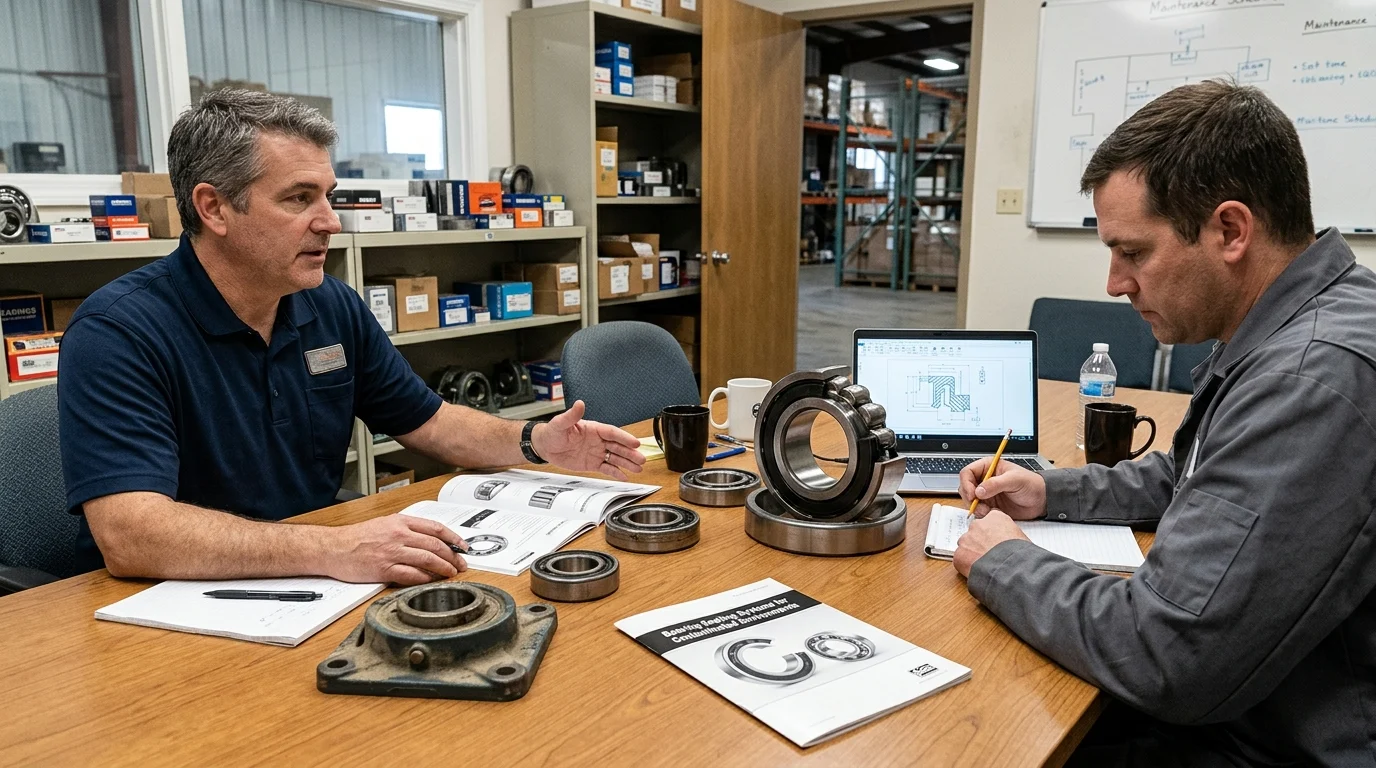
Implementing robust industrial bearing dust protection requires a multi-layered defense strategy rather than relying on a single component. Effective protection systems are engineered to address the specific contamination pathways inherent to the equipment's design, combining physical barriers, fluid dynamics, and strict component tolerances to isolate the bearing cavity.
A comprehensive protection plan evaluates the entire bearing ecosystem. This holistic approach ensures that seals, lubricants, and housing architectures work in concert to repel particulates, thereby preserving the critical elastohydrodynamic film required for optimal bearing performance.
Common contamination paths and sealing methods
Contaminants typically infiltrate bearings through microscopic gaps between the rotating shaft and the stationary housing, or through compromised breathers and grease fittings. To counter this, engineers deploy various sealing methods tailored to the severity of the environment.
Standard contact seals, such as nitrile rubber lip seals, provide a physical barrier that rides directly on the shaft. However, in highly abrasive environments, labyrinth seals are often preferred. These non-contact seals utilize a complex pathway of interlocking stationary and rotating rings to impede dust ingress. Because labyrinth seals rely on tortuous paths rather than physical contact, they require exceptionally tight diametral clearances, generally maintained between 0.2 mm and 0.5 mm, to effectively block fine particulates without generating friction.
How lubrication, housing design, and shaft condition affect protection
Lubrication serves as a critical secondary barrier against particulate ingress. When a bearing housing is properly packed, grease acts as a dynamic, viscous plug that traps dust before it can reach the rolling elements. Implementing a continuous or highly frequent purging strategy forces contaminated grease outward, continuously refreshing the barrier at the seal interface.
Housing design and shaft condition dictate how well these seals and lubricants perform. Standard housings may require modifications, such as the addition of V-ring deflectors or flinger rings, to physically eject dust radially away from the primary seal via centrifugal force. Furthermore, the condition of the shaft is paramount for contact seals; for a lip seal to function without rapid degradation, the shaft's surface finish must typically be precision-machined and maintained between Ra 0.2 µm and 0.8 µm. Any deviation or excessive runout will create microscopic gaps, instantly compromising the protection system.
How to compare seals, lubrication, and bearing options
Selecting the appropriate protection mechanisms involves balancing contamination resistance against operational constraints. Specifying heavy-duty seals indiscriminately can lead to unintended consequences, such as excessive heat generation or premature lubricant degradation, which can be just as detrimental as dust ingress.
Engineering teams must objectively compare available sealing technologies, bearing housing configurations, and lubrication properties to find the optimal configuration. This requires a thorough analysis of kinematics, thermal dynamics, and lifecycle costs.
Which seal and housing types perform best in dusty conditions
Standard nitrile rubber (NBR) lip seals provide adequate defense in mildly dusty environments but degrade rapidly under heavy abrasive loads. For moderate to severe dust, non-contact labyrinth seals perform exceptionally well, offering zero-wear characteristics and indefinite lifespans, provided the clearances remain uncompromised.
For extreme particulate exposure—such as primary crushers or heavy conveyor pulleys—taconite seals deliver superior protection. A taconite seal combines a multi-stage labyrinth design with an internal contact seal and dedicated grease purge ports. This hybrid approach ensures that even if dust penetrates the outer labyrinth, it is trapped and subsequently flushed out by the pressurized grease barrier before reaching the bearing cavity.
How to evaluate friction, speed, grease retention, and cost
Engineers must evaluate the speed factor (ndm), calculated as the mean bearing diameter in millimeters multiplied by the rotational speed in RPM, to determine seal viability. Contact seals generate significant friction, which elevates operating temperatures and typically limits applications to an ndm of 150,000 to 200,000.
Conversely, non-contact labyrinth seals generate near-zero friction, easily accommodating high-speed applications exceeding 500,000 ndm without thermal penalties. Grease retention is also impacted by seal choice; contact seals retain low-viscosity lubricants well but risk thermal breakdown, while labyrinth seals require stiffer greases (NLGI Grade 2 or 3) to prevent leakage. Cost evaluations must extend beyond the initial purchase price to include the energy costs of friction and the maintenance labor required for frequent replacements.
What a practical comparison table should include
To streamline the specification process, engineering teams should utilize standardized evaluation matrices. A practical comparison table clarifies the trade-offs between speed capabilities, protection levels, and operational costs.
| Seal Technology | Max Speed Factor (ndm) | Dust Protection Level | Friction & Heat Generation | Relative Cost Impact |
|---|---|---|---|---|
| Standard Lip Seal (Contact) | < 200,000 | Moderate | High | Low ($) |
| V-Ring Deflector (Elastomeric) | < 300,000 | Moderate to Good | Low to Moderate | Low ($) |
| Labyrinth Seal (Non-Contact) | > 500,000 | Good | Negligible | Medium ($$) |
| Taconite Seal (Hybrid Purge) | < 400,000 | Excellent | Moderate | High ($$$) |
By applying this data, reliability engineers can confidently match the sealing technology to the exact kinematic and environmental demands of the asset.
How to extend bearing life in dusty industrial settings
Advanced sealing technologies can only fulfill their designed service life when supported by rigorous maintenance protocols. The operational phase is where theoretical protection is tested against real-world execution. Poor installation practices or inconsistent lubrication routines will swiftly neutralize the benefits of even the most expensive bearing housings.
To maximize bearing longevity in dusty environments, maintenance departments must transition from reactive component replacement to a proactive regime of precision maintenance, contamination control, and continuous monitoring.
Inspection, installation, and lubrication best practices
The foundation of extended bearing life begins during installation. Bearings must be installed in a clean environment; opening a bearing wrapper on a dusty plant floor immediately introduces particulates before the equipment even operates. Technicians should utilize proper induction heaters and mounting tools to prevent impact damage that could compromise seal seating.
In operation, lubrication best practices dictate the survival of the bearing. Transitioning from periodic manual greasing to automated single-point or multi-point lubricators ensures a consistent, uninterrupted grease barrier. Delivering precise volumes—such as 2 to 5 grams per day, depending on bearing size—maintains positive pressure within the housing to repel dust without risking seal blowout, a common consequence of manual over-greasing.
How condition monitoring and contamination control reduce failures
Proactive condition monitoring enables maintenance teams to detect contamination before catastrophic failure occurs. High-frequency enveloping (HFE) vibration analysis is highly effective in identifying the earliest stages of surface distress caused by particulate ingress, long before overall vibration velocity increases.
Lubricant analysis is equally critical in dusty environments. Routine sampling of the grease from the bearing housing can quantify contamination levels. For example, if laboratory analysis reveals a silicon concentration exceeding 20 to 25 ppm, it strongly indicates active dust ingress, prompting immediate inspection of the seals before the bearing sustains irreversible abrasive wear.
Which maintenance changes deliver the fastest return
Prioritizing specific maintenance upgrades yields rapid financial returns and immediate improvements in equipment reliability. The most impactful change is often standardizing lubrication practices through automation, which eliminates the variability of human error and ensures seals are constantly purged.
Retrofitting highly exposed assets, such as tail pulleys on outdoor conveyors, with taconite seals and automated purge systems frequently extends the mean time between failures (MTBF) dramatically. Facilities implementing these specific upgrades often report extending MTBF from a baseline of 6 to 8 months to well over 24 months, delivering an exceptionally fast return on investment through reduced labor and minimized downtime.
How maintenance teams should choose the best protection strategy
Developing a standardized strategy for industrial bearing dust protection requires aligning component specifications with specific operational realities. Maintenance and reliability teams cannot rely on a one-size-fits-all approach; instead, they must implement a systematic methodology to evaluate each asset's criticality and operating environment.
By structuring the selection process around empirical data and defined operational parameters, organizations can eliminate guesswork, optimize their spare parts inventory, and ensure maximum protection for their most critical rotating equipment.
Which selection criteria matter most by duty cycle and environment
The primary selection criteria must account for both the environmental severity and the equipment's duty cycle. Continuous operation demands solutions with low friction and automated lubrication, whereas intermittent operation might prioritize static sealing capabilities to prevent ingress during cooling cycles.
Environmental compliance and localized conditions also dictate protection standards. In environments requiring frequent washdowns that also feature heavy ambient dust—such as certain agricultural or chemical processing areas—components must meet stringent ingress protection ratings. Specifying housings and seals rated to IP66 or IP69K ensures that neither high-pressure water nor fine dust can penetrate the bearing cavity. Additionally, target cleanliness levels should be established, aiming to maintain internal grease cleanliness at or better than ISO 4406 code 22/20/17 to ensure maximum fatigue life.
How to build a practical decision framework
Establishing a practical decision framework ensures consistent, reliable component selection across the facility. This framework should cross-reference the environmental dust load with the equipment's speed and criticality to output a standardized protection package.
| Environmental Dust Load | Equipment Speed (ndm) | Recommended Primary Seal | Lubrication Strategy | Condition Monitoring Frequency |
|---|---|---|---|---|
| Low (< 5 mg/m³) | < 300,000 | Standard Lip Seal | Manual (Monthly) | Quarterly Vibration |
| Moderate (5-20 mg/m³) | > 300,000 | Labyrinth Seal | Auto-Lube (Low Volume) | Monthly Vibration |
| Severe (> 50 mg/m³) | < 200,000 | Taconite / Hybrid | Auto-Lube (Continuous Purge) | Continuous Online Monitoring |
| Severe + Washdown | Variable | IP69K Rated Housing | Auto-Lube + Water-Resistant Grease | Monthly Vibration & Grease Analysis |
By adopting a matrix similar to this, maintenance teams can rapidly deploy the most effective bearing dust protection strategies, ensuring capital investments yield maximum operational uptime and extended
Key Takeaways
- The most important conclusions and rationale for industrial bearing dust protection
- Specs, compliance, and risk checks worth validating before you commit
- Practical next steps and caveats readers can apply immediately
Frequently Asked Questions
Why do bearings fail faster in dusty industrial environments?
Dust particles can break the thin lubricant film and cause three-body abrasion. This raises friction, heat, and vibration, leading to early spalling and reduced bearing life.
Which sealing method works best for heavy dust exposure?
For severe dust, labyrinth seals are often better than standard lip seals because they block contamination without shaft contact. They work best when housing and shaft clearances are tightly controlled.
How often should grease be purged in dusty conditions?
Purge often enough to push contaminated grease out before dust reaches rolling elements. Set intervals by dust level, operating hours, and temperature, then adjust based on inspection results.
Can shaft wear reduce bearing dust protection?
Yes. A worn, scored, or out-of-tolerance shaft can create gaps at the seal interface, letting dust in. Inspect shaft surfaces during maintenance and repair or sleeve damaged areas.
Which industries need the strongest bearing dust protection?
Mining, cement, aggregate, and agricultural processing usually face the highest risk. These sites have persistent airborne particulates that can overwhelm standard seals and shorten bearing service life.