
Introduction
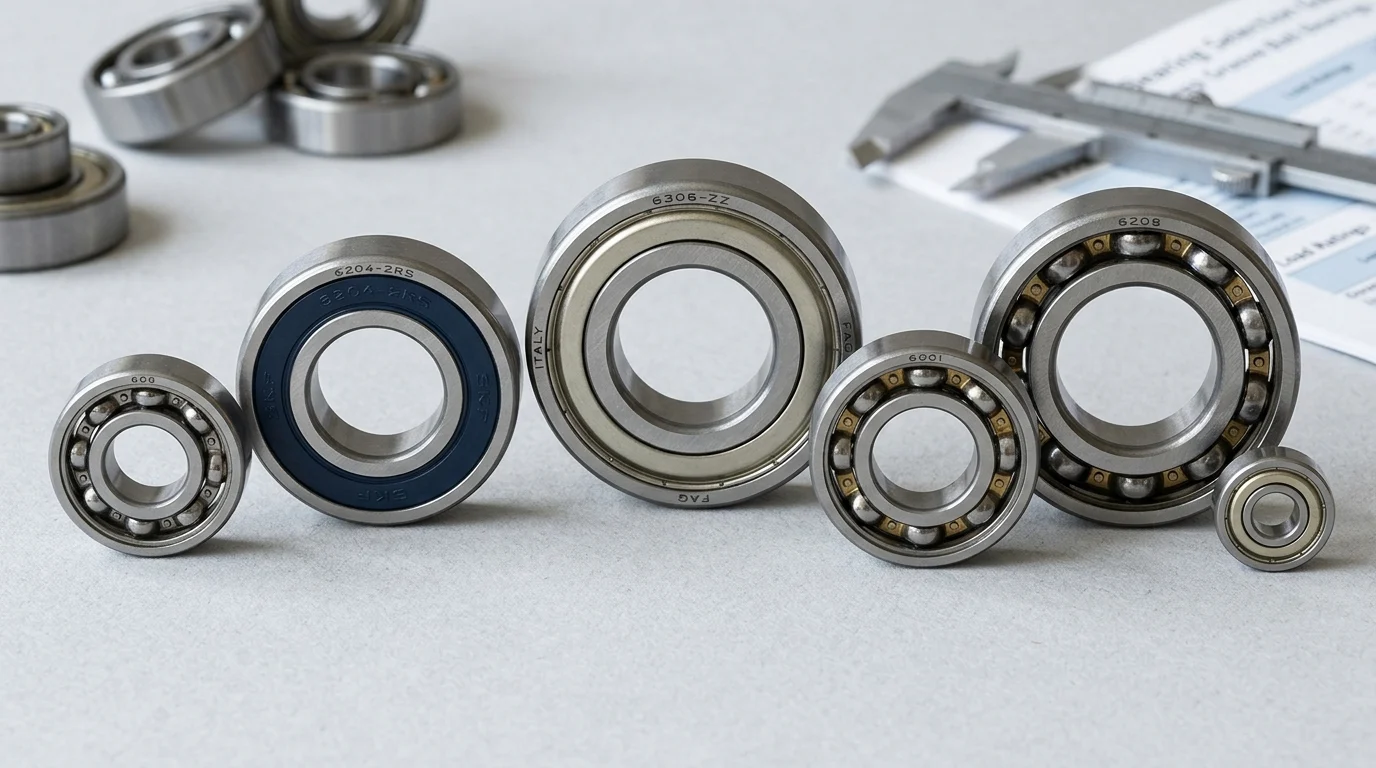
Selecting a deep groove ball bearing is not just a matter of matching shaft size or picking a familiar part number. The right choice affects load capacity, speed, lubrication performance, operating temperature, and ultimately machine uptime and maintenance cost. In industrial equipment, small differences in clearance, seal type, material, or precision grade can determine whether a bearing runs reliably for years or fails far too soon. This guide explains the key factors that matter in real applications, from load and speed requirements to environmental conditions and service life, so you can make a specification that supports dependable, cost-effective machine performance.
Why Deep Groove Ball Bearing Selection Matters
Deep groove ball bearings are the most ubiquitous rolling-element bearings in industrial machinery, prized for their versatility, low friction, and ability to accommodate both radial and axial loads. However, treating these critical components as generic commodities frequently leads to catastrophic mechanical failures. In high-demand environments such as pulp and paper mills, chemical processing plants, and automated assembly lines, precision in following a deep groove ball bearing selection guide is paramount.
Industry reliability studies indicate that rolling bearing failures account for roughly 40% to 50% of all electric motor breakdowns. Selecting the precise bearing variant—optimizing for internal geometry, material composition, and lubrication—is the foundational step in mitigating these risks and ensuring long-term mechanical stability.
Impact on uptime, maintenance, and total cost
The direct correlation between bearing selection and machine uptime cannot be overstated. When design engineers utilize the L10 life calculation to specify a bearing, matching the dynamic load rating to the application's true duty cycle can extend the Mean Time Between Failures (MTBF) from a baseline of 5,000 hours to well over 20,000 hours.
This extension drastically reduces maintenance intervals and labor expenditures. From a Total Cost of Ownership (TCO) perspective, investing in an optimized bearing specification minimizes secondary damage to shafts and housings, driving down aggregate operational costs despite potentially higher initial procurement expenses.
Risks of incorrect bearing selection
Conversely, improper bearing selection introduces severe operational hazards. Specifying a bearing with inadequate load capacity or incorrect clearance often initiates a cascade of failure modes, including subsurface fatigue spalling and catastrophic cage fracture.
Thermal runaway is a particularly acute risk. Operating a standard deep groove ball bearing just 15°C above its designated thermal equilibrium limit can degrade the elastohydrodynamic lubricant film, effectively halving the bearing's operational lifespan and precipitating unplanned downtime.
Key Technical Factors for Bearing Selection
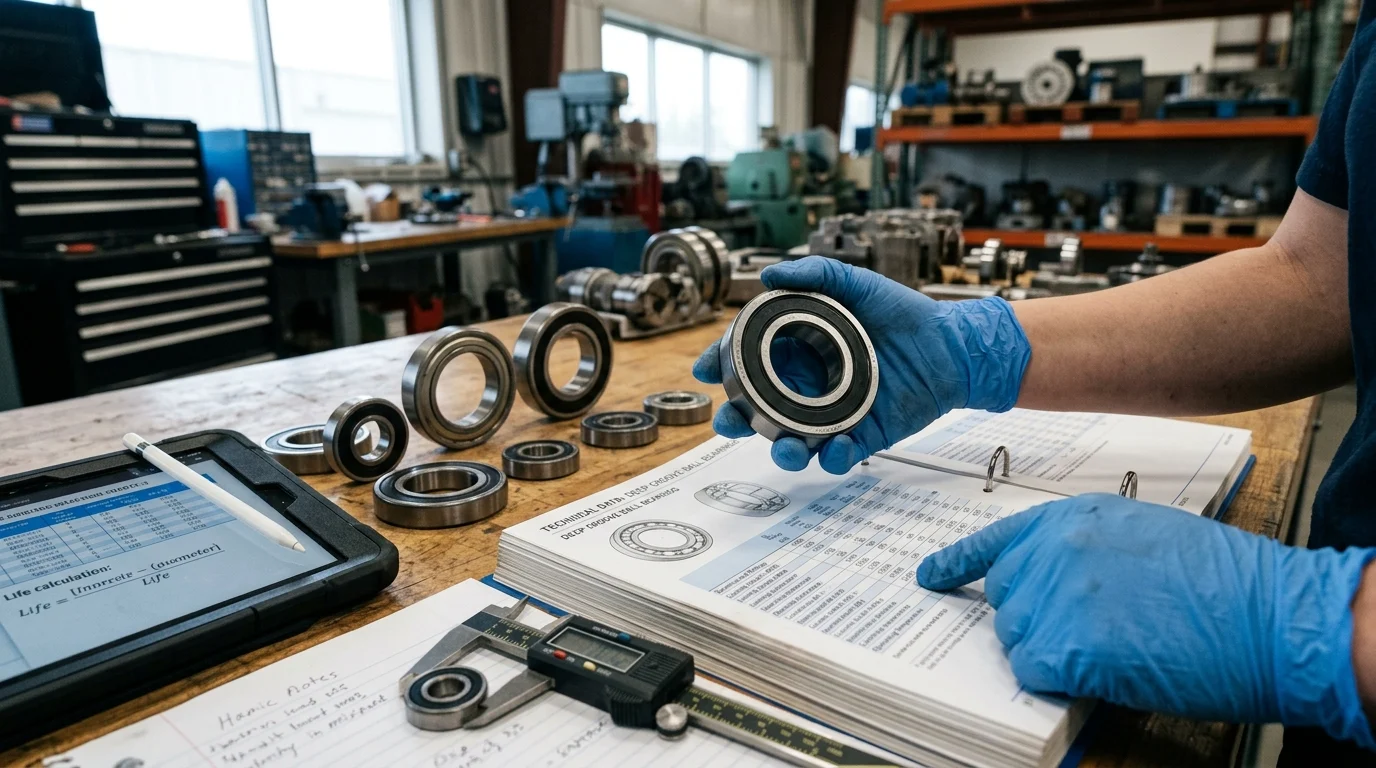
Successful integration of deep groove ball bearings requires a rigorous evaluation of the mechanical and environmental stresses present in the application. Engineers must synthesize multiple dynamic variables to establish the minimum performance thresholds required for the bearing.
Load, speed, temperature, vibration, and misalignment
The primary technical parameters involve dynamic load (C), static load (C0), and operational speed. Deep groove ball bearings excel in high-speed applications, often achieving Ndm factors (bore diameter in mm multiplied by speed in RPM) exceeding 500,000 when paired with appropriate cages and lubrication.
Temperature fluctuations dictate both metallurgical limits and lubrication viscosity requirements. Furthermore, while deep groove designs are highly adaptable, they possess strict limitations regarding shaft deflection and misalignment, typically tolerating only 2 to 10 arc minutes of angular misalignment before edge loading drastically reduces fatigue life.
Internal clearance, cage material, and sealing options
Internal radial clearance is a critical specification. Standard clearances (CN) are suitable for nominal conditions, but electric motors operating at elevated temperatures frequently require a C3 clearance (typically 13 to 28 µm of radial play for a 50mm bore) to accommodate thermal expansion of the inner ring.
Cage materials—ranging from stamped steel for general use to glass-fiber reinforced polyamide (PA66) for high speeds, or machined brass for heavy vibration—must be matched to the environment. Sealing options also dictate performance; while open bearings maximize speed, shielded (ZZ) or contact-sealed (2RS) variants provide necessary contaminant ingress protection.
Using comparison tables for selection
To streamline the engineering process, engineers frequently rely on comparison matrices to evaluate the trade-offs between different sealing and shielding configurations.
| Seal Type | Friction/Drag | Speed Limit Penalty | Contaminant Protection | Relubrication |
|---|---|---|---|---|
| Open (None) | Very Low | 0% (Baseline) | None | Required |
| Shielded (ZZ) | Low | ~5% to 10% | Moderate (Dust) | Sealed for life |
| Non-Contact Seal (LLB) | Low | ~10% to 15% | Good (Dust, light splash) | Sealed for life |
| Contact Seal (2RS) | High | ~30% to 40% | Excellent (Moisture, debris) | Sealed for life |
Utilizing such tables ensures that the selected bearing does not inadvertently restrict operational speeds while attempting to maximize environmental protection.
How to Compare Materials, Standards, and Suppliers
Beyond dimensional and geometric specifications, the metallurgical quality and the manufacturing precision of the bearing dictate its maximum performance ceiling. Navigating the global supply chain requires a strict methodology for evaluating materials, international standards, and vendor reliability.
Standard vs premium bearing differences
The baseline material for industrial deep groove ball bearings is SAE 52100 (100Cr6) high-carbon chromium steel. However, the difference between standard and premium bearings lies in the steel's purity.
Premium manufacturers utilize vacuum-degassed, ultra-clean steel that reduces non-metallic inclusions to below 10 parts per million (ppm). This reduction in microscopic stress concentrators can increase the rolling contact fatigue life by up to 40% compared to standard commercial-grade steel. For applications facing stray electrical currents, hybrid bearings utilizing silicon nitride (Si3N4) ceramic balls provide necessary electrical insulation and lower centrifugal mass.
ISO standards, traceability, and inspection data
Global standardization ensures interchangeability, but tolerance classes define precision. Engineers must align ISO 492 standard tolerance classes with their corresponding ABEC ratings to guarantee rotational accuracy.
| ISO 492 Class | ABEC Equivalent | Max Radial Runout (50mm bore) | Typical Application |
|---|---|---|---|
| Normal (P0) | ABEC 1 | 20 µm | General machinery, conveyors |
| Class 6 (P6) | ABEC 3 | 10 µm | Electric motors, standard pumps |
| Class 5 (P5) | ABEC 5 | 5 µm | Machine tool spindles, robotics |
| Class 4 (P4) | ABEC 7 | 4 µm | High-speed precision spindles |
Specifying a Class 5 / ABEC 5 bearing for a standard conveyor roller incurs unnecessary costs, whereas utilizing a Normal class bearing in a precision spindle will result in unacceptable vibration and rapid failure.
Supplier consistency, support, and quality control
Supplier evaluation is just as critical as the physical specification. Industrial buyers must audit suppliers for statistical process control, specifically looking at Process Capability Index (CPK) metrics.
While a CPK of 1.33 is often considered acceptable for standard commercial applications, critical industrial machinery demands a CPK of greater than 1.67. This threshold ensures a defect rate of less than 1 defect per million opportunities (DPMO), guaranteeing batch-to-batch consistency. Furthermore, full material traceability and access to factory inspection data are non-negotiable requirements for aerospace, medical, and heavy industrial applications.
Practical Steps to Build a Selection Process
Developing a repeatable selection process bridges the gap between theoretical engineering and practical procurement. A structured approach minimizes specification errors and optimizes lifecycle costs across the machinery fleet.
Step-by-step matching for application requirements
The selection process begins by defining the envelope dimensions (bore, outside diameter, and width). Next, engineers must calculate the equivalent dynamic bearing load using the formula P = X(Fr) + Y(Fa), combining radial and axial forces.
Following load calculations, the kinematic viscosity of the lubricant at operating temperature must be determined. Achieving a viscosity ratio (kappa, κ) greater than 1.0 is mandatory to ensure full elastohydrodynamic separation of the rolling elements, thereby preventing metal-to-metal contact and premature wear.
Balancing price, service life, and inventory strategy
Procurement teams must balance upfront component pricing against service life and inventory carrying costs. A premium deep groove ball bearing may carry a 300% price premium over a generic alternative.
However, if the generic bearing fails prematurely, the associated downtime and maintenance labor can easily exceed $5,000 per incident in heavy industrial settings. Additionally, buyers must consider inventory strategies; specifying custom clearances (like C4) or specialized high-temperature greases often subjects the buyer to Minimum Order Quantities (MOQs) of 500 to 1,000 units, necessitating strategic stock management.
Common specification and installation mistakes
Even the most rigorously specified bearing will fail if subjected to improper handling. Industry data reveals that installation errors account for approximately 16% of all premature bearing failures.
A common mistake is applying impact force directly to the outer ring when pressing the bearing onto a shaft, which immediately brinells the raceways. Furthermore, during thermal expansion fitting, heating a standard bearing above 120°C permanently alters the metallurgical structure of the steel, resulting in a severe loss of hardness and dimensional stability.
How to Finalize the Right Bearing Choice
The culmination of the bearing selection process requires a final technical review. This phase ensures that the shortlisted components align perfectly with the machine's operational targets and reliability mandates.
Shortlist criteria for final evaluation
When finalizing the shortlist, engineers must scrutinize the nuanced specifications that differentiate top-tier candidates. This includes reviewing the factory grease fill rates, which are highly application-dependent.
For high-speed electric motors, a grease fill of 25% to 35% of the internal free space is ideal to prevent churning and overheating. Conversely, low-speed, heavily loaded applications may require a 40% to 50% fill rate to ensure adequate lubricant supply over extended maintenance intervals.
Aligning recommendations with performance targets
The final step involves aligning the bearing choice with verifiable performance targets through prototyping and vibration analysis.
For standard industrial motors, the baseline vibration velocity of the newly installed bearing should register well under 2.8 mm/s RMS. By establishing these hard performance metrics during the validation phase, reliability teams can confirm that the selected deep groove ball bearing will meet its projected operational lifespan, thereby securing maximum return on investment for the machinery.
Key Takeaways
- The most important conclusions and rationale for deep groove ball bearing selection guide
- Specs, compliance, and risk checks worth validating before you commit
- Practical next steps and caveats readers can apply immediately
Frequently Asked Questions
When should I choose a C3 clearance deep groove ball bearing?
Use C3 when the inner ring runs hotter than the outer ring, such as in electric motors or high-speed service. It helps prevent preload from thermal expansion.
Which seal type is best for dusty or wet industrial machines?
Choose 2RS for moisture and heavy debris, LLB for dust or light splash, and ZZ for cleaner environments needing lower drag. Match sealing to contamination level and speed.
How do I decide between open, shielded, and sealed bearings?
Open suits clean, relubricated systems and highest speed. ZZ balances speed with basic dust protection. Sealed types reduce contamination risk and maintenance in harsh environments.
What operating conditions matter most when selecting a deep groove ball bearing?
Check radial and axial loads, RPM, temperature, vibration, and misalignment first. These factors determine needed clearance, cage material, lubrication, and whether deep groove bearings are suitable.
Can the wrong bearing choice really shorten machine life?
Yes. Incorrect load rating, clearance, or sealing can cause heat, lubricant failure, spalling, and cage damage. Proper selection helps extend uptime and reduce unplanned maintenance.