
Introduction
In agricultural equipment, bearing performance directly affects uptime, maintenance costs, and the ability to work through narrow planting and harvest windows. OEM bearings are designed for the specific loads, speeds, contamination exposure, and vibration levels found in tractors, combines, and implements, making them better suited to field conditions than generic alternatives. This article explains how that application-specific engineering improves reliability, reduces unplanned failures, and supports longer service life. It also shows why bearing selection matters not only for machine durability, but for productivity and total operating cost when every hour of downtime carries real financial consequences.
Why OEM Bearings Matter for Reliability in Agricultural Machinery
Agricultural machinery operates in some of the most unforgiving environments, requiring mechanical components that can withstand extreme dynamic forces and severe contamination. At the core of this mechanical resilience are OEM bearings, which serve as the critical interface between moving parts in tractors, combines, and implements. Unlike standard industrial bearings designed for controlled indoor environments, bearings specified for agricultural equipment must tolerate heavy vibrations, variable loads, and corrosive elements.
The financial implications of bearing failure in this sector are severe. Unexpected downtime during peak harvest windows can cost operators between $800 and $1,200 per hour in lost yield and idle labor. Consequently, specifying the correct OEM components is not merely an engineering preference, but a fundamental requirement for ensuring equipment reliability and protecting the end-user's profitability.
Uptime, Seasonal Productivity, and Total Cost
The agricultural sector is defined by narrow, weather-dependent operational windows. During planting and harvesting seasons, equipment must operate continuously, often running 18 to 24 hours a day. In these high-stakes scenarios, uptime is the primary metric for mechanical success.
A single bearing failure on a combine harvester's rotor or a planter's disc hub can halt operations entirely, jeopardizing the season's yield. By utilizing OEM bearings engineered specifically for the machine's unique load profile, manufacturers drastically reduce the probability of catastrophic mid-season failures, thereby optimizing seasonal productivity and lowering the total cost of ownership.
Operating Conditions That Demand OEM Performance
The operating conditions of agricultural machinery are characterized by high levels of particulate contamination, moisture, and variable shock loads. Tillage equipment drags through abrasive soils, while balers process dense, dusty organic matter under high compression.
Standard off-the-shelf bearings quickly succumb to these environments as abrasive particles breach standard seals, degrading the lubricant and scoring the raceways. OEM bearings mitigate these risks through application-specific engineering, featuring specialized sealing arrangements and metallurgical enhancements designed to endure the precise rotational speeds, axial loads, and environmental hazards unique to each operational zone.
What Defines OEM Bearings in Agricultural Machinery Applications
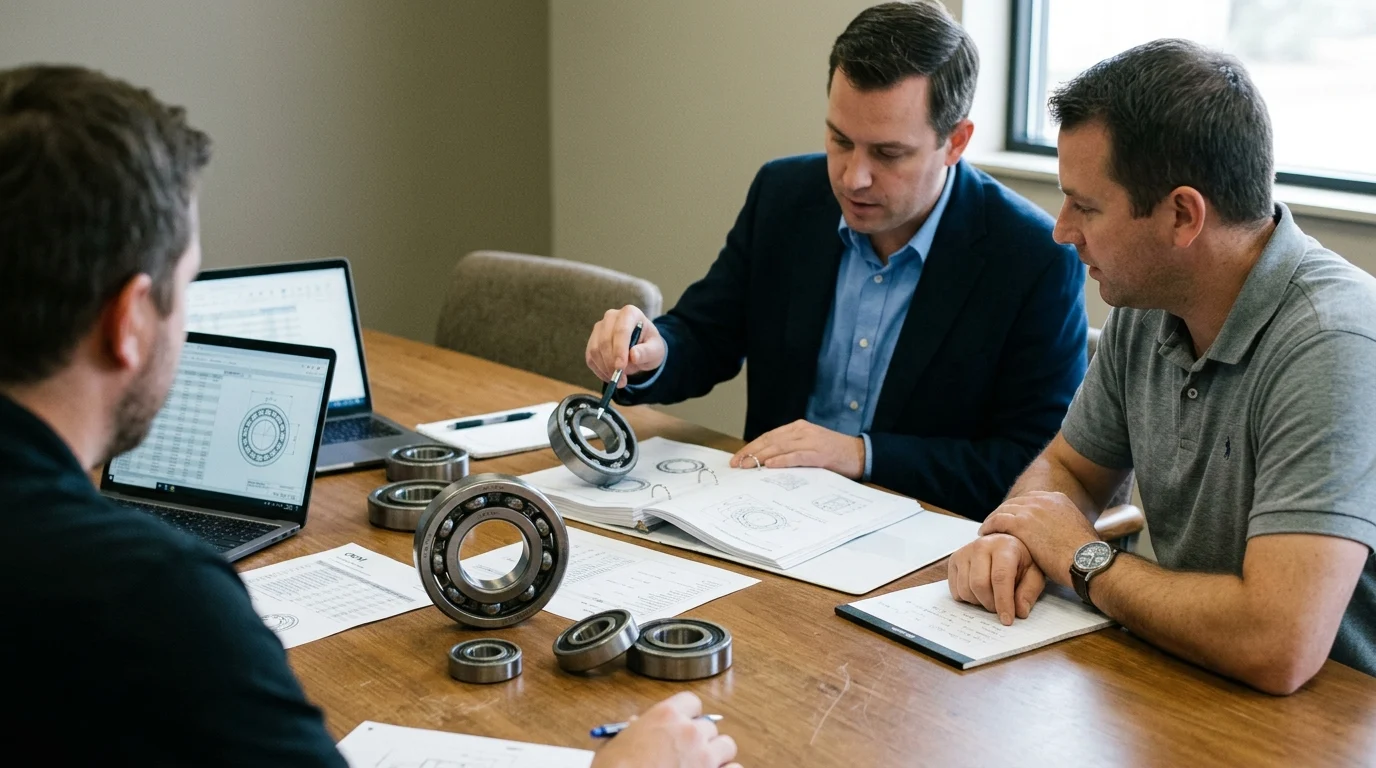
Defining OEM bearings in the context of agricultural machinery requires examining the precise engineering specifications dictated by the equipment manufacturer. These are not generic catalog components; they are custom-engineered or highly modified bearings designed to meet the exact performance criteria of a specific machine.
This level of customization involves tight control over dimensional tolerances and internal clearances, such as C3 or C4 designations, which are critical for accommodating thermal expansion and shaft deflection under heavy, continuous agricultural loads.
OEM vs Aftermarket Bearings
The distinction between OEM and aftermarket bearings lies primarily in the rigor of specification and quality control. While aftermarket bearings may match the basic boundary dimensions such as bore, outer diameter, and width, they frequently lack the proprietary internal geometries and advanced sealing technologies required for agricultural reliability.
| Feature | OEM Agricultural Bearings | Standard Aftermarket Bearings |
|---|---|---|
| Dimensional Tolerance | ABEC 3 or higher | Often ABEC 1 |
| Internal Clearance | Application-specific (e.g., C3/C4) | Standard (CN) |
| Seal Design | Triple-lip nitrile or labyrinth | Single or double-lip standard |
| Grease Fill | 30% to 40% specialized polyurea | 20% to 25% standard lithium |
| Expected Lifecycle | 3,000+ hours in severe conditions | Variable, often < 1,000 hours |
Bearing Types and Machine Positions That Affect Reliability
Different machine positions require distinct bearing architectures to maintain system reliability. Deep groove ball bearings are frequently utilized in idler pulleys and gauge wheels due to their high-speed capabilities and moderate load capacities.
Conversely, tapered roller bearings are essential for wheel hubs and gearbox output shafts, where they must manage combined radial and axial loads that can easily exceed 50 kN in heavy tractors. Spherical roller bearings are heavily deployed in combine rotors and articulation joints, providing crucial misalignment capabilities to compensate for the flexing of heavy equipment frames over uneven terrain.
Key Specification Differences That Influence Performance
The performance of OEM bearings is heavily influenced by nuanced specification differences that extend beyond basic load ratings. Sealing technology is paramount; OEM specifications often mandate multi-lip seals with heavy-duty steel trash guards to prevent crop wrap and aggressive soil ingress.
Furthermore, the lubrication strategy is custom-tailored to the application. OEM bearings frequently utilize premium, water-resistant polyurea or calcium-sulfonate complex greases. The fill volumes are precisely calculated, often strictly controlled between 30% and 40% of the free internal space, ensuring adequate lubrication without causing excessive thermal buildup from grease churning during high-speed transport.
How OEM Bearings Improve Reliability in Real Operating Conditions
The theoretical advantages of OEM bearings must translate into measurable reliability improvements in the field. When agricultural machinery is deployed, the bearings are immediately subjected to a barrage of environmental and mechanical stresses.
The superior design of OEM components directly counteracts these forces, preserving rotational efficiency, maintaining shaft alignment, and preventing premature system degradation across thousands of acres of operation.
Resistance to Dust, Mud, Moisture, and Shock Loads
Agricultural equipment operates in a constant state of exposure to abrasive dust, viscous mud, and heavy precipitation. OEM bearings combat these elements through advanced sealing materials, such as heavy-duty nitrile butadiene rubber (NBR) or fluoroelastomers, which maintain their integrity and flexibility across a broad temperature range of -20°C to 120°C.
Additionally, the ability to absorb shock loads from subterranean rocks and uneven terrain is enhanced by superior steel purity and optimized raceway profiles. These refinements distribute mechanical stress more evenly across the rolling elements, preventing localized plastic deformation and subsequent micro-cracking.
Design and Specification Factors That Improve Performance
Several specific design factors elevate the performance of OEM bearings above standard alternatives. Cage design is a critical factor; while standard bearings often rely on stamped steel cages, OEM agricultural bearings frequently employ glass-fiber reinforced polyamide cages.
These composite cages offer excellent elasticity, allowing them to absorb heavy structural vibrations without fracturing. They also provide self-lubricating properties in the event of marginal lubrication. Furthermore, the micro-geometry of the raceways is often honed to specific surface finish parameters, reducing internal friction and extending the fatigue life of the bearing under high-stress conditions.
Common Failure Modes Reduced by OEM Bearings
By addressing the root causes of mechanical degradation, OEM bearings significantly reduce common failure modes that plague agricultural machinery. Contamination-induced wear, which leads to abrasive spalling and eventual seizure, is dramatically curtailed by the superior multi-lip sealing arrangements.
False brinelling, a type of wear caused by vibration while the equipment is stationary during transport or off-season storage, is mitigated through optimized internal clearances and premium grease formulations that maintain a protective hydrodynamic film on the raceways. Field data indicates that specifying OEM bearings can reduce premature failure rates by up to 40% in high-contamination zones compared to standard industrial alternatives.
How to Evaluate OEM Bearings for Agricultural Equipment
Selecting the appropriate OEM bearings requires a rigorous evaluation process that balances complex engineering requirements with supply chain realities. Equipment manufacturers must look beyond basic catalog specifications to ensure the chosen components will deliver the necessary reliability.
This comprehensive evaluation encompasses aggressive laboratory testing, total cost of ownership analysis, and stringent supplier audits to guarantee consistent production quality.
Procurement and Engineering Evaluation Steps
The engineering evaluation of OEM bearings involves extensive laboratory and field testing protocols. Procurement teams and engineers collaborate to subject prototype bearings to accelerated life testing designed to mimic years of field abuse in a matter of weeks.
This evaluation often includes highly abrasive mud slurry tests lasting 500 hours or more, specifically designed to evaluate seal efficacy under continuous exposure to corrosive media. Dynamic load testing is simultaneously conducted to verify that the bearing can withstand the specific torque and radial forces generated by the agricultural implement without exceeding acceptable thermal limits.
Unit Price vs Lifecycle Cost
While OEM bearings typically command a higher initial purchase price, their total lifecycle cost is significantly lower when factoring in reliability, maintenance reduction, and operational uptime.
| Cost Factor | OEM Bearing Strategy | Standard Aftermarket Strategy |
|---|---|---|
| Initial Unit Price | $45.00 | $15.00 |
| Expected Replacements (5 Years) | 0 | 3 |
| Labor Cost per Replacement | $0.00 | $120.00 |
| Estimated Downtime Penalty | $0.00 | $1,000.00 |
| Total 5-Year Lifecycle Cost | $45.00 | $1,375.00 |
This cost analysis demonstrates that the upfront premium paid for OEM components is rapidly offset by the avoidance of labor-intensive replacements and catastrophic downtime during critical harvesting windows.
Quality, Compliance, and Supply Considerations
Evaluating an OEM bearing supplier requires a thorough assessment of their quality management systems and supply chain reliability. Suppliers must typically demonstrate strict compliance with international quality standards such as ISO 9001 or IATF 16949 to ensure lot-to-lot consistency.
Furthermore, procurement teams must align with the supplier's production capabilities. Minimum order quantities (MOQs) for custom-engineered agricultural bearings typically range from 1,000 to 5,000 units, depending on the bearing's size and tooling complexity. Factoring in lead times, which frequently span 12 to 16 weeks for specialized production runs, is critical for maintaining uninterrupted assembly line operations and meeting seasonal manufacturing deadlines.
Decision Framework for Choosing OEM Bearings
Establishing a robust decision framework is essential for consistently selecting OEM bearings that enhance agricultural machinery reliability. This framework must integrate technical specifications, environmental considerations, and long-term strategic goals to ensure that every bearing chosen contributes to the overall durability of the equipment.
A common baseline metric in modern agricultural engineering is targeting a mean time between failures (MTBF) of at least 3,000 operating hours for critical rotating components, requiring a highly systematic approach to bearing selection.
Specification and Sourcing Criteria
The primary sourcing criteria must center on matching the bearing's dynamic load rating (C) and static load rating (C0) to the empirical data gathered from the machine's actual field operation. Engineers must define the exact boundary conditions, including maximum operational speeds, expected misalignment limits, and specific chemical exposures like fertilizers or pesticides.
Sourcing decisions should then prioritize manufacturing partners who possess the engineering capability to custom-tailor sealing and lubrication packages to these exact specifications, rather than relying on standard catalog offerings that only approximate the heavy-duty requirements of the agricultural sector.
Connecting Bearing Choice to Long-Term Reliability
Ultimately, the rigorous selection of OEM bearings is a direct investment in the long-term reliability and market reputation of the agricultural machinery brand. Bearings are foundational components; their failure often precipitates severe secondary damage to shafts, housings, and adjacent gearings.
By adhering to a strict OEM specification process, equipment manufacturers effectively purchase an insurance policy against premature warranty claims and customer dissatisfaction. High-quality OEM bearings ensure that the machinery consistently performs under the severe, unpredictable conditions of modern agriculture, thereby securing both the end-user's seasonal productivity and the manufacturer's long-term competitive advantage.
Key Takeaways
- The most important conclusions and rationale for OEM Bearings
- Specs, compliance, and risk checks worth validating before you commit
- Practical next steps and caveats readers can apply immediately
Frequently Asked Questions
Why are OEM bearings better for agricultural machinery?
They are built for dust, moisture, shock loads, and long duty cycles. Their seals, grease, and internal clearances are matched to the machine, helping reduce breakdowns during planting and harvest.
How do OEM bearings differ from aftermarket bearings?
OEM bearings may share dimensions with aftermarket parts, but they often use tighter tolerances, application-specific C3/C4 clearances, better seals, and specialized grease for longer service life.
Which farm equipment positions need OEM bearings most?
High-risk positions include combine rotors, planter disc hubs, wheel hubs, gearbox output shafts, idler pulleys, and articulation joints where contamination, heavy loads, or misalignment are common.
Can OEM bearings lower total operating costs?
Yes. They help prevent in-season failures, reduce emergency repairs, and minimize downtime that can cost hundreds of dollars per hour during narrow planting or harvest windows.
What should I check when selecting an OEM bearing?
Confirm bore and outer diameter, load type, speed, internal clearance, seal design, grease type, and operating environment. Matching the exact machine position is critical for reliability.