
Introduction
Choosing between deep groove ball bearings and self-aligning bearings is less about which design is universally better and more about which operating problem you need to solve. Deep groove ball bearings favor high speed, compactness, and combined radial and moderate axial loads, but they depend on accurate shaft and housing alignment. Self-aligning bearings trade some rigidity and load behavior for the ability to tolerate shaft deflection and mounting errors. This comparison explains how their internal geometry affects load capacity, misalignment tolerance, speed limits, and maintenance demands, so you can match the bearing type to real machine conditions rather than relying on broad rules of thumb.
Deep Groove Ball Bearing vs Self-Aligning Bearing Overview
Selecting the optimal bearing architecture is critical for rotary equipment reliability and structural design. The choice between deep groove ball bearings (DGBBs) and self-aligning ball bearings (SABBs) fundamentally dictates the mechanical limits of a system, influencing everything from shaft rigidity requirements to maintenance intervals. While both utilize rolling spherical elements to minimize friction, their internal geometries are engineered to solve entirely different kinematic challenges.
Key differences in design and function
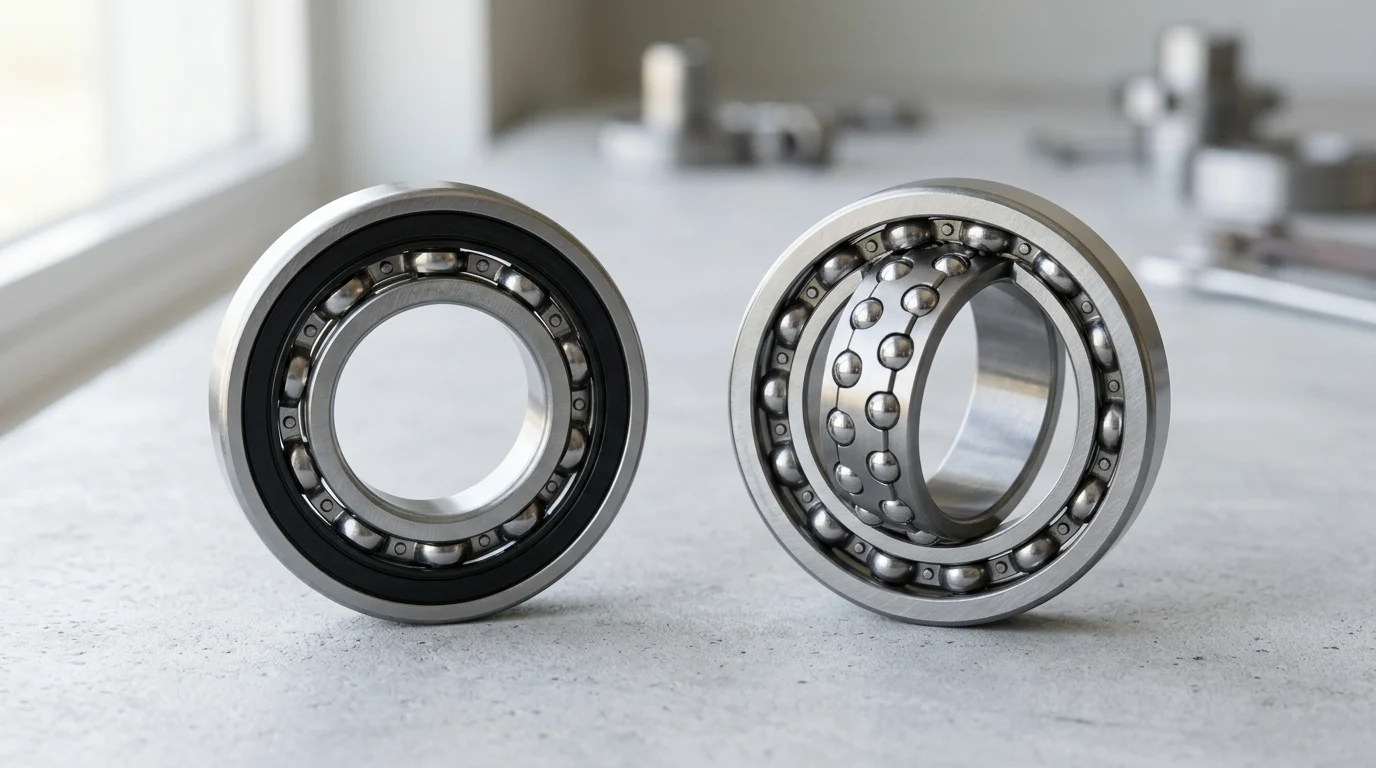
Deep groove ball bearings feature a single row of balls with raceways that closely match the ball diameter. This tight conformity, typically exhibiting an osculation ratio between 0.51 and 0.53, allows them to support significant radial loads alongside moderate axial loads in both directions. The rigid nature of this design provides excellent shaft support but demands precise alignment.
Conversely, self-aligning ball bearings incorporate two rows of balls and a common sphered outer ring raceway. This geometric departure allows the inner ring and ball assembly to pivot independently of the outer ring. Consequently, while standard DGBBs can only tolerate angular misalignments of 2 to 10 minutes of arc before internal stresses spike, SABBs routinely accommodate dynamic misalignments ranging from 1.5° to 3° without degrading performance.
How bearing choice affects uptime and maintenance
The architectural differences directly impact equipment uptime and total cost of ownership. In rigid systems, deep groove ball bearings offer exceptional longevity due to their continuous, uninterrupted raceway contact. However, if thermal expansion, mounting errors, or shaft deflection introduces misalignment exceeding 0.1°, DGBBs suffer from severe edge loading. This edge loading can easily reduce the L10 bearing fatigue life by up to 50% and accelerate lubricant degradation.
Self-aligning bearings mitigate these stress concentrations entirely in flexible or poorly aligned assemblies. By allowing the rolling elements to track naturally despite shaft bending, SABBs preserve hydrodynamic film thickness and prevent the localized heat generation that typically leads to catastrophic failure. This self-correcting capability extends maintenance intervals and reduces replacement frequency in less rigid structural frameworks.
Performance and Application Comparison
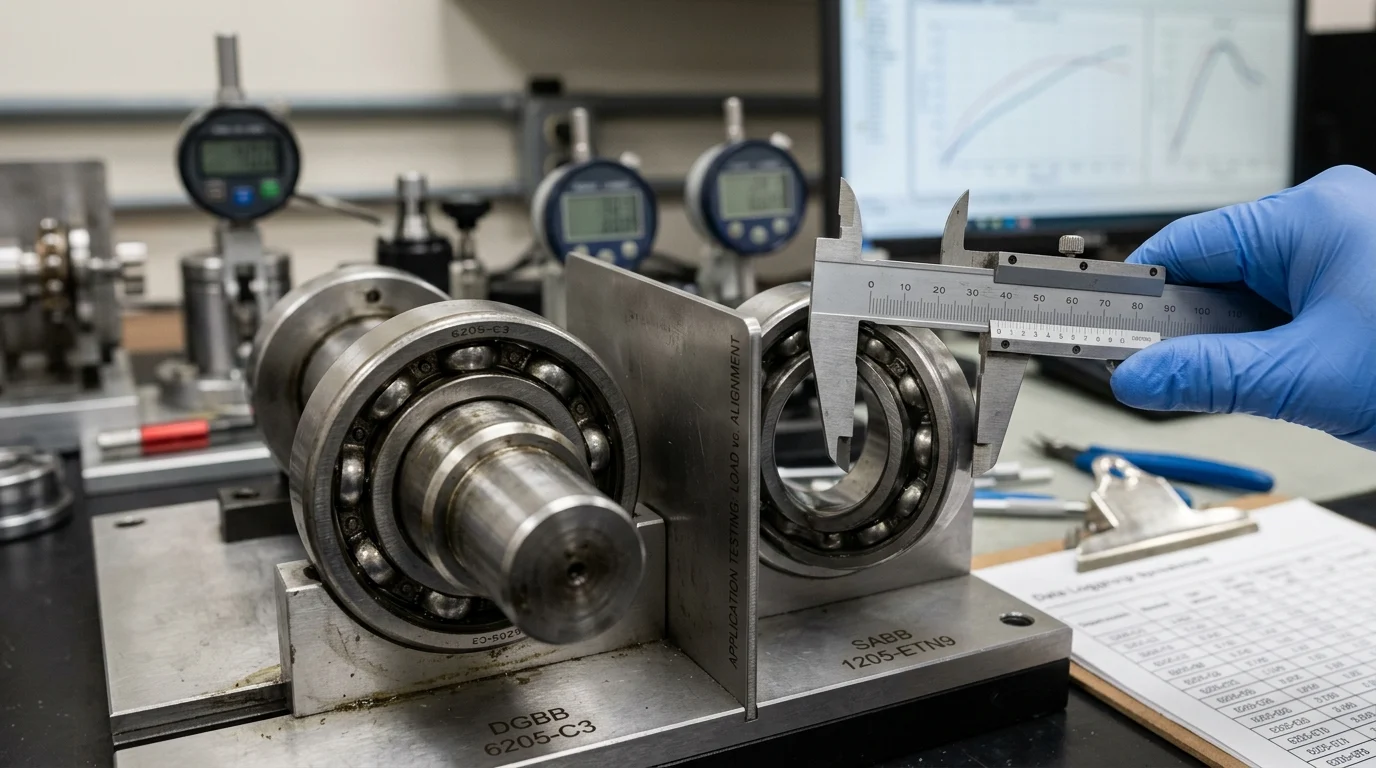
Evaluating performance requires a comparative analysis of load ratings, kinematic limits, and tribological behavior. Engineers must balance the high-speed, rigid characteristics of deep groove designs against the forgiving, low-friction nature of self-aligning variants to optimize system efficiency.
Load, speed, friction, and noise differences
Due to their tight raceway conformity, deep groove ball bearings possess an inherently higher dynamic load capacity ($C$) for a given boundary dimension compared to self-aligning bearings. However, self-aligning bearings generate less internal friction at high speeds because the balls maintain a point contact with the sphered outer raceway, rather than the elongated elliptical contact seen in deep grooves under heavy load.
Noise generation is generally lower in precision DGBBs, which can achieve rotational limits exceeding 100,000 RPM in miniature and machine tool spindle applications. SABBs are typically restricted to lower maximum speeds due to the mass of the dual-row cage and the complex kinematics of the pivoting elements.
| Metric | Deep Groove Ball Bearings | Self-Aligning Ball Bearings |
|---|---|---|
| Angular Misalignment Tolerance | 0.03° to 0.16° (2 to 10 arc minutes) | 1.5° to 3.0° |
| Radial Load Capacity | High | Moderate |
| Axial Load Capacity | Moderate (up to 50% of $C_0$) | Low (typically < 20% of $C_0$) |
| Friction Coefficient | 0.0015 (Standard) | 0.0010 (Very Low) |
| High-Speed Suitability | Excellent | Good (Cage limited) |
When deep groove ball bearings are the better choice
Deep groove ball bearings are the definitive choice for applications characterized by high rigidity, precision machining, and combined loading. Electric motors, automotive gearboxes, and centrifugal pumps rely on DGBBs to maintain strict rotor positioning and minimize vibration.
They are exceptionally well-suited for scenarios where axial loads are present. A standard deep groove bearing can safely accommodate axial forces up to 50% of its static radial load rating ($C_0$) without catastrophic failure, making it highly versatile for fixed-end bearing arrangements where thrust forces cannot be entirely eliminated.
When self-aligning bearings are the better choice
Self-aligning bearings become the superior technical choice when structural rigidity is difficult, impractical, or economically prohibitive to achieve. Agricultural machinery, long conveyor rollers, and textile plant shafting frequently experience operational deflection under load that exceeds 0.002 radians.
In these unyielding environments, rigid bearings would bind, overheat, and fail prematurely. SABBs are also highly effective in plummer block housings mounted on fabricated steel frames, where achieving perfect concentricity across multiple independent bearing stations is practically impossible.
Selection Factors for Engineers and Buyers
Beyond pure kinematic performance, procurement specialists and mechanical engineers must evaluate the commercial and manufacturing implications of their bearing selections. Housing tolerances, supply chain availability, and compliance metrics heavily influence the final unit cost and scalability of the assembly.
Housing accuracy, misalignment, and installation quality
The selection between these two bearing types drastically alters the required precision of surrounding components. Deep groove ball bearings demand stringent housing and shaft tolerances, typically requiring IT5 to IT7 machining grades to prevent parasitic preloads and ensure absolute coaxiality.
Self-aligning bearings are far more forgiving. Because they internally compensate for angular deviations, manufacturers can often relax housing tolerances to IT8 or IT9 grades. This reduction in machining precision can significantly lower the manufacturing costs of large structural frames, weldments, and long drive shafts by eliminating the need for secondary line-boring operations.
Cost, availability, and replacement standardization
From a procurement perspective, deep groove ball bearings are the most commoditized rolling element bearings globally. Standard series (such as the 6200 or 6300 lines) benefit from massive economies of scale. Buyers can expect standard unit costs to be highly competitive, though custom lubrication or sealing requests may require Minimum Order Quantities (MOQs) starting at 10,000 to 25,000 units.
Conversely, self-aligning bearings (such as the 1200 or 2200 series) command a price premium of 20% to 40% over equivalent-sized DGBBs due to their complex dual-row assembly. Furthermore, specialized SABBs with tapered bores (for adapter sleeves) or specific polyamide cages frequently experience lead times of 6 to 8 weeks, necessitating tighter inventory management.
| Procurement & Manufacturing Factor | Deep Groove Ball Bearings | Self-Aligning Ball Bearings |
|---|---|---|
| Required Machining Tolerance | IT5 to IT7 (High precision) | IT8 to IT9 (Moderate precision) |
| Relative Cost Index | Baseline (1.0x) | Premium (1.2x to 1.4x) |
| Standard MOQ (Custom Variants) | 10,000+ units | 1,000 – 5,000 units |
| Global Availability | Ubiquitous (Off-the-shelf) | High, but specialized variants take 6-8 weeks |
Specifications, materials, and compliance checks
Regardless of the chosen architecture, strict compliance and material specification checks are mandatory for industrial applications. Both bearing types are predominantly manufactured from 52100 (100Cr6) high-carbon bearing steel, which must be verified against ISO 683-17 metallurgical standards to ensure adequate fatigue resistance.
Buyers must ensure dimensional compliance with ISO 15 for boundary dimensions to guarantee global interchangeability. Additionally, specifying the correct ABEC (Annular Bearing Engineering Committee) or ISO P-class precision rating—ranging from ABEC 1 (ISO P0) for standard industrial use to ABEC 9 (ISO P2) for ultra-precision applications—is critical. For global distribution, all applied lubricants, elastomer seals, and polymeric cage materials must carry verifiable RoHS and REACH certifications.
Decision Guide
Finalizing a bearing specification requires translating qualitative operational conditions into strict quantitative thresholds. Engineers must execute a sequential validation process to ensure the selected bearing architecture aligns precisely with the mechanical and environmental realities of the application.
Step-by-step bearing selection process
The first phase of the selection process requires calculating the equivalent dynamic bearing load ($P$) and comparing it against the basic dynamic load rating ($C$) of candidate bearings to achieve the target $L_{10}$ fatigue life. Once baseline load requirements are established, engineers must quantify expected shaft deflection and mounting inaccuracies. If the combined angular misalignment is calculated to exceed 0.16° (approximately 10 minutes of arc), deep groove ball bearings must be eliminated from consideration unless expensive redesigns to increase shaft rigidity are implemented.
The second phase involves evaluating axial loads and environmental constraints. If the application requires supporting axial forces that exceed 20% of the applied radial load, the shallow outer ring raceway of a self-aligning bearing will likely suffer from edge truncation and rapid failure; a deep groove ball bearing or a spherical roller bearing must be utilized instead.
Finally, engineers must specify the internal radial clearance classes (such as C3 or C4 for high-temperature operations) and select appropriate lubrication. Standard lithium-complex greases are typically rated for operating thresholds between -20°C and 120°C. However, applications pushing the 100,000 RPM speed limits of precision deep groove bearings or testing the 3° misalignment limits of self-aligning bearings will necessitate advanced synthetic lubricants to prevent thermal runaway and premature wear.
Key Takeaways
- The most important conclusions and rationale for deep groove ball bearing vs self-aligning bearing
- Specs, compliance, and risk checks worth validating before you commit
- Practical next steps and caveats readers can apply immediately
Frequently Asked Questions
When should I choose a deep groove ball bearing?
Use a deep groove ball bearing in rigid, well-aligned machines that need high speed, low noise, and moderate axial load capacity, such as electric motors, pumps, and gearboxes.
When is a self-aligning bearing the better option?
Choose a self-aligning bearing when shaft deflection, housing errors, or thermal growth may cause misalignment. It suits flexible assemblies where keeping uptime matters more than maximum speed or thrust capacity.
How much misalignment can each bearing type handle?
Deep groove ball bearings typically tolerate only about 0.03° to 0.16°. Self-aligning bearings can usually handle about 1.5° to 3°, making them far more forgiving in imperfect installations.
Which bearing is better for axial loads?
Deep groove ball bearings are better for axial loads. They can handle moderate thrust in both directions, while self-aligning ball bearings are mainly for radial loads and only light axial force.
Does misalignment really shorten deep groove bearing life?
Yes. If misalignment exceeds about 0.1°, deep groove bearings can develop edge loading, extra heat, and faster lubricant breakdown, which may cut fatigue life significantly and increase replacement frequency.