
Introduction
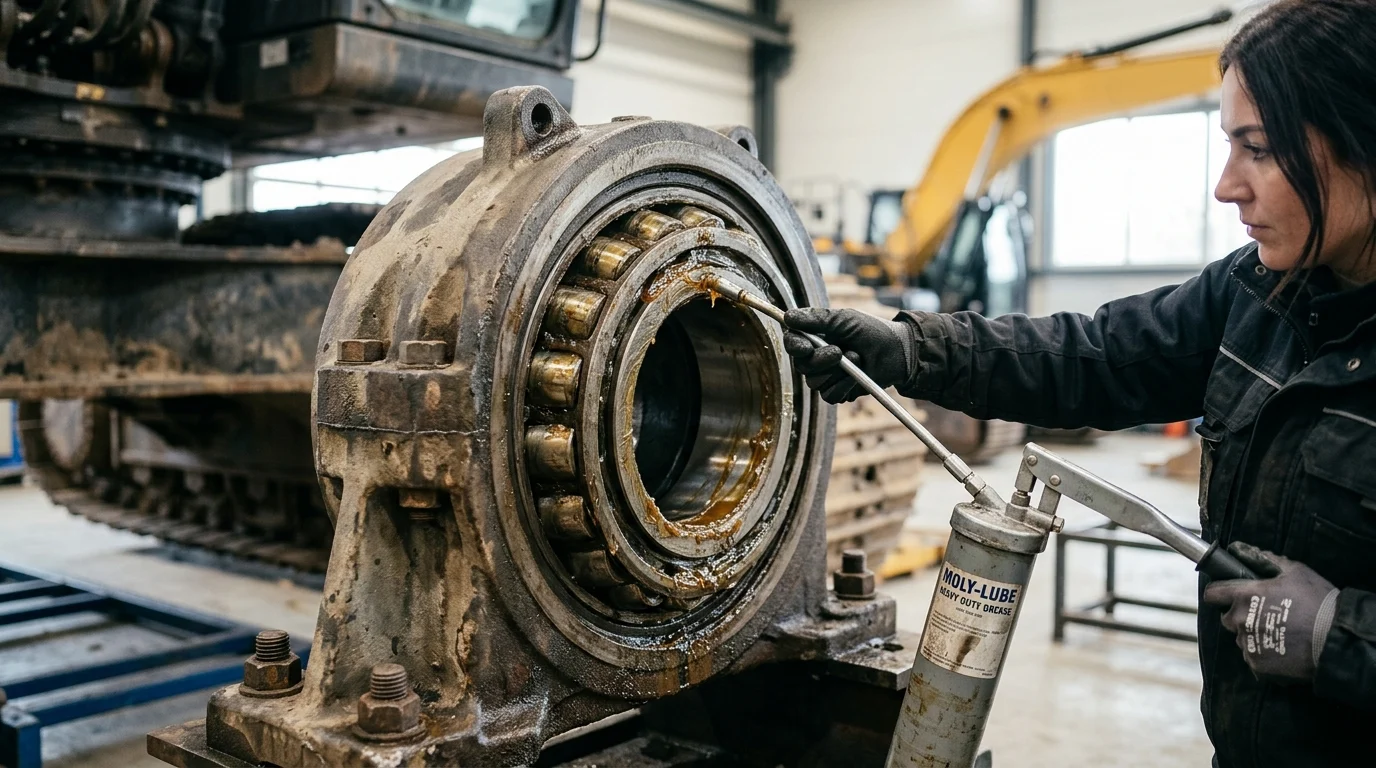
Keeping bearings alive in heavy machinery depends on more than adding grease on schedule. Lubrication must maintain a thin protective film under high loads, contamination, vibration, and heat—conditions common in mining, construction, and agriculture. When that film breaks down, friction rises quickly, temperatures climb, and bearing damage can follow long before other components show problems. This guide explains the basics beginners need to understand: why lubrication matters, how poor practices lead to early failure, and what operating conditions should shape lubricant choice, application method, and service intervals. From there, the article moves into the practical decisions that improve uptime and reduce avoidable wear.
Why Bearing Lubrication Matters for Heavy Machinery Uptime
Heavy machinery relies on rolling element bearings to transmit extreme loads while minimizing friction. The fundamental purpose of bearing lubrication is to establish a microscopic elastohydrodynamic film—often measuring between 0.1 and 1.0 microns thick—that physically separates the rolling elements from the raceways under intense pressure.
How Poor Lubrication Increases Bearing Failures
Industry data consistently indicates that improper lubrication accounts for approximately 36% to 50% of all premature bearing failures in industrial applications. When the lubricant film collapses, the resulting metal-to-metal contact accelerates adhesive wear and localized micro-spalling. If unaddressed, this friction generates excessive heat, frequently pushing bearing temperatures beyond the critical 100°C threshold. Operating above this thermal limit rapidly degrades the lubricant's base oil and depletes anti-wear additives. This creates a cascading effect that culminates in catastrophic metallurgical failure and costly unplanned downtime.
Operating Conditions in Mining, Construction, and Agriculture
Mobile and stationary equipment in mining, construction, and agriculture operate in highly unforgiving environments that stress lubricants to their limits. In mining applications, assets like crushers and conveyors face extreme particulate contamination and continuous shock loads, demanding high-viscosity base oils to maintain film strength. Agricultural machinery frequently operates in high-moisture environments, requiring greases with stringent water washout resistance—typically yielding less than a 5% loss per ASTM D1264 standards. Meanwhile, construction equipment, such as hydraulic excavators, often endures severe temperature fluctuations ranging from -30°C in winter climates to internal operating temperatures exceeding 120°C. These extreme gradients necessitate lubricants with a high viscosity index to ensure the oil film neither thickens to a solid at startup nor thins out dangerously at peak operating temperatures.
Bearing Lubrication Basics for Heavy Machinery
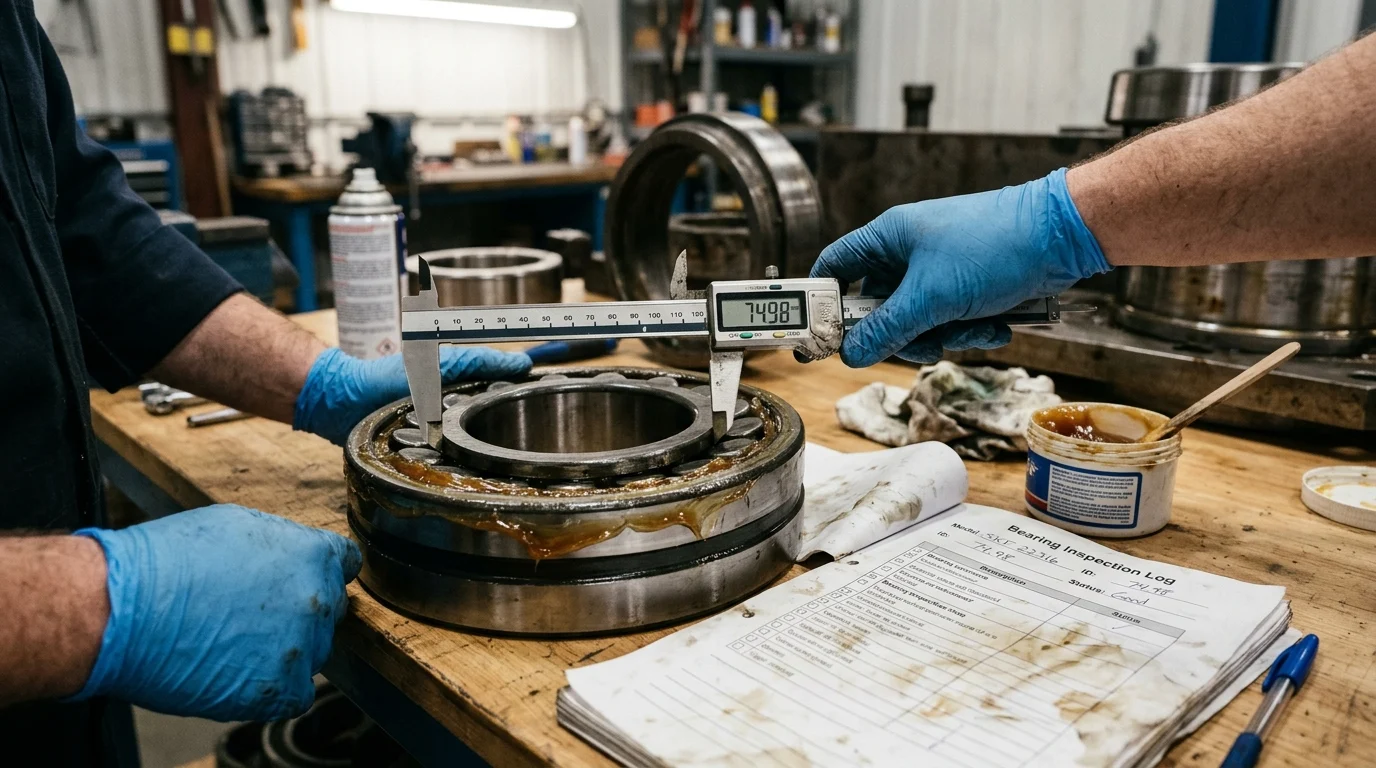
A robust understanding of lubrication fundamentals is essential for specifying the correct medium for heavy-duty bearings. All industrial lubricants consist of a base oil—which performs the actual hydrodynamic separation of metal surfaces—and an additive package that enhances properties like oxidation resistance and anti-wear capabilities. For grease, a thickener is added to hold the base oil in suspension, acting much like a sponge holding water.
Key Lubrication Terms and Concepts
Kinematic viscosity is the most critical property of any fluid lubricant. It is typically measured in centistokes (cSt) at 40°C and classified by ISO Viscosity Grades (ISO VG). Heavy machinery generally utilizes ISO VG 150 to 460 for heavily loaded bearings operating at moderate speeds. Another vital metric for grease is the National Lubricating Grease Institute (NLGI) consistency number, where NLGI Grade 2 serves as the industry standard for multipurpose heavy equipment applications. Additionally, the dropping point indicates the temperature at which the grease's thickener structure breaks down and releases the base oil. For reliable operation, this dropping point should exceed the bearing's maximum operating temperature by at least 50°C.
When to Use Grease vs Oil
The engineering choice between grease and oil is largely dictated by the bearing's speed factor (NDm), calculated by multiplying the bearing's pitch diameter (in millimeters) by its rotational speed (in RPM). Grease is generally preferred for applications with a speed factor below 500,000 NDm, as it provides an effective barrier against external contaminants and requires less complex sealing arrangements. Conversely, circulating oil systems become structurally necessary when the NDm exceeds the 500,000 threshold, or when the system must actively dissipate friction-generated heat away from the bearing housing.
Grease and Oil Comparison
To facilitate the selection process, the following comparison highlights the operational trade-offs between grease and oil in heavy machinery applications.
| Feature | Grease Lubrication | Oil Lubrication (Circulating/Bath) |
|---|---|---|
| Speed Limit (NDm) | Up to 500,000 | > 500,000 (often up to 1,000,000+) |
| Cooling Capacity | Poor; retains internal heat | Excellent; actively removes heat |
| Contamination Sealing | Excellent; acts as a physical barrier | Requires complex, high-quality seals |
| Maintenance Frequency | Requires periodic manual or auto re-greasing | Requires oil analysis and scheduled fluid changes |
| System Cost | Low to moderate (seals/fittings) | High (pumps, filters, reservoirs) |
How to Build an Effective Lubrication Program
Transitioning from reactive maintenance to a proactive reliability culture requires a formalized lubrication program. Ad hoc greasing schedules based on operational convenience rather than engineering requirements inevitably lead to premature component degradation and inflated maintenance budgets.
Steps for Selecting the Right Lubricant
Selecting the optimal lubricant involves a calculated, multi-step process. First, determine the required kinematic viscosity at operating temperature using the bearing's physical dimensions and rotational speed. Next, select an appropriate thickener for grease applications. For instance, calcium sulfonate complex greases offer superior inherent water resistance and extreme pressure (EP) properties compared to standard lithium complexes, making them ideal for heavy off-highway equipment. Finally, verify the additive package. Heavy machinery bearings subjected to severe shock loads mandate EP additives—typically containing sulfur-phosphorus compounds—to prevent micro-welding and scoring under boundary lubrication conditions.
Common Lubrication Mistakes and How to Prevent Them
Over-greasing remains one of the most prevalent and destructive mistakes in heavy machinery maintenance. Forcing excess grease into a bearing cavity—often exceeding the recommended 30% to 50% fill volume—causes severe fluid churning. This churning generates excessive internal friction, rapidly elevating temperatures and accelerating base oil oxidation, which can ultimately blow out the bearing seals. Another critical error is mixing incompatible thickeners, such as combining polyurea and lithium-based greases. This chemical incompatibility can cause the thickener matrix to collapse, dropping the consistency to an NLGI 0 or softer, resulting in total lubricant run-out and immediate bearing failure.
Condition Monitoring Methods for Bearings
Condition monitoring elevates a lubrication program from preventative to predictive. For oil-lubricated systems, routine fluid analysis should track viscosity, oxidation levels, and particulate contamination using the ISO 4406 cleanliness code, aiming for strict targets like 16/14/11 for highly critical bearings. For grease-lubricated bearings, high-frequency acoustic ultrasound (typically measuring in the 20 kHz to 100 kHz range) allows technicians to hear the exact moment a bearing has received sufficient grease, effectively preventing over-lubrication. Vibration analysis further complements this by detecting early-stage raceway defects caused by marginal lubrication film thickness long before they become audible to the human ear.
Standards, Suppliers, and Lubrication Systems
Ensuring long-term machinery reliability requires aligning the selected lubricants with stringent industry standards, securing dependable supply chains, and deploying efficient delivery mechanisms. The physical method of application is often just as critical to bearing survival as the chemical composition of the lubricant itself.
How OEM and Operating Requirements Guide Selection
Original Equipment Manufacturers (OEMs) provide baseline lubrication specifications that serve as the foundation for warranty compliance and initial operation. However, these recommendations are often conservative and assume standard operating environments. Reliability engineers must cross-reference OEM guidelines with actual field conditions. For example, if a mining excavator specified for an ISO VG 220 mineral oil is relocated to a sub-arctic environment where ambient temperatures drop to -40°C, the operator must select a synthetic Polyalphaolefin (PAO)-based alternative. This alternative should have a pour point at least 10°C below the lowest ambient temperature to prevent dry starts and immediate bearing scoring.
How to Evaluate Lubricant Suppliers and Products
Evaluating a lubricant supplier extends well beyond the unit cost per liter or kilogram. Industrial operators should audit suppliers based on their ISO 9001 quality management certifications and their ability to provide Certificate of Analysis (CoA) documentation for every batch to ensure chemical consistency. Key supplier evaluation metrics include guaranteed lead times (e.g., a maximum 14-day delivery window for bulk orders), robust technical engineering support capabilities, and the provision of localized oil analysis laboratory services to seamlessly support the facility's condition monitoring program.
Manual vs Centralized vs Automatic Lubrication Systems
The delivery mechanism determines how consistently the elastohydrodynamic film is maintained during equipment operation. Manual lubrication is labor-intensive and introduces human error, but requires minimal upfront capital. Conversely, centralized and automatic systems provide continuous, metered dosing, significantly reducing bearing failure rates by eliminating the feast-or-famine lubrication cycle.
| Lubrication System | Initial Capital Cost | Labor Requirement | Dosing Accuracy | Ideal Application |
|---|---|---|---|---|
| Manual (Grease Gun) | < $100 | High (daily/weekly routes) | Low (highly prone to over-greasing) | Non-critical, easily accessible bearings |
| Single-Point Auto | $50 – $200 per point | Low (replace every 1-12 months) | High | Isolated, hard-to-reach, or hazardous locations |
| Centralized Auto System | $2,000 – $10,000+ | Very Low (refill main bulk reservoir) | Very High | Large machinery (excavators, crushers) with dozens of points |
A Decision Framework for Better Lubrication Choices
Optimizing bearing lubrication across a fleet of heavy machinery requires a systematic approach rather than isolated, reactive decisions. A structured decision framework ensures that maintenance resources are deployed efficiently, maximizing the return on investment in lubricants and minimizing expensive unplanned downtime.
How to Prioritize Lubrication by Machine Criticality
Not all operational assets require the same level of lubrication sophistication. Maintenance teams should prioritize lubrication efforts using an asset criticality matrix. 'Class A' assets—such as a primary gyratory crusher where a main bearing failure causes a 100% production bottleneck and costs exceeding $50,000 per hour in downtime—demand premium synthetic lubricants, centralized automatic dispensing, and continuous condition monitoring. Conversely, 'Class C' assets, like redundant secondary conveyors or auxiliary pumps, may operate perfectly well on conventional mineral-based greases applied manually on a scheduled preventative maintenance route.
Building a Repeatable Lubrication Strategy
Building a repeatable lubrication strategy relies on standardizing procedures and tracking objective performance metrics. Every lubrication point must have a documented procedure detailing the specific lubricant type, required volume (e.g., exactly 15 grams per application), frequency, and application method. Furthermore, organizations must track Key Performance Indicators (KPIs) such as Mean Time Between Failures (MTBF) for critical bearings, overall lubricant consumption rates, and the percentage of oil analysis reports returning with a 'normal' status. By institutionalizing these quantitative practices, industrial facilities can systematically eliminate lubrication-induced failures and extend the lifecycle of their heavy machinery fleet.
Key Takeaways
- The most important conclusions and rationale for bearing lubrication heavy machinery
- Specs, compliance, and risk checks worth validating before you commit
- Practical next steps and caveats readers can apply immediately
Frequently Asked Questions
Why is bearing lubrication so important for heavy machinery?
It creates a thin film that prevents metal-to-metal contact, reducing heat, wear, and sudden downtime. Poor lubrication is a leading cause of premature bearing failure.
Should I use grease or oil for heavy machinery bearings?
Use grease for lower-speed, contamination-prone bearings, typically below 500,000 NDm. Use circulating oil when speeds are higher or when the bearing needs active cooling.
What grease grade is common for heavy equipment bearings?
NLGI 2 is the usual starting point for multipurpose heavy equipment. Always confirm it matches load, temperature, moisture, and OEM requirements.
How do harsh environments affect bearing lubricant choice?
Mining needs strong contamination resistance, agriculture needs water washout resistance, and construction needs a high viscosity index for wide temperature swings.
What temperature rule should I follow for bearing grease?
Choose grease with a dropping point at least 50°C above the bearing’s maximum operating temperature. This helps maintain grease structure and lubrication reliability.