
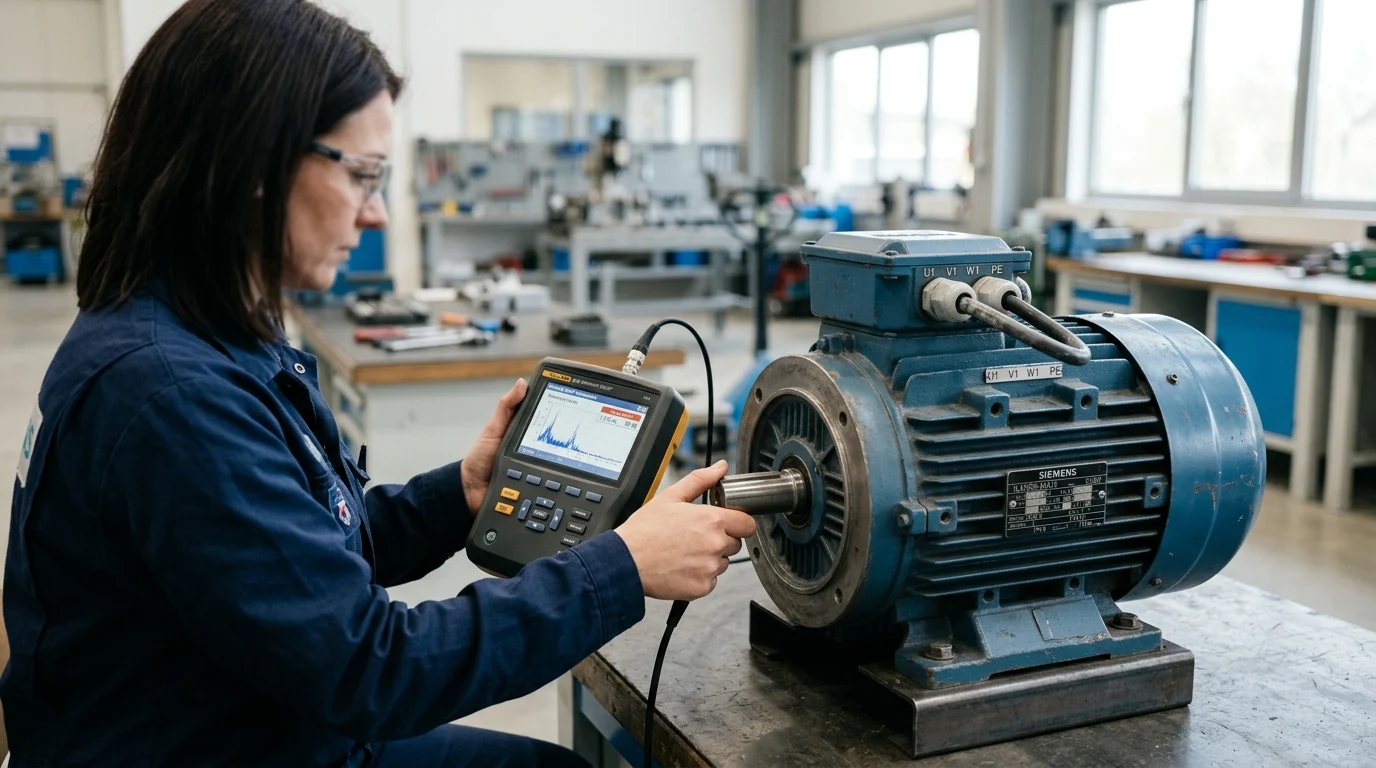
Introduction
Unusual bearing noise in an electric motor is often the first practical sign that friction, contamination, misalignment, or electrical damage is developing inside the machine. Because bearings are responsible for a large share of motor failures, identifying the source of the sound early can prevent unplanned downtime, shaft damage, and wider equipment problems. This article explains the most common reasons motor bearings become noisy, what each noise pattern may indicate, and the corrective actions that restore smooth operation. With that context, the following sections move from symptoms to likely causes and then to effective fixes.
Why Bearing Noise in Electric Motors Matters
In industrial drive systems, the acoustic emissions of electric motors serve as a primary indicator of electromechanical health. Bearing noise is rarely a localized annoyance; rather, it is a critical diagnostic metric. Statistical reliability studies consistently indicate that rolling-element bearing failures account for 50% to 60% of all electric motor breakdowns. When a bearing begins to emit abnormal noise, it has typically already breached its optimal operating parameters, signaling a degradation in the elasto-hydrodynamic lubrication film or the onset of microscopic raceway fatigue.
Addressing bearing noise proactively is essential for maintaining the L10 life expectancy of the motor. Ignoring these acoustic anomalies allows minor tribological issues to cascade into catastrophic mechanical seizures, which can compromise the stator winding, damage the rotor shaft, and induce severe collateral damage to coupled driven equipment.
Early warning signs of bearing failure
The degradation of a bearing is not initially perceptible to the human ear. Early warning signs manifest as high-frequency acoustic emissions and ultrasonic transients, typically in the 20 kHz to 40 kHz range. These frequencies are generated by micro-spalling, subsurface fatigue, or the initial shearing of an inadequate lubricant film. By the time bearing noise enters the audible human spectrum (20 Hz to 20 kHz), the internal geometry of the bearing has already sustained measurable physical damage.
Vibration analysis further corroborates these early signs. An increase in acceleration enveloping (often measured in gE) generally precedes a rise in overall velocity vibration (measured in in/s or mm/s). Detecting these high-frequency anomalies provides maintenance personnel with a critical operational window, often spanning several weeks to months, to schedule a controlled intervention before the onset of heavy mechanical grinding or catastrophic failure.
Reliability and cost impacts
The transition from early micro-pitting to audible noise carries severe financial and operational implications. Unplanned downtime in continuous process industries can incur costs exceeding $10,000 per hour, eclipsing the nominal cost of a replacement bearing. Furthermore, an operating motor with compromised bearings suffers from reduced mechanical efficiency.
Increased rotational friction elevates the motor's operating temperature and current draw. For every 10°C rise in motor operating temperature above its rated class, the insulation lifespan is effectively halved. Therefore, mitigating bearing noise is not solely a mechanical maintenance objective; it is a fundamental requirement for optimizing energy efficiency and protecting the capital investment of the entire electromechanical drivetrain.
Types of Bearing Noise in Electric Motors
Acoustic profiling is a highly effective non-destructive testing methodology for evaluating motor bearings. Different failure modes generate distinct acoustic signatures, characterized by specific frequencies, amplitudes, and temporal patterns. A baseline increase of 10 to 15 decibels (dB) in overall noise levels typically indicates severe degradation, demanding immediate investigation. Categorizing these noise types allows reliability engineers to isolate the root cause without prematurely disassembling the motor.
Mechanical noise patterns
Mechanical bearing noise generally originates from physical defects within the bearing components. The acoustic pattern often correlates directly with the rotational speed of the motor and the physical geometry of the bearing.
| Noise Signature | Acoustic Characteristics | Probable Defect |
|---|---|---|
| High-Pitched Whine | Continuous, speed-dependent | Inadequate internal clearance, tight fit |
| Clicking or Popping | Intermittent, sharp transients | Cage damage, broken rolling elements |
| Low-Frequency Rumble | Continuous, heavy vibration | Severe raceway spalling, generalized wear |
| Rhythmic Beating | Modulated amplitude | Outer ring distortion, housing out-of-roundness |
Engineers rely on these acoustic profiles to determine the severity of the fault. For instance, a rhythmic clicking that accelerates with motor RPM strongly suggests a localized defect on a specific rolling element, whereas a continuous, heavy rumble points to widespread raceway fatigue that is nearing catastrophic failure.
Lubrication-related noise
Lubrication anomalies produce distinct acoustic profiles, primarily due to metal-to-metal contact resulting from film breakdown. A starved bearing typically emits a continuous, high-pitched squeal or hissing sound. This occurs when the base oil viscosity is insufficient to separate the rolling elements from the raceway under load.
When subjected to starvation, bearings operate at significantly elevated temperatures, frequently exceeding 80°C. Conversely, an over-greased bearing may produce a churning or squelching noise. This is caused by the rolling elements plowing through excess grease, which dramatically increases fluid friction, traps heat, and accelerates the oxidation of the lubricant.
Contamination and fit-related noise
Particulate contamination introduces random, high-frequency acoustic transients into the motor's operating signature. A crunching or grinding sound often indicates that abrasive particles—such as silica dust, metal shavings, or process debris—have bypassed the bearing seals. Particles as small as 10 to 50 microns can breach the lubrication film, causing three-body abrasive wear.
Fit-related noise, on the other hand, is often characterized by a cyclic groaning or a harsh whine. If the housing fit is too loose, the outer ring may creep or spin, generating a fretting noise. If the shaft interference fit is excessively tight, the internal clearance of the bearing is eliminated, leading to excessive preload, elevated operating temperatures, and a strained acoustic whine.
Common Causes of Bearing Noise
Isolating the root cause of bearing noise requires a systematic analysis of the motor's operating environment, maintenance history, and electromechanical integration. While noise is the symptom, the underlying catalyst typically falls into one of three distinct categories: tribological failures, mechanical integration errors, or environmental and electrical degradation. Industry data indicates that lubrication errors alone account for up to 80% of all premature bearing failures, making root cause identification critical for preventing recurrence.
Lubrication and grease issues
Lubrication failures are the most pervasive cause of bearing noise. Issues arise not only from a lack of grease but also from incorrect specifications, such as using incompatible thickeners (e.g., mixing polyurea with lithium complex) or an inadequate base oil viscosity. For standard electric motors, a minimum operating viscosity of 15 to 20 centistokes (cSt) at operating temperature is generally required to maintain elastohydrodynamic film thickness.
Over-greasing is equally detrimental. Injecting excessive grease ruptures bearing seals and causes the rollers to churn the lubricant. This fluid friction can rapidly elevate bearing temperatures by 15°C to 20°C, causing the base oil to bleed out of the thickener prematurely and leaving behind a hardened, ineffective clay-like residue that induces severe acoustic grinding.
Misalignment, imbalance, and mounting errors
Mechanical stresses introduced during installation or operation are primary drivers of bearing noise. Shaft misalignment exceeding 0.002 inches per inch of distance between couplings induces severe axial and radial preloads on the motor bearings. This artificial load accelerates fatigue and generates a distinct, low-frequency acoustic rumble coupled with high axial vibration.
Imbalance in the driven equipment or the motor rotor itself subjects the bearings to excessive centrifugal forces, leading to premature raceway spalling. Furthermore, mounting errors, such as using a hammer to force a bearing onto a shaft or applying heat unevenly, can cause brinelling—permanent microscopic indentations on the raceways that produce a rhythmic clicking noise during operation.
Contamination, corrosion, and electrical damage
Electric motors controlled by Variable Frequency Drives (VFDs) are highly susceptible to Electrical Discharge Machining (EDM). High-frequency switching in VFDs generates common mode voltages. When this voltage exceeds the dielectric breakdown threshold of the bearing grease (typically 2 to 5 volts), it arcs through the bearing to ground. This arcing causes microscopic pitting and fluting on the raceways, resulting in a high-pitched, continuous whine.
Simultaneously, environmental contamination and corrosion compromise the bearing's metallurgy. Moisture ingress leads to rust formation, while chemical vapors can degrade the lubricant. When the bearing rotates over these oxidized or contaminated surfaces, it generates a harsh, irregular crunching noise that signifies immediate and irreversible mechanical damage.
How to Diagnose and Fix Bearing Noise
Accurate diagnosis of bearing noise relies on quantitative condition monitoring rather than subjective auditory assessments. By employing high-resolution analytical tools, maintenance professionals can pinpoint the exact nature and location of the defect, ensuring that corrective actions are targeted and effective. The diagnostic process must differentiate between electrical noise, aerodynamic noise, and true mechanical bearing degradation.
Inspection and troubleshooting steps
The diagnostic framework begins with vibration spectrum analysis, which isolates the specific fault frequencies associated with bearing geometry. By analyzing the velocity (in/s) and acceleration (g) envelopes, technicians can identify defects on the inner race, outer race, cage, or rolling elements.
| Fault Acronym | Description | Diagnostic Indication |
|---|---|---|
| BPFO | Ball Pass Frequency Outer | Defect on the stationary outer raceway |
| BPFI | Ball Pass Frequency Inner | Defect on the rotating inner raceway |
| BSF | Ball Spin Frequency | Damage to individual rolling elements |
| FTF | Fundamental Train Frequency | Cage degradation or deformation |
In addition to vibration analysis, ultrasonic monitoring is utilized to detect early-stage friction. Technicians use heterodyning instruments to translate ultrasonic frequencies (above 20 kHz) into the audible range, allowing them to hear the precise quality of the friction. A baseline measurement is established, and any deviation exceeding 8 dB triggers a targeted troubleshooting protocol, starting with a review of lubrication adequacy and shaft alignment.
Corrective actions for common faults
Once a fault is identified, corrective actions must be executed with high precision. If the diagnosis reveals misalignment as the root cause, laser alignment tools must be deployed to bring the shaft alignment within a tolerance of less than 0.05 mm, significantly reducing the parasitic load on the bearings.
For noise induced by VFD electrical arcing (EDM), corrective action requires establishing a safe path to ground. Installing shaft grounding rings, utilizing insulated bearings on the non-drive end, or applying conductive grease can effectively mitigate common mode voltages. If the noise is purely lubrication-related, a controlled relubrication protocol must be initiated. This involves purging the degraded grease while the motor is running (if safe) and carefully replenishing the cavity using volumetric calculations to prevent over-pressurization.
How to Prevent Bearing Noise
Preventing bearing noise is fundamentally an exercise in controlling the operating environment and adhering to strict tribological standards. A proactive reliability strategy shifts the focus from reactive firefighting to predictive asset management. By implementing rigorous maintenance frameworks and leveraging digital condition monitoring, industrial facilities can maximize the L10 life of their motor bearings and eliminate unplanned mechanical outages.
Preventive maintenance practices
A cornerstone of preventive maintenance is the adoption of precision lubrication practices. Facilities must abandon calendar-based greasing in favor of condition-based or acoustic lubrication. Using an ultrasonic grease caddy allows technicians to monitor the friction levels in real-time while injecting grease. The optimal state is achieved when the ultrasonic decibel level drops by 8 to 10 dB and stabilizes.
Storage and handling of replacement bearings also dictate future performance. Bearings must be stored horizontally in a climate-controlled environment to prevent false brinelling and condensation. Furthermore, maintaining strict cleanliness standards during installation—ensuring that the work environment is free of particulates—prevents the introduction of contaminants that cause immediate abrasive noise upon startup.
Condition monitoring methods
Continuous condition monitoring utilizes Industrial Internet of Things (IIoT) sensors to provide round-the-clock surveillance of motor health. Permanent accelerometers and temperature probes are mounted directly to the motor housing, transmitting triaxial vibration data and thermal metrics to a centralized dashboard.
Modern sensors employ high-frequency sampling rates exceeding 10 kHz, capturing the micro-impact transients that precede audible bearing noise. Machine learning algorithms analyze this data against historical baselines, automatically generating alerts when specific fault frequencies (such as BPFO or BPFI) begin to trend upward. This continuous oversight removes the guesswork from maintenance scheduling, allowing for precisely timed interventions.
Repair vs replacement decisions
When bearing noise indicates irreversible damage, engineers must navigate the repair versus replacement decision. A standard industry metric is the 60% rule: if the cost to overhaul the motor—including bearing replacement, precision balancing, and potential stator rewinding—exceeds 60% of the cost of a new, highly efficient motor, replacement is the superior economic choice.
However, for highly customized or large-frame motors, bearing replacement is typically the default action.
Key Takeaways
- The most important conclusions and rationale for Bearing Noise in Electric Motors
- Specs, compliance, and risk checks worth validating before you commit
- Practical next steps and caveats readers can apply immediately
Frequently Asked Questions
What is the most common cause of bearing noise in electric motors?
Lubrication failure is the most common cause. Use the correct grease or oil type, apply the proper amount, and follow the motor maker’s relubrication interval.
How can I tell if bearing noise is caused by poor lubrication?
Poor lubrication often sounds like a high-pitched squeal, hiss, or whine and usually comes with rising bearing temperature. Check grease condition, quantity, and contamination first.
What does a rumbling or grinding motor bearing usually mean?
Rumbling or grinding usually points to raceway wear, spalling, or advanced damage. Plan shutdown soon, inspect the bearing, and replace it before shaft or winding damage occurs.
Can misalignment or improper fit make motor bearings noisy?
Yes. Misalignment, tight fits, or housing distortion can create whining, beating, or uneven vibration. Check shaft alignment, bearing seats, and internal clearance during maintenance.
When should a noisy motor bearing be replaced?
Replace it when noise increases, vibration trends worsen, or temperature rises abnormally. If audible noise appears suddenly under normal load, schedule inspection immediately rather than waiting for failure.