
Introduction
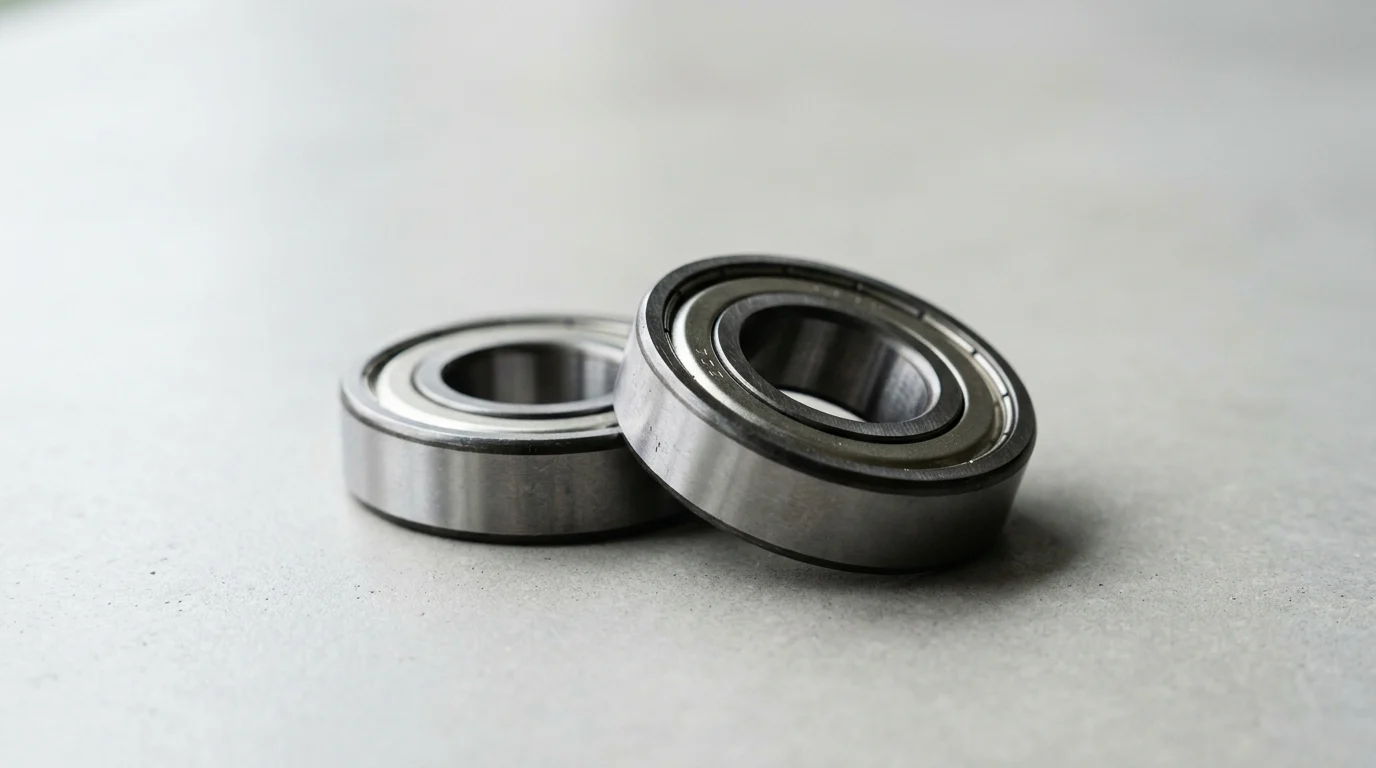
In automotive transmissions, deep groove ball bearings run at high speed under tight thermal and efficiency constraints, so grease quantity is not a minor detail but a design variable. The standard fill rate refers to how much of the bearing’s free internal space is occupied by grease, and the acceptable range must balance film formation against churning losses and heat buildup. This article explains the typical fill-rate range used for transmission-duty bearings, why it differs from lower-speed applications, and how overfilling or underfilling affects temperature, torque, service life, and reliability. With that context, the discussion can move directly into the practical standards and operating factors that determine the right fill level.
Grease fill rate in deep groove ball bearings
Deep groove ball bearings (DGBBs) deployed within automotive transmissions operate under highly dynamic conditions, necessitating strict control over lubrication parameters. The grease fill rate—defined as the percentage of the bearing’s free internal volume occupied by grease—serves as a critical engineering specification. In modern transmission architectures, these bearings frequently sustain rotational speeds ranging from 5,000 to over 10,000 RPM. Consequently, selecting the appropriate grease fill volume is paramount for ensuring optimal elastohydrodynamic film thickness while mitigating parasitic energy losses.
Effects on heat generation and churning
The volume of grease introduced into a DGBB directly dictates its thermal equilibrium. Excessive grease fill rates induce severe churning, a fluid dynamics phenomenon where the rolling elements and cage continuously plow through surplus lubricant. This internal fluid friction generates rapid localized heating, often pushing operating temperatures beyond 120°C and accelerating base oil oxidation. When the grease cannot channel properly—meaning it fails to clear a path for the rolling elements—the continuous churning drastically reduces the lubricant’s operational lifespan.
Conversely, insufficient grease volumes precipitate lubricant starvation. Without an adequate reservoir of grease adhering to the cage and raceway shoulders to slowly bleed base oil into the contact zones, the bearing experiences localized metal-to-metal contact. This starvation leads to heightened friction coefficients, rapid temperature spikes, and premature micro-pitting on the raceway surfaces.
Why there is no single standard fill rate
Automotive transmission environments inherently reject the concept of a universal standard grease fill rate. While commercial off-the-shelf industrial bearings typically default to a 25% to 35% fill rate, transmission DGBBs must accommodate highly specific duty cycles, ambient fluid interactions, and distinct thermal gradients. The optimal fill rate is a highly application-specific variable rather than an industry-wide constant.
For instance, a sealed-for-life bearing operating adjacent to a high-temperature clutch pack may require a conservative 15% to 20% fill of high-viscosity synthetic grease to prevent seal blowout from thermal expansion. In contrast, a heavily loaded, lower-speed output shaft support bearing might demand a 30% to 40% fill to ensure adequate boundary lubrication under high-torque shock loads. Therefore, the “standard” is defined solely by the unique operational envelope of the specific transmission component.
How grease fill rate is defined
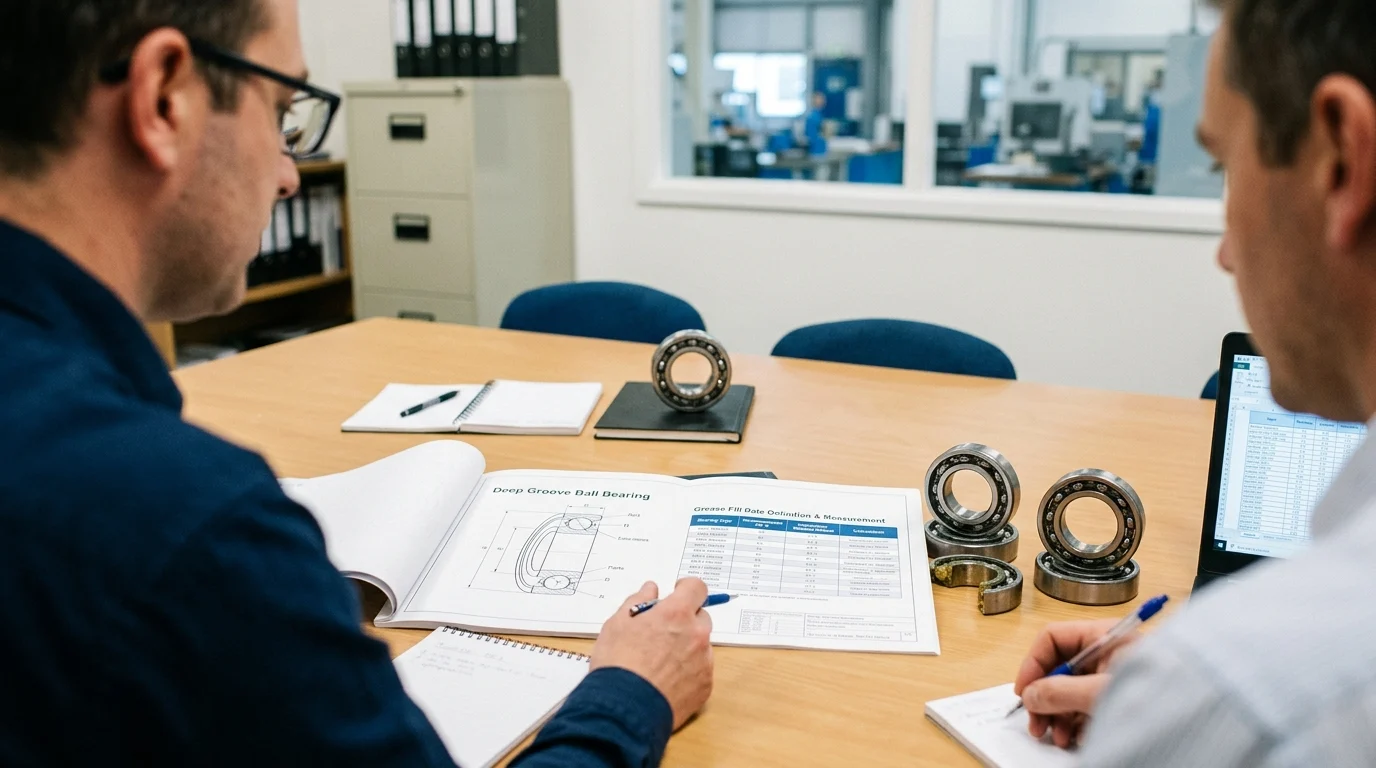
Establishing the correct grease fill rate requires precise geometric calculations and an understanding of the bearing’s internal architecture. The fill rate is not a measure of absolute mass, but rather a volumetric ratio that must account for the specific dimensions and component volumes of the DGBB in question.
Free internal volume and fill percentage
The foundation of the grease fill calculation is the bearing’s free internal volume. This is mathematically determined by calculating the total internal space between the inner and outer rings, and then subtracting the volumetric displacement of the rolling elements, the cage, and the seals or shields. The remaining void represents 100% of the available space.
The grease fill percentage is the ratio of the volume of the injected grease to this free internal volume. Because grease is dispensed by mass during manufacturing, engineers must convert the target volumetric fill percentage into a target mass using the specific gravity of the selected grease, which typically ranges from 0.85 to 1.05 g/cm³ depending on the thickener and base oil formulation.
Operating variables that set practical fill rate
Practical fill rates are dictated by a matrix of operating variables, primarily the speed factor (often denoted as $Nd_m$, calculated by multiplying the bearing’s mean diameter in millimeters by its rotational speed in RPM). Applications with high $Nd_m$ values—such as those exceeding 400,000 mm/min—generate immense centrifugal forces and require lower fill rates to allow the grease to channel efficiently and avoid excessive heat generation.
Load parameters and spatial orientation also heavily influence the fill rate. Vertical shaft applications often require slightly higher fill percentages or specialized thickeners to counteract gravity-induced grease migration, whereas horizontal shafts in automotive transmissions benefit from the natural retention of grease within the raceway path.
Low, moderate, and high fill ranges
Depending on the calculated $Nd_m$ and load profile, engineers categorize target fill rates into three primary ranges. Each range is optimized to balance cooling, lubrication longevity, and friction reduction.
| Fill Range | Percentage | Typical Transmission Application | Operating Characteristics |
|---|---|---|---|
| Low | 10% – 20% | High-speed input shafts, EV gearboxes | Minimizes churning heat; requires excellent grease channeling; $Nd_m$ > 500,000. |
| Moderate | 25% – 35% | General intermediate shafts | Standard baseline; balances cooling with adequate oil bleed life. |
| High | 40% – 50%+ | Low-speed output shafts, high-load pivots | Maximizes lubricant reservoir for boundary lubrication; $Nd_m$ < 200,000. |
How correct grease fill is determined
Determining the exact grease fill volume transcends theoretical calculation; it demands rigorous empirical testing and strict manufacturing controls. Automotive standards require exceptional precision, often mandating grease dispensing tolerances as tight as $\pm 0.1$ grams for standard DGBBs, and up to $\pm 5$ milligrams for specialized micro-bearings used in precision actuation mechanisms.
Test methods and validation criteria
The validation of a proposed grease fill rate relies on advanced rig testing that simulates the transmission’s operational duty cycle. Engineers utilize thermography and embedded thermocouples to monitor the bearing’s temperature profile during continuous running tests. A successful fill rate is validated when the bearing demonstrates a stable, low-plateau operating temperature after an initial run-in period, indicating that the grease has channeled effectively without starving the contact zones.
Acoustic emission testing and vibration analysis are also deployed as validation criteria. High-frequency acoustic spikes often indicate asperities breaching the elastohydrodynamic film due to underfilling, while elevated low-frequency vibrations can suggest uneven grease distribution or churning caused by overfilling.
Effects of grease chemistry, cage design, and clearance
The physical and chemical properties of the grease directly impact the optimal fill volume. Greases formulated with low-viscosity base oils (e.g., 20–50 cSt at 40°C) combined with polyurea thickeners tend to channel rapidly, allowing for slightly higher fill rates without severe thermal penalties compared to heavy lithium-complex greases.
Furthermore, internal bearing geometry alters grease behavior. A polyamide cage with optimized pockets may retain grease more effectively than a standard stamped steel ribbon cage, influencing the required reservoir volume. Similarly, bearings with larger internal radial clearances (such as C3 or C4 classes) utilized to accommodate thermal expansion will inherently possess a slightly larger free internal volume, necessitating a proportional adjustment in the absolute mass of the grease fill.
Process to set and verify fill rate
Transitioning from prototype validation to mass production requires a robust process to set and verify the fill rate. Automotive bearing manufacturers employ automated, volumetric positive-displacement pumps or time-pressure dispensing systems to inject the grease. To ensure compliance, statistical process control (SPC) is strictly applied.
Verification is typically achieved through in-line automated weighing systems. The bearing is weighed before and immediately after the grease injection station. If the delta falls outside the calculated tolerance band (e.g., target mass $\pm 5$%), the component is automatically rejected from the assembly line, ensuring that deviations in fill rate do not reach the transmission assembly plant.
Specification and supply chain risks
The specification of grease fill rates carries significant supply chain and quality assurance implications. In the high-volume automotive sector, where transmission defect tolerances are frequently targeted at less than 1 Part Per Million (PPM), rigorous oversight of the lubrication process is non-negotiable.
OEM specifications, PPAP, and traceability
Original Equipment Manufacturers (OEMs) strictly control grease fill specifications through the Production Part Approval Process (PPAP). Suppliers must submit detailed control plans illustrating how the grease fill rate is maintained across production batches. Traceability is paramount; suppliers must link specific bearing production lots to specific batches of grease, complete with Certificates of Analysis (CoA) verifying the grease’s specific gravity, penetration, and base oil viscosity.
Any unauthorized alteration to the grease type, dispensing equipment, or fill volume by the tier-supplier constitutes a severe breach of the PPAP, potentially resulting in catastrophic transmission failures and costly field recalls.
Failure modes from overfill, underfill, and grease incompatibility
Deviations from the validated grease fill rate introduce specific, highly destructive failure modes. Overfilling frequently leads to the hydrostatic blowout of elastomeric seals as internal temperatures and pressures rise, subsequently allowing transmission fluid to wash out the grease or permitting the ingress of wear debris. This condition also causes severe thermal degradation of the grease thickener.
Underfilling accelerates raceway wear and cage failure due to starvation, often manifesting as unacceptable acoustic noise (exceeding 60 dB) within the transmission housing. Additionally, if a supplier inadvertently mixes incompatible greases (e.g., polyurea with barium complex) during a line changeover, the resulting chemical reaction can cause the thickener matrix to collapse, liquefying the grease and causing total lubrication failure regardless of the initial fill volume.
Supplier comparison points for procurement
When procuring DGBBs for automotive transmissions, buyers and quality engineers must evaluate suppliers based on their capability to control and verify grease fill rates. Evaluating these competencies ensures the integrity of the transmission system over its expected lifecycle.
| Evaluation Criteria | OEM Expectation | Risk of Supplier Failure |
|---|---|---|
| Dispensing Technology | Automated positive-displacement pumps | High variance in fill volume across batches; inconsistent thermal performance. |
| In-line Verification | 100% automated pre- and post-weighing | Defective, underfilled bearings reaching the assembly line (high PPM). |
| Environmental Control | Climate-controlled cleanroom dispensing | Contamination ingress; temperature-induced viscosity changes affecting dispensed mass. |
| Traceability Systems | Barcode/RFID linking bearing lot to grease batch | Inability to isolate root causes during field warranty claims. |
How to make grease fill decisions
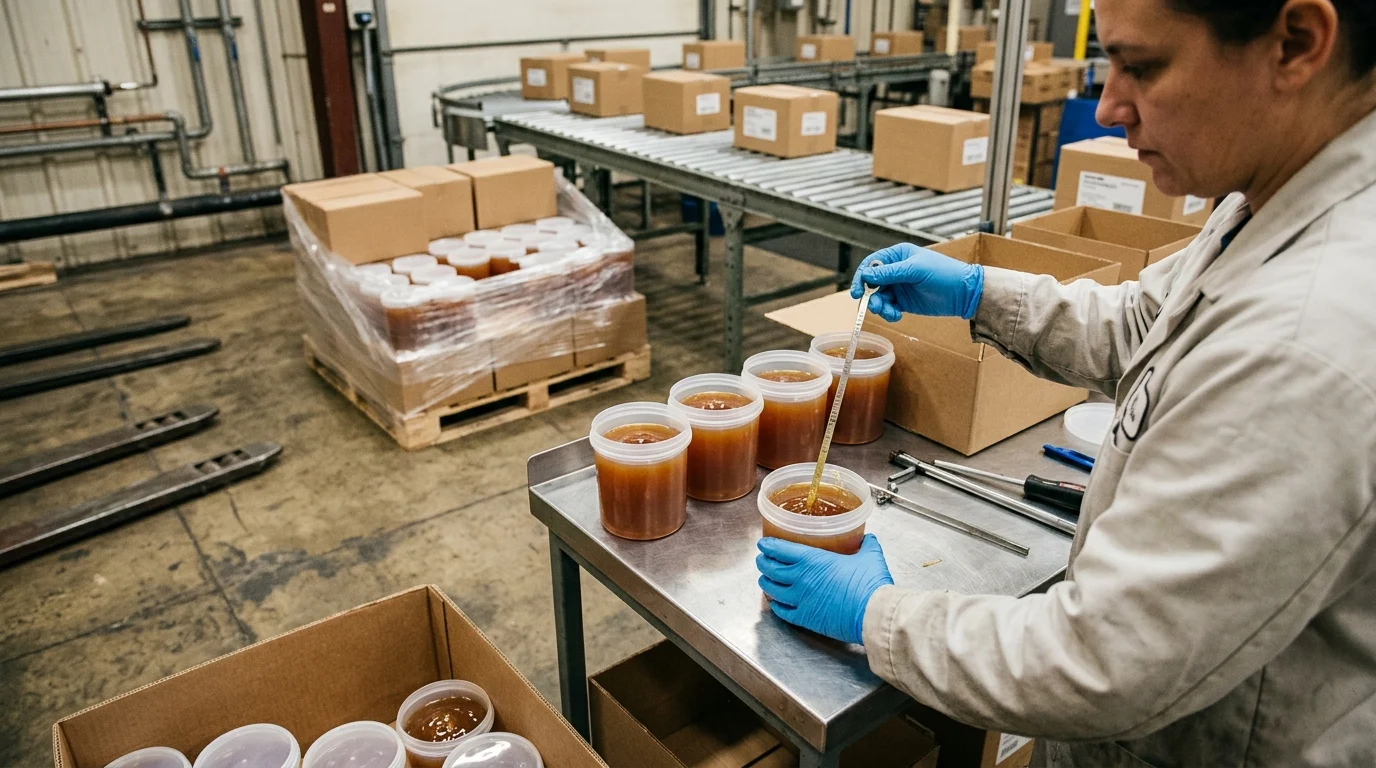
Synthesizing operational parameters to finalize a grease fill specification requires a calculated balance of engineering trade-offs. With industry data indicating that over 80% of premature bearing failures are linked to lubrication anomalies, the decision-making process for grease volume must be methodical and evidence-based.
Decision framework for speed, temperature, and duty cycle
Engineers must utilize a holistic decision framework that integrates speed, operating temperature, and the transmission’s duty cycle. For traditional internal combustion engine (ICE) gearboxes, a moderate fill rate of 25% to 30% often provides the necessary longevity for standard load profiles. However, the paradigm shifts dramatically for high-speed Electric Vehicle (EV) transmissions.
EV traction motor reduction gearboxes frequently subject DGBBs to speeds exceeding 15,000 RPM. In these environments, the decision framework dictates a shift toward ultra-low fill rates (10% to 15%) utilizing specialized low-viscosity greases. This minimizes churning heat while relying on the rapid channeling characteristics of the grease to maintain the elastohydrodynamic film during high-frequency acceleration and deceleration cycles.
When to use catalog guidance and when to validate
Determining when to rely on manufacturer catalog guidance versus when to invest in custom validation is a critical project management decision. Catalog guidance—which typically recommends a standard 30% fill for DGBBs—is sufficient for low-risk, auxiliary automotive components such as standard alternator bearings or low-speed actuator pivots.
However, for primary transmission shafts, differentials, and high-speed EV reduction gears, catalog defaults are inadequate. The stringent warranty expectations of modern automotive drivetrains, often exceeding 150,000 miles, mandate bespoke validation. In these critical path applications, engineers must bypass standard guidance and conduct rigorous rig testing to define, validate, and specify a custom grease fill rate tailored to the exact thermal and dynamic signature of the transmission.
Key Takeaways
- The most important conclusions and rationale for Deep Groove Ball Bearings
- Specs, compliance, and risk checks worth validating before you commit
- Practical next steps and caveats readers can apply immediately
Frequently Asked Questions
Is there a single standard grease fill rate for deep groove ball bearings in auto transmissions?
No. Most cases use about 15%–40% of free internal volume, depending on speed, load, temperature, seals, and shaft orientation.
What fill rate is common for high-speed transmission deep groove ball bearings?
For high-speed service, a lower fill around 15%–25% is often used to reduce churning, heat, and seal pressure.
What happens if a bearing is overfilled with grease?
Overfilling increases churning, raises temperature, accelerates grease oxidation, and can shorten bearing and seal life.
How is grease fill rate measured in a deep groove ball bearing?
It is the percentage of the bearing’s free internal volume filled with grease, then converted to grease mass using the grease density.
Can VETOR GROUP help match grease fill to OEM bearing applications?
Yes. VETOR GROUP supports OEM-oriented deep groove bearing supply with model-based recommendations for speed, load, precision, and delivery needs.