
Introduction
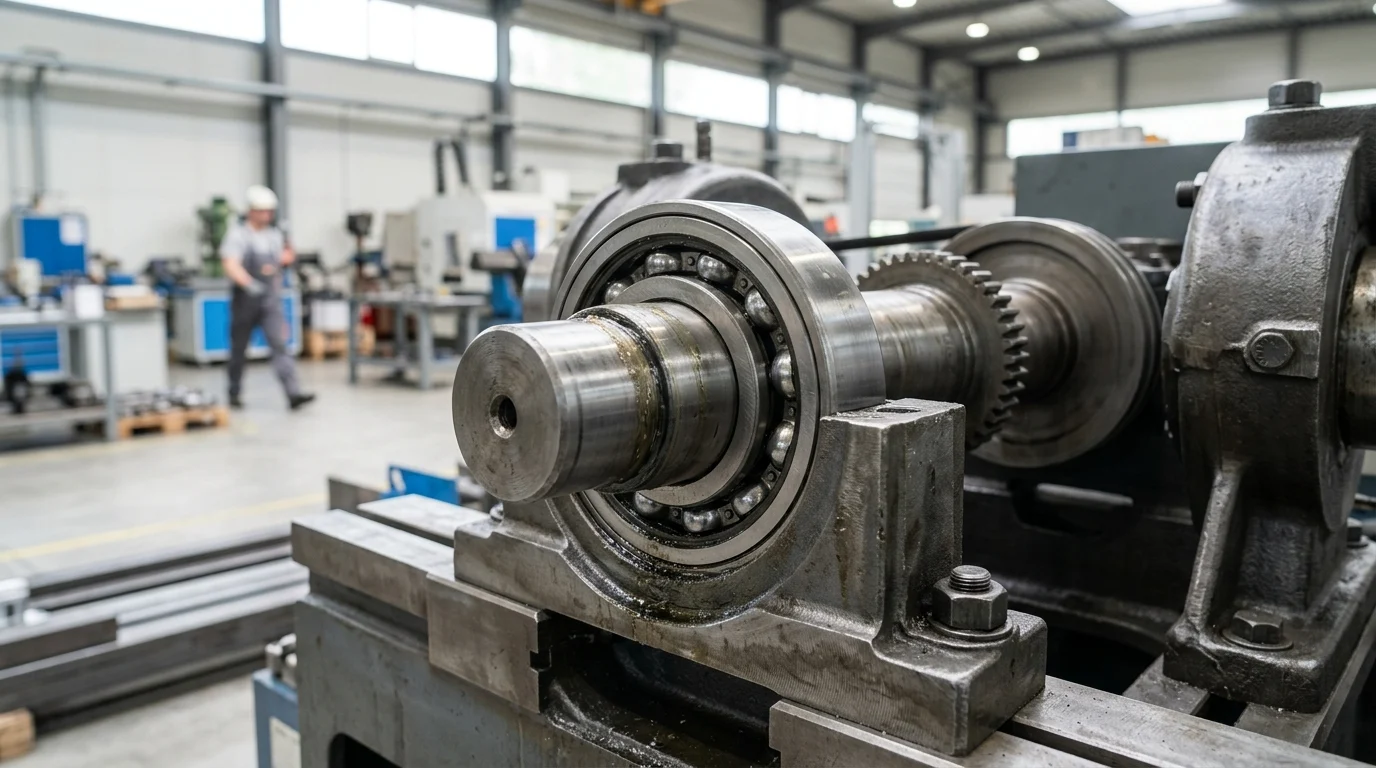
Selecting a bearing for industrial equipment involves more than matching shaft size and speed. Load direction and magnitude, operating temperature, contamination, lubrication method, alignment, and required service life all affect whether a bearing will run reliably or fail early. A poor choice can increase friction, shorten maintenance intervals, and raise total operating cost through downtime and component damage. This article outlines the key factors engineers and maintenance teams should evaluate, explains how application conditions influence bearing type and material, and provides a practical framework for narrowing options so the final selection supports performance, durability, and cost control.
Why Bearing Selection Requires a Strategic Process
Choosing the correct bearing for industrial applications is a rigorous engineering decision that dictates machinery performance, maintenance intervals, and overall operational efficiency. Bearings act as the fundamental interface between stationary and rotating components, absorbing immense forces while minimizing friction. Treating bearings as interchangeable commodities rather than highly engineered system components often leads to premature failure and costly systemic damage.
A strategic selection process aligns the mechanical capabilities of a bearing with the specific kinetic and environmental demands of the application. Engineers must evaluate multiple overlapping variables, moving beyond basic shaft dimensions to consider complex dynamic loads, thermal expansion coefficients, and lubricant lifecycle. Implementing a structured selection methodology ensures that the specified component achieves its targeted operational lifespan while optimizing the overall mechanical assembly.
Operating conditions, uptime, and total cost
The relationship between operating conditions, equipment uptime, and total cost of ownership (TCO) is the primary driver of strategic bearing selection. Industrial environments subject bearings to extreme conditions, including heavy shock loads, corrosive chemicals, and continuous high-speed rotation. When a bearing is under-specified for its operating environment, the result is accelerated wear, spalling, and sudden catastrophic failure.
Unplanned downtime carries severe financial penalties. In heavy industries such as mining, paper milling, or petrochemical processing, unexpected machinery stoppages can incur costs ranging from $10,000 to over $50,000 per hour. Investing in a premium bearing with an optimized internal geometry and advanced lubrication system may increase the initial component cost by 30% to 50%, but this upfront expenditure is rapidly offset by the elimination of just one unplanned maintenance event over the equipment’s lifecycle.
How early specification reduces maintenance risk
Specifying bearing parameters during the initial design phase drastically reduces long-term maintenance risks. Industry data indicates that bearing failures account for up to 51% of all electric motor breakdowns. By rigorously defining the L10 nominal life—the statistical metric representing the hours of operation that 90% of a group of identical bearings will exceed before fatigue spalling occurs—engineers can align the bearing’s lifecycle with the scheduled maintenance intervals of the broader machine.
For example, specifying an L10 life target of 100,000 hours for a critical industrial gearbox ensures that the bearings will likely outlast other wear components, allowing for synchronized, planned overhauls. Early specification also allows engineers to account for thermal gradients and structural deflections, ensuring that housing tolerances and shaft fits are perfectly matched to the chosen bearing, thereby preventing parasitic loads that initiate premature fatigue.
Key Technical Factors for Matching Bearings
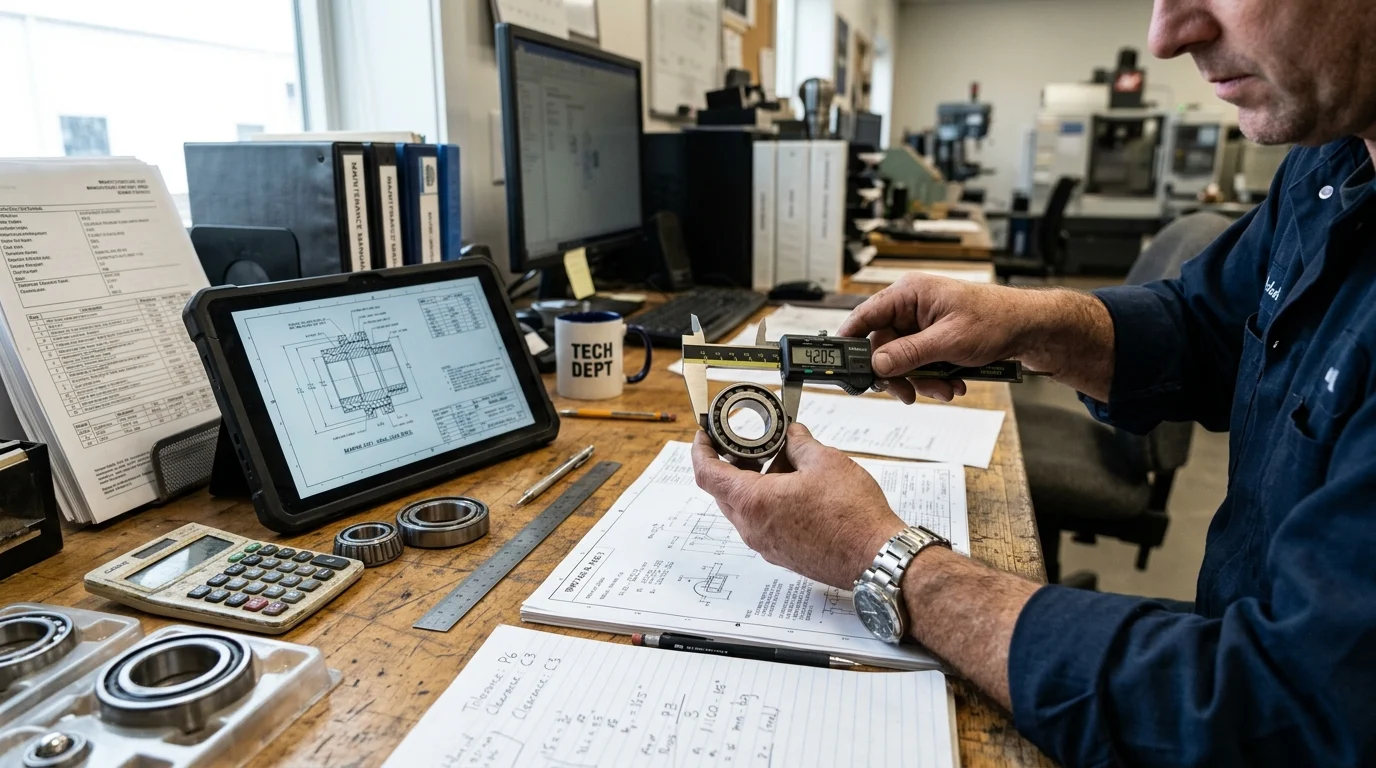
Selecting the optimal bearing requires a comprehensive analysis of the physical forces and kinematic constraints governing the machinery. The fundamental physics of the application dictate the required internal geometry, cage design, and contact angle of the bearing. Engineers must systematically evaluate these technical factors to match the bearing’s capabilities with the operational envelope.
Load, speed, temperature, contamination, and misalignment
Five primary technical variables govern bearing specification: load, speed, temperature, contamination, and misalignment. Load must be evaluated in terms of both dynamic rating (C) for rotating conditions and static rating (C0) for stationary shock loads, factoring in both radial and axial (thrust) vectors. Speed capabilities are typically assessed using the NdM factor (bearing pitch diameter in mm multiplied by speed in RPM); high-speed spindle applications frequently exceed an NdM of 1,000,000, necessitating specialized cage designs and precision tolerances.
Temperature profiles dictate both material selection and internal clearance. Operating temperatures exceeding 120°C (248°F) typically require specialized heat treatment to prevent dimensional instability. Contamination risks require specific sealing configurations to protect the rolling elements. Finally, misalignment must be quantified; while rigid ball bearings can only tolerate a few minutes of arc, specialized spherical roller bearings are designed to accommodate up to 2.0 degrees of dynamic shaft misalignment without localized edge loading.
Bearing types for different applications
Different bearing types are engineered to handle specific combinations of radial and axial forces. Deep groove ball bearings are the industry standard for versatile, high-speed applications with moderate radial and light axial loads. When high axial loads are present simultaneously with radial loads, angular contact ball bearings—often deployed in duplex pairs—provide the necessary stiffness and load distribution.
For heavy-duty industrial applications characterized by massive radial loads and shock impacts, cylindrical roller bearings offer superior line-contact load distribution compared to the point-contact of ball bearings. Tapered roller bearings excel in applications like automotive wheel hubs and heavy gearboxes, where they must manage severe, simultaneous radial and unidirectional thrust loads. Thrust bearings, available in both ball and roller configurations, are strictly dedicated to handling heavy axial loads parallel to the shaft axis.
Using comparison tables to assess options
To navigate the complexities of bearing selection, engineers frequently rely on matrix comparisons to evaluate trade-offs between load capacity, speed limits, and misalignment tolerance. Utilizing a standardized comparison framework ensures that no critical performance metric is overlooked during the specification phase.
| Bearing Type | Primary Load Direction | Speed Capability | Misalignment Tolerance |
|---|---|---|---|
| Deep Groove Ball | Radial (Light Axial) | Very High | Low (< 0.25°) |
| Angular Contact | Combined Radial & Axial | High | Very Low (< 0.1°) |
| Cylindrical Roller | High Radial | Medium to High | Low (< 0.1°) |
| Spherical Roller | Very High Radial & Axial | Low to Medium | High (up to 2.0°) |
| Tapered Roller | Heavy Combined Loads | Medium | Low (< 0.1°) |
Materials, Sealing, Lubrication, and Compliance
Beyond geometric dimensions and load ratings, the physical composition and environmental protection mechanisms of a bearing determine its survivability in harsh industrial settings. Material science, tribology, and strict adherence to manufacturing tolerances form the critical triad that separates high-performance bearings from failure-prone alternatives.
Choosing steel, stainless steel, or ceramic
The vast majority of industrial bearings are manufactured from SAE 52100 chrome steel, which offers an excellent balance of hardness, fatigue resistance, and cost-effectiveness for standard applications operating below 120°C. However, in environments exposed to moisture, corrosive chemicals, or stringent washdown requirements (such as food and beverage processing), AISI 440C stainless steel is required, despite an approximate 20% reduction in dynamic load capacity compared to chrome steel.
For extreme environments, hybrid ceramic bearings—featuring steel rings and Silicon Nitride (Si3N4) rolling elements—provide significant advantages. Ceramic balls are up to 40% lighter than standard steel, which drastically reduces centrifugal forces at ultra-high speeds, thereby extending grease life and lowering operating temperatures. Furthermore, ceramic elements act as electrical insulators, preventing the destructive electrical pitting (fluting) that frequently destroys standard bearings in modern variable frequency drive (VFD) electric motors.
Sealing systems, relubrication, and mounting conditions
A bearing’s longevity is inextricably linked to its sealing and lubrication strategy. Integral seals (such as 2RS rubber contact seals) provide robust protection against fluid and particulate ingress but generate friction that limits maximum operating speeds. Non-contact metal shields (ZZ) allow for higher speeds by eliminating seal friction, but offer minimal protection against heavy contamination.
Lubrication must be meticulously matched to the application. For sealed-for-life bearings, the factory grease fill typically occupies 30% to 50% of the internal free space; overfilling causes excessive churning and rapid thermal degradation. In open or shielded bearings requiring relubrication, engineers must design accessible zerk fittings and specify the exact grease thickener (e.g., lithium complex, polyurea) and base oil viscosity required for the operating temperature and speed envelope.
Quality standards, tolerances, and traceability
Precision and repeatability are governed by international quality standards, specifically the ABEC (Annular Bearing Engineering Committee) scale and ISO 492 equivalent classes. Higher precision classes mandate tighter dimensional controls on bore, outer diameter, and radial runout, which is critical for minimizing vibration in high-speed spindles or precision instrumentation.
Traceability is equally vital for compliance and root-cause failure analysis. Reputable manufacturers laser-etch batch codes and manufacturing dates onto the bearing rings, ensuring that metallurgical origins and production runs can be audited. Below is a comparison of common precision standards and their corresponding tolerances.
| ABEC Standard | ISO Equivalent | Max Radial Runout (50mm Bore) | Typical Application |
|---|---|---|---|
| ABEC 1 | Class 0 (Normal) | 20.0 µm | Electric motors, gearboxes, standard fans |
| ABEC 3 | Class 6 | 10.0 µm | Pumps, standard machine tools |
| ABEC 5 | Class 5 | 5.0 µm | High-speed rotors, precision gear drives |
| ABEC 7 | Class 4 | 2.5 µm | CNC spindles, aerospace components |
Practical Steps to Select the Right Bearing
Translating theoretical bearing parameters into a finalized engineering specification requires a methodical, step-by-step approach. Ad-hoc selection based on dimensional fit alone inevitably leads to sub-optimal performance. Engineers must bridge the gap between abstract mathematical models and physical operating conditions through rigorous calculation and empirical validation.
Defining duty requirements step by step
The specification process begins with defining the spatial constraints: the required shaft diameter (bore), the maximum housing diameter (OD), and the available width. Once the envelope is established, engineers must calculate the equivalent dynamic bearing load using the standard formula P = XFr + YFa, where Fr is the radial load, Fa is the axial load, and X/Y are bearing-specific geometry factors.
With the equivalent load calculated, the required basic dynamic load rating (C) is derived to meet the application’s target L10 life. For example, a standard agricultural implement may only require an L10 life of 4,000 to 8,000 hours, whereas continuous 24/7 power generation equipment demands an L10 life exceeding 100,000 hours. This calculated C value is then used to filter vendor catalogs for bearings that possess the necessary fatigue resistance within the established dimensional envelope.
Balancing OEM guidance with application testing
While mathematical models and OEM catalog data provide a robust baseline, they cannot fully account for the complex dynamic interactions within a physical machine assembly. Housing resonance, localized thermal expansion, and assembly-induced stresses often deviate from theoretical predictions. Therefore, balancing OEM guidance with physical prototyping and application testing is essential for critical machinery.
During the testing phase, vibration analysis serves as the primary diagnostic tool to validate bearing selection. By monitoring the prototype under full load, engineers can ensure that vibration levels remain within acceptable thresholds—typically staying below 2.8 mm/s RMS for rigid foundation machinery as per ISO 10816 standards. If high-frequency peaks indicate premature cage rattle or rolling element skidding, the engineering team must consult with the bearing manufacturer to adjust the internal clearance or preload specifications.
Finalizing the Best Bearing Choice
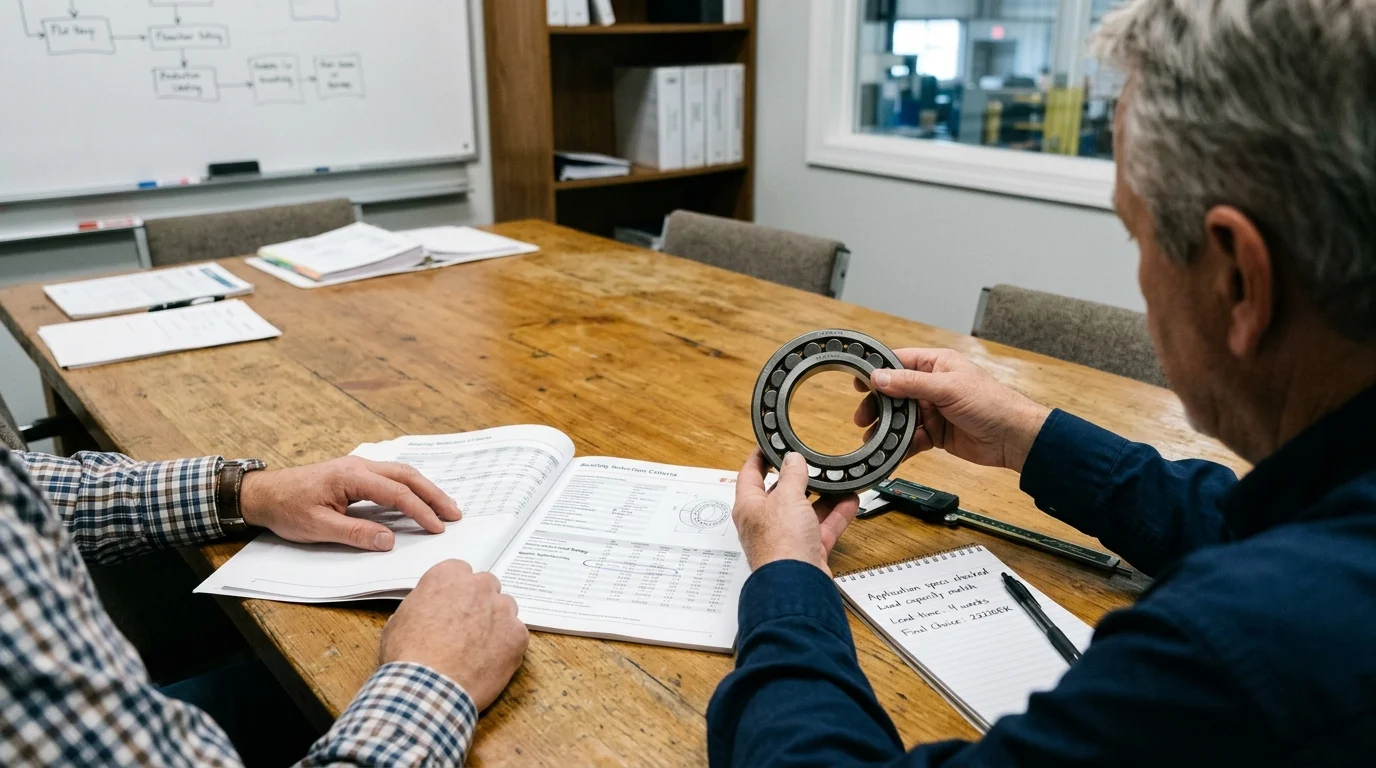
The final phase of bearing selection bridges the gap between engineering specifications and procurement realities. Identifying the mechanically perfect bearing is only half the battle; ensuring that it can be reliably sourced, installed, and maintained throughout the equipment’s lifecycle is equally critical for long-term operational success.
Decision criteria for reliability and maintainability
Decision criteria must encompass supply chain viability and long-term maintainability. Sourcing highly exotic, custom-engineered bearings may solve a specific technical challenge, but it introduces significant logistical risk. Lead times for specialized aerospace or ultra-precision spindle bearings can easily extend from 12 to 16 weeks, and manufacturers may enforce strict Minimum Order Quantities (MOQs) that inflate inventory holding costs.
Maintainability also dictates the final choice. If an application requires frequent bearing replacement due to unavoidable environmental contamination, selecting an easily accessible, split-housing pillow block bearing with standard dimensions may yield a lower total cost of ownership than integrating a highly complex, sealed custom bearing that requires complete machine disassembly to replace.
Documenting the final selection
Once the optimal bearing is identified, the selection must be rigorously documented in a formal engineering specification. This document should detail not only the core part number but all critical suffixes that define the bearing’s internal architecture. For instance, specifying a generic ‘6205’ bearing is insufficient; the documentation must explicitly state ‘6205-2RS1/C3’ to ensure the procurement team purchases the variant with dual contact seals and a C3 radial internal clearance, which is vital for accommodating higher thermal differentials.
Comprehensive documentation must also include the required lubrication protocol,
Key Takeaways
- The most important conclusions and rationale for Bearing Applications
- Specs, compliance, and risk checks worth validating before you commit
- Practical next steps and caveats readers can apply immediately
Frequently Asked Questions
What is the first step in choosing a bearing for industrial equipment?
Start with the application data: load type, speed, temperature, contamination level, and shaft/housing dimensions. This prevents under-specifying the bearing and reduces downtime risk.
When should deep groove ball bearings be used?
Use deep groove ball bearings for high-speed applications with moderate radial loads and light axial loads, such as motors, fans, and general machinery.
How do harsh environments affect bearing selection?
Dust, moisture, chemicals, and heat require stronger sealing, suitable lubrication, and sometimes special materials or heat treatment. Matching these factors helps extend service life.
Why does early bearing specification matter?
Selecting bearings during machine design helps match fits, clearance, and life targets like L10. This lowers maintenance risk and supports planned service intervals.
Can VETOR GROUP support OEM and bulk bearing sourcing?
Yes. VETOR GROUP supplies factory-direct bearings with OEM customization, precision manufacturing, competitive pricing, and global delivery for industrial and automotive buyers.