
Introduction
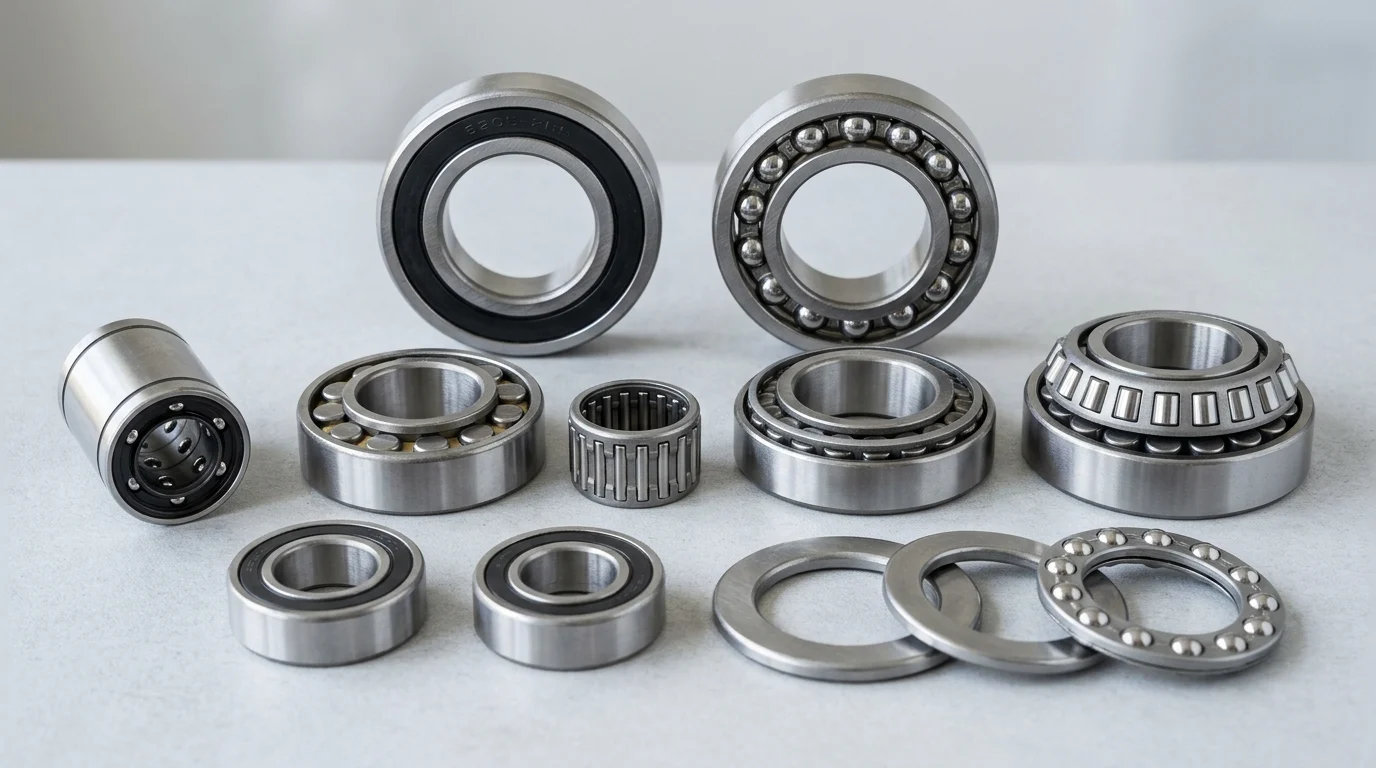
Bearings do more than reduce friction—they determine how reliably a machine handles load, speed, heat, and contamination over time. The main bearing types differ in geometry, contact pattern, and load capacity, which makes each one better suited to certain operating conditions. This article outlines the most common types, including ball, roller, plain, and thrust bearings, and explains where each is typically used in equipment ranging from motors and gearboxes to conveyors and pumps. By the end, you’ll have a practical framework for matching bearing designs to application demands and understanding why the wrong choice can shorten service life and increase energy loss.
Why Bearing Types Matter in Industrial Equipment
The specification of industrial bearings fundamentally dictates the mechanical efficiency, thermal management, and lifecycle reliability of rotating machinery. Selecting from the different types of bearings is not merely a geometric matching exercise; it is a critical engineering decision that balances kinetic constraints against operational longevity and maintenance budgets.
Impact on uptime and energy use
The direct impact of bearing selection on system uptime and energy consumption is profound. Rolling element bearings typically exhibit friction coefficients ranging from 0.001 to 0.005, which is significantly lower than plain bearings operating under boundary lubrication conditions. However, misapplying a bearing type—such as utilizing a standard deep groove ball bearing where a high-capacity cylindrical roller is required—can increase localized friction, leading to a 5% to 15% surge in parasitic energy loss.
In high-output industrial environments, this mechanical inefficiency rapidly translates into elevated thermal signatures and premature metal fatigue. The downstream effect is unplanned downtime, which routinely exceeds $10,000 per hour in heavy manufacturing and continuous process facilities, making the initial specification a critical factor in overall plant profitability.
Effects of load, speed, lubrication, and environment
Operational variables dictate the absolute boundaries of bearing performance. Radial loads act perpendicular to the shaft, while axial (thrust) loads run parallel; the magnitude and combination of these forces severely restrict viable bearing architectures. Speed capabilities are quantified by the DN value (bore diameter in millimeters multiplied by speed in RPM). High-speed machine tool spindles routinely demand DN values exceeding 2,000,000, necessitating precision angular contact bearings with optimized cage designs.
Furthermore, environmental factors alter baseline specifications. Standard 52100 steel bearings operate reliably up to 120°C. In contrast, high-temperature variants utilizing specialized heat treatments, increased internal clearances, and synthetic fluorinated lubricants can sustain prolonged exposure to temperatures up to 350°C in applications like industrial kilns and steel continuous casters.
Main Types of Bearings and Their Uses
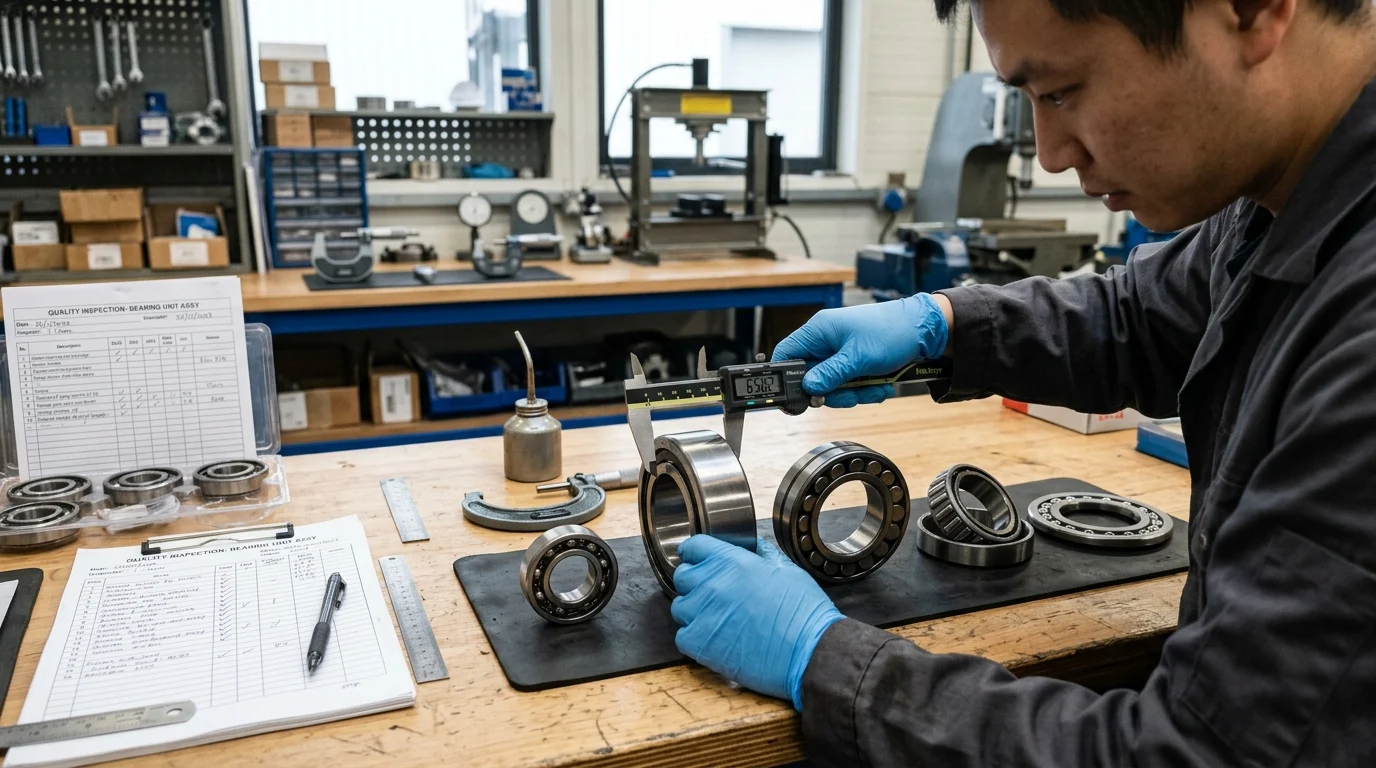
The mechanical landscape relies on a distinct taxonomy of bearing designs, categorized primarily by their rolling elements and primary load-bearing vectors. Understanding these classifications allows engineers to accurately map component capabilities to specific kinematic demands.
Ball, roller, and needle bearings
Ball bearings utilize spherical elements to minimize rolling friction, making them ideal for high-speed, low-to-moderate load applications. Deep groove ball bearings are ubiquitous due to their ability to handle both radial and minor axial loads, frequently supporting electric motors operating at speeds up to 30,000 RPM.
Cylindrical roller bearings substitute spheres with cylinders, substantially increasing the contact area and consequently their radial load capacity, though they are generally restricted to pure radial forces. Needle roller bearings represent a specialized subset of cylindrical rollers, featuring a length-to-diameter ratio typically ranging from 3:1 to 10:1. This geometry provides exceptional load capacity within a highly constrained radial envelope, commonly utilized in automotive transmissions, universal joints, and aerospace actuators.
Thrust, spherical, and tapered roller bearings
When forces shift from radial to axial, or when shaft misalignment is a constant threat, alternative geometries are required. Thrust bearings are engineered exclusively for axial loads and are critical in applications like heavy-duty extruders and rotary tables. Spherical roller bearings feature barrel-shaped rollers and a spherical outer ring raceway, granting them self-aligning properties capable of accommodating shaft deflections and mounting misalignments of up to 2 degrees without sacrificing heavy radial load capacity.
Tapered roller bearings utilize conical rollers and raceways to support severe combined loads (simultaneous radial and axial forces). This dual-action capability makes them the standard specification for wheel hubs, heavy gearboxes, and mining equipment.
| Bearing Type | Primary Load Direction | Max Misalignment Tolerance | Typical Friction Coefficient |
|---|---|---|---|
| Deep Groove Ball | Radial (Moderate Axial) | 0.15 degrees | 0.0015 |
| Cylindrical Roller | High Radial | 0.05 degrees | 0.0011 |
| Spherical Roller | Heavy Radial & Axial | Up to 2.0 degrees | 0.0018 |
| Tapered Roller | Heavy Combined | 0.05 degrees | 0.0018 |
Common industrial applications
The deployment of different types of bearings varies drastically across industrial sectors based on extreme operational requirements. In the aerospace sector, ceramic hybrid bearings are favored for their low mass and resistance to centrifugal expansion at extreme RPMs. The mining industry relies heavily on large-bore spherical roller bearings capable of supporting dynamic loads exceeding 500 kN in jaw crushers and vibratory screens.
Meanwhile, the robotics and automation sector frequently specifies cross-roller bearings. These specialized components handle complex multi-directional loads within a single, highly compact rotational joint, achieving positioning accuracies measured in arc-seconds for robotic arms and precision indexers.
How to Compare Bearing Performance
Evaluating the performance of different types of bearings requires moving beyond basic dimensional matching to analyze metallurgical properties, lifecycle projections, and degradation mechanisms under actual operating conditions.
Key technical selection criteria
The foundational metric for bearing performance is the L10 fatigue life, calculated using ISO 281 standards. This equation projects the number of operating hours that 90% of a given group of identical bearings will exceed before the first evidence of metal fatigue (spalling) occurs. The calculation relies heavily on the Dynamic Load Rating (C), which represents the constant radial load a bearing can endure for one million revolutions.
Engineers must also evaluate the Static Load Rating (C0) to prevent permanent plastic deformation of the raceways during shock loads or stationary states. A general safety threshold is maintaining peak operational and shock loads below 50% of the C0 rating to prevent localized yielding of the steel.
Material and design tradeoffs
Material science fundamentally dictates a bearing’s operational ceiling. The industry standard is high-carbon chromium steel (AISI 52100), heat-treated to a hardness of 58-65 HRC, which provides an optimal balance of fatigue resistance and cost. However, corrosive environments necessitate martensitic stainless steels like 440C, which trade approximately 20% of their dynamic load capacity for improved oxidation resistance.
For extreme performance, Silicon Nitride (Si3N4) rolling elements are used in hybrid bearings. These ceramic elements are 40% less dense than steel, vastly reducing centrifugal forces at high speeds, and are inherently non-conductive, mitigating electrical pitting in variable frequency drive (VFD) motors.
| Material Grade | Typical Hardness (HRC) | Max Operating Temp (°C) | Relative Corrosion Resistance |
|---|---|---|---|
| AISI 52100 Chrome Steel | 60-64 | 120 (Standard) | Low |
| AISI 440C Stainless Steel | 58-62 | 150 | High |
| Silicon Nitride (Si3N4) | 75+ | 1000+ | Excellent |
| M50 Tool Steel | 60-65 | 315 | Moderate |
Failure modes, maintenance, and lubrication
Recognizing failure modes is critical for comparative analysis and system improvement. Sub-surface fatigue manifests as spalling, while static overloading causes true brinelling (indentations on the raceway). False brinelling occurs from vibration-induced fretting while the machine is stationary, a common issue in standby equipment.
Notably, industry reliability data indicates that 50% to 80% of premature bearing failures are attributed to improper lubrication rather than actual material fatigue. Selecting the correct kinematic viscosity is paramount; heavily loaded industrial gearboxes often require ISO VG 220 or 320 oils to maintain a sufficient elastohydrodynamic film, whereas high-speed spindles demand ultra-low viscosity ISO VG 32 oils or specialized channeling grease to prevent thermal runaway from fluid churning.
How to Select the Right Bearing
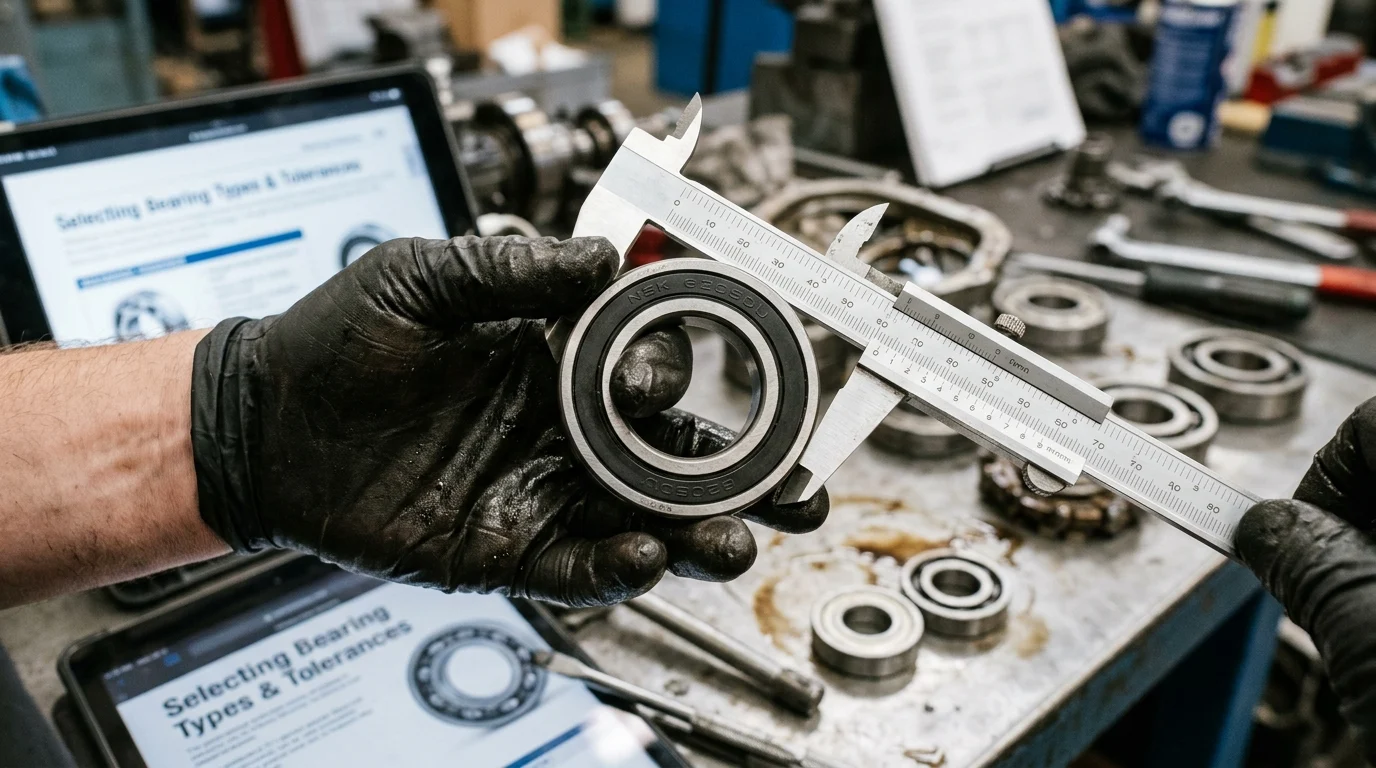
Navigating the procurement and engineering specification of bearings requires a systematic approach, balancing precise technical requirements against supply chain realities, manufacturing tolerances, and total lifecycle costs.
Step-by-step selection process
The selection process follows a strict hierarchy of engineering constraints. First, the magnitude and vector of the applied loads dictate the fundamental bearing family. Second, the required L10 life is established based on the application—typically targeting 20,000 to 30,000 hours for continuous-duty industrial gearboxes, or up to 100,000 hours for highly critical paper mill machinery.
Third, the operating speed is validated against the manufacturer’s thermal reference speed and limiting speed. Finally, engineers must specify the internal clearance (e.g., C3 or C4 for applications expecting significant thermal expansion across the shaft) and the sealing arrangement, choosing between non-contact metallic shields (ZZ) for low friction or contact rubber seals (2RS) for heavy particulate contamination environments.
Sourcing, standards, and supplier factors
Sourcing industrial bearings requires strict adherence to international tolerance standards, primarily governed by ISO (metric) and ABEC (imperial). Standard industrial electric motors typically utilize ABEC 1 or ABEC 3 bearings. However, high-precision applications, such as CNC machine tools and turbomachinery, demand ABEC 7 or ABEC 9 classifications, where radial runout is restricted to tightly controlled bands of less than 0.0001 inches (2.5 micrometers).
Supply chain dynamics also play a critical role in part selection. While standard ISO-dimensioned 52100 steel bearings are globally commoditized with immediate off-the-shelf availability, custom dimensions, specialized anti-corrosion coatings, or aerospace-grade alloys frequently carry manufacturing lead times extending 16 to 24 weeks, requiring robust inventory forecasting.
Decision criteria for final choice
The ultimate decision hinges on Total Cost of Ownership (TCO) rather than the initial unit price. A premium hybrid ceramic bearing may cost 300% more upfront than a standard steel equivalent, but if it extends the maintenance interval from 12 months to 48 months in a critical production line, the return on investment is rapidly justified by the reduction in labor and downtime.
Procurement teams must also evaluate Minimum Order Quantity (MOQ) thresholds. Tier 1 bearing manufacturers may require MOQs of 1,000 to 5,000 units for custom internal clearances or specialized factory grease fills. Consequently, engineering and purchasing departments must weigh the long-term benefits of a perfectly optimized custom bearing against the logistical agility of specifying a slightly over-engineered, readily available catalog standard.
Key Takeaways
- The most important conclusions and rationale for Different Types of Bearings
- Specs, compliance, and risk checks worth validating before you commit
- Practical next steps and caveats readers can apply immediately
Frequently Asked Questions
Which bearing type is best for high-speed electric motors?
Deep groove ball bearings are the common choice for high-speed motors because they offer low friction, stable running, and support radial plus light axial loads.
When should I choose a tapered roller bearing?
Use tapered roller bearings when your application has combined radial and axial loads, such as wheel hubs, gearboxes, and heavy-duty transmission systems.
What bearing works best in tight installation spaces?
Needle roller bearings are ideal when radial space is limited. They provide high load capacity in a compact design, often used in automotive transmissions and joints.
How do I handle shaft misalignment in industrial equipment?
Spherical roller bearings are a practical solution. They tolerate misalignment and shaft deflection while still carrying heavy radial loads in demanding machinery.
Can VETOR GROUP supply OEM bearings for global buyers?
Yes. VETOR GROUP offers factory-direct bearing supply with OEM customization, precision manufacturing, competitive pricing, and fast export service for worldwide B2B customers.