
Introduction
Early bearing failure in high-temperature applications is rarely caused by heat alone. As temperatures climb, lubricant viscosity drops, oxidation accelerates, internal clearances shift, and bearing steel can lose hardness, all of which increase friction, fatigue, and the risk of spalling or seizure. These effects are especially severe in equipment such as furnaces, ovens, and glass-processing lines, where thermal exposure is continuous and often combined with heavy loads or contamination. This article explains the main failure mechanisms behind premature bearing damage in hot environments and shows which operating conditions, material limits, and lubrication choices matter most when extending service life.
Why Industrial Bearings Fail Early in High-Temperature Environments
Industrial bearings operating in extreme thermal environments—such as metallurgical furnaces, glass manufacturing plants, and industrial baking ovens—face unique tribological and metallurgical challenges. Standard rolling-element bearings are typically engineered to operate reliably up to 120°C (248°F). Exceeding this thermal threshold without proper specification initiates a cascade of degradation mechanisms, significantly truncating the component's operational lifespan.
When thermal limits are breached, the physical properties of both the bearing steel and the lubrication system are fundamentally altered. Understanding the exact mechanisms of these failures is the first step toward engineering a resilient high-temperature mechanical system.
How Elevated Temperature Accelerates Bearing Wear
The relationship between operational temperature and bearing longevity is fundamentally non-linear. As ambient and frictional temperatures rise, the bearing steel undergoes detrimental metallurgical changes. Standard AISI 52100 bearing steel begins to experience a critical reduction in hardness and dimensional stability when continuous operating temperatures exceed 150°C (302°F).
This softening directly reduces the dynamic load-carrying capacity of the raceways and rolling elements. Consequently, the bearing becomes highly susceptible to sub-surface fatigue, accelerating the onset of micro-cracking and premature spalling. Even brief thermal excursions above the steel's tempering temperature can cause irreversible structural changes that permanently diminish the bearing's fatigue life.
Which Operating Conditions Increase Failure Risk
Specific operating parameters synergistically compound the risks of thermal degradation. High radial or axial loads combined with continuous rotational speeds above 3,000 RPM generate substantial internal friction, further elevating the localized operating temperature beyond ambient environmental levels.
Additionally, environments characterized by rapid thermal cycling induce severe thermo-mechanical stress. Rapid heating without uniform distribution can cause a temperature differential of just 40°C between the inner and outer rings. This gradient can completely consume standard internal clearances within minutes, resulting in extreme radial preloading and catastrophic mechanical seizure.
What Failure Mechanisms Drive Early Bearing Failure at High Temperature
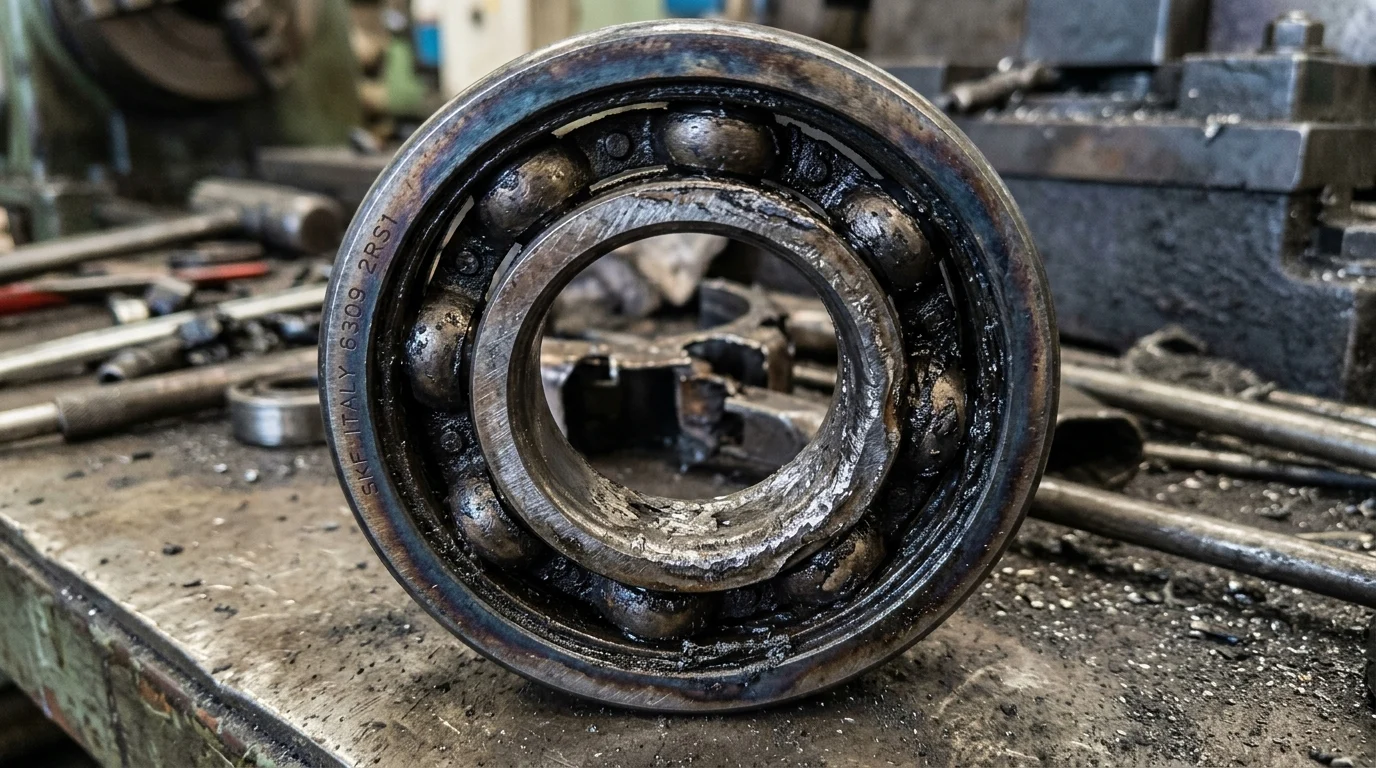
High-temperature bearing failure is rarely the result of a single isolated factor; rather, it emerges from complex interactions between the lubricant, the bearing metallurgy, and the sealing components. Identifying the dominant failure mechanism is critical for implementing effective corrective actions and selecting appropriate replacement components.
How Lubricant Breakdown and Oxidation Reduce Bearing Life
Lubrication failure is the primary catalyst for early bearing mortality in high-temperature applications. According to the Arrhenius rate rule for chemical reactions, the rate of base oil oxidation approximately doubles for every 10°C (18°F) increase in operating temperature above 70°C. This rapid oxidation drastically reduces the effective lifespan of standard lubricants.
As temperatures approach 150°C to 200°C, conventional lithium-complex greases undergo rapid oil bleeding and evaporation. The thickener matrix degrades into a hard, carbonaceous deposit that acts as an abrasive rather than a lubricant. This coking effect blocks rolling elements, increases internal friction, and accelerates raceway wear, ultimately leading to total bearing lockup.
Why Thermal Expansion and Clearance Changes Cause Damage
Bearings are manufactured with specific internal clearances to accommodate normal operational thermal expansion. However, in high-temperature applications, the shaft and the inner ring typically operate at a significantly higher temperature than the housing and outer ring, creating a thermal gradient.
If a bearing with standard (CN) clearance is subjected to a 50°C thermal gradient between the inner and outer rings, the internal clearance will reduce by approximately 0.001 mm per millimeter of shaft diameter. This reduction often eliminates the operating clearance entirely. The resulting negative clearance causes extreme internal stress, generating secondary frictional heat that rapidly destroys the bearing structure.
How Contamination, Seal Degradation, and Fatigue Contribute to Failure
Elastomeric seals and shields are highly vulnerable to thermal degradation, and their failure directly precedes bearing destruction. Standard Nitrile Butadiene Rubber (NBR) seals harden, crack, and lose their interference fit when exposed to continuous temperatures exceeding 100°C (212°F). Once seal integrity is compromised, external contaminants—such as abrasive dust, scale, or moisture—freely enter the bearing cavity while the remaining lubricant escapes.
To prevent this contamination cycle, specifying high-temperature elastomers is essential for enclosed bearings operating in harsh environments.
| Seal Material | Continuous Temp Limit | Peak Temp Limit | Chemical Resistance |
|---|---|---|---|
| Nitrile (NBR) | 100°C (212°F) | 120°C (248°F) | Good |
| Polyacrylic (ACM) | 150°C (302°F) | 175°C (347°F) | Good |
| Fluoroelastomer (FKM/Viton) | 200°C (392°F) | 230°C (446°F) | Excellent |
| PTFE (Teflon) | 260°C (500°F) | 300°C (572°F) | Outstanding |
How to Specify Industrial Bearings for High-Temperature Service
Specifying industrial bearings for extreme thermal environments requires a fundamental departure from standard catalog selections. Engineers must evaluate the entire tribological system, including metallurgy, heat treatment, internal geometry, and advanced lubrication technologies, to ensure reliability under severe thermal stress.
Which Materials, Heat Treatments, Cages, and Seals Perform Best
Standard bearing steel must undergo specialized heat stabilization processes to prevent dimensional growth at elevated temperatures. Bearings designated with stabilization codes S0 through S4 are tempered to withstand specific thermal limits. For instance, S3 stabilization allows continuous operation up to 250°C (482°F), though it incurs a permanent reduction in dynamic load capacity by up to 25% due to the altered microstructure.
For applications continuously exceeding 300°C, engineers must pivot away from 52100 steel entirely. High-alloy tool steels like M50, or hybrid ceramic bearings equipped with silicon nitride (Si3N4) rolling elements, become necessary. Ceramic rolling elements maintain their hardness at extreme temperatures, resist micro-welding, and possess a lower coefficient of thermal expansion, drastically reducing the risk of seizure.
How to Compare Grease, Oil, and Solid Lubrication
The selection of lubrication often dictates the absolute thermal limit of the bearing system. While standard mineral oils fail early, synthetic base oils like polyalphaolefins (PAO) and perfluoropolyethers (PFPE) offer superior oxidative stability. For continuous temperatures exceeding 250°C, solid lubrication matrices eliminate the risks of evaporation and coking entirely.
Solid lubricants, such as graphite or molybdenum disulfide (MoS2) embedded in a polymer structure, fill the bearing cavity and transfer a continuous sacrificial film to the raceways without requiring relubrication.
| Lubricant Type | Base/Thickener | Effective Temp Range | Key Characteristic |
|---|---|---|---|
| Standard Grease | Mineral / Lithium | -20°C to 120°C | Cost-effective, standard industrial use |
| High-Temp Grease | PAO / Polyurea | -40°C to 180°C | Excellent shear stability, low coking |
| Extreme-Temp Grease | PFPE / PTFE | -30°C to 260°C | Chemically inert, high cost |
| Solid Lubricant | Graphite / MoS2 | -150°C to 350°C+ | No evaporation, maintenance-free |
What Criteria Buyers Should Use to Evaluate Temperature Ratings
When evaluating temperature ratings, buyers must scrutinize the modified rating life equation (ISO 281). High-temperature bearings require a larger initial internal clearance, typically C3, C4, or even C5, to prevent preloading as the bearing components expand.
Furthermore, buyers must apply temperature factors to the dynamic load rating. Operating a standard 52100 steel bearing at 200°C requires multiplying the basic dynamic load rating by a reduction factor of 0.73. This derating means engineers must often specify a physically larger bearing to handle the same mechanical load that a smaller bearing could manage at ambient temperatures.
What Installation and Maintenance Practices Prevent Early Failure
Even the most meticulously specified high-temperature bearings will succumb to premature failure if installation procedures and ongoing maintenance protocols are not strictly calibrated for thermal expansion and extreme operating conditions.
Which Mounting Fits, Tolerances, and Alignment Checks Matter Most
Mounting fits must account for the differential thermal expansion between the bearing rings, the shaft, and the housing. If an inner ring is mounted with a heavy interference fit on a shaft that expands significantly at 200°C, the resulting hoop stress can fracture the bearing ring.
Engineers typically specify looser housing fits (such as G6 or H7 tolerances) for the non-locating bearing to allow necessary axial displacement. Ensuring precise shaft alignment within 0.05 mm is also critical, as high temperatures amplify the destructive forces of angular misalignment, leading to edge loading and rapid cage failure.
How Temperature and Vibration Monitoring Improve Reliability
Deploying continuous condition monitoring is highly recommended to detect early-stage thermal degradation. High-frequency vibration analysis—typically monitoring the 1,000 to 10,000 Hz envelope band—can detect micro-spalling caused by lubricant starvation weeks before catastrophic mechanical failure occurs.
Paired with continuous infrared thermography or RTD sensors embedded in the bearing housing, maintenance teams can establish baseline operating temperatures. Alarms should be triggered if temperatures spike by more than 15°C above the established norm, as this rapid delta is a reliable precursor to impending lubrication failure or clearance loss.
What Maintenance Steps Reduce Unplanned Downtime
Maintenance protocols must be rigorously adapted to the thermal environment. Relubrication intervals for high-temperature greases cannot follow standard calendar-based schedules. A bearing operating at 160°C may require relubrication every 40 to 50 hours, compared to a 6-month interval for the same bearing operating at 70°C.
Utilizing automated, single-point lubricators equipped with thermal-resistant tubing ensures a continuous, metered supply of fresh grease. This automated purging pushes out degraded thickeners and prevents the accumulation of abrasive carbon deposits, significantly extending operational uptime.
How to Reduce Risk When Selecting High-Temperature Bearings
Selecting high-temperature bearings inherently involves balancing technical performance requirements with commercial realities. Mitigating risk requires a holistic evaluation of the operating environment rather than automatically defaulting to the most expensive extreme-temperature bearing available on the market.
When Standard Bearings with Process Changes Are Sufficient
In many industrial scenarios, modifying the local environment is more cost-effective than upgrading the bearing metallurgy. Implementing water-cooled bearing housings or installing radiant heat shields can reduce the localized ambient temperature by 40°C to 80°C.
If environmental modifications can maintain the bearing operating temperature consistently below 120°C, standard AISI 52100 bearings with C3 clearance and high-quality synthetic grease are entirely sufficient. This approach minimizes the risk of supply chain disruptions, as standard bearings are readily available from multiple global distributors with zero minimum order quantities (MOQs).
How to Balance Lifecycle Cost, Reliability, and Availability
Balancing lifecycle cost requires calculating the Total Cost of Ownership (TCO). High-temperature specialty bearings, such as those utilizing PFPE lubricants or ceramic rolling elements, can command a price premium of 300% to 800% over standard variants. Furthermore, lead times for specialized S4-stabilized or custom-clearance bearings can frequently exceed 16 to 24 weeks.
Procurement teams must weigh this initial capital expenditure and availability risk against the operational savings generated by extended maintenance intervals and the avoidance of unplanned downtime. In heavy industries like steel manufacturing or paper milling, unexpected bearing failures can cost facilities upwards of $20,000 per hour in lost production, easily justifying the investment in specialized high-temperature components.
Key Takeaways
- The most important conclusions and rationale for Industrial Bearings
- Specs, compliance, and risk checks worth validating before you commit
- Practical next steps and caveats readers can apply immediately
Frequently Asked Questions
At what temperature do standard industrial bearings start failing early?
Risk rises quickly above 120°C. Continuous operation past 150°C can soften standard bearing steel and shorten fatigue life.
Why does lubricant fail faster in high-temperature bearings?
Heat accelerates oil oxidation and grease breakdown. Above roughly 150°C, common greases can coke, lose film strength, and cause rapid wear or lockup.
How can thermal expansion damage an industrial bearing?
A hotter inner ring expands more than the outer ring, reducing internal clearance. If clearance goes negative, friction spikes and seizure can follow.
Which operating conditions make high-temperature bearing failure more likely?
High loads, speeds above 3,000 RPM, and rapid thermal cycling are major risks. Together, they increase friction, heat, and internal stress.
What should be checked first when a bearing fails in a hot environment?
Check operating temperature, grease type, internal clearance, and seal material. Also inspect for cracked seals, grease coking, and contamination entry.