
Introduction
For sea shipments of auto wheel bearings, packaging decisions directly affect corrosion risk, vibration damage, customs compliance, and claim exposure. This article explains how standard fumigation pallets and properly selected moisture desiccants work together to protect bearing raceways and rolling elements during long transit cycles. You will see why pallet quality, load stability, humidity control, and container conditions must be treated as one system rather than separate tasks. The discussion also highlights common failure points that lead to rust, false brinelling, rejected batches, and avoidable logistics losses, setting up the practical packaging and handling requirements covered next.
Why Proper Fumigation Pallets and Moisture Control Matter
Sea freight remains the dominant mode of transport for global automotive component supply chains. When shipping high-precision auto wheel bearings, a fully loaded 20-foot container typically carries between 18,000 kg and 22,000 kg of cargo, with the value density of a single container often ranging between $50,000 and $120,000. Protecting this investment requires rigorous environmental and mechanical controls. Substandard packaging directly jeopardizes component integrity, leading to catastrophic assembly line rejections and severe financial liabilities.
The intersection of biological regulations, chemical moisture control, and mechanical stabilization forms the foundation of proper transit packaging. Standardized fumigation pallets and advanced desiccants are not optional accessories; they are critical engineered safeguards against the harsh realities of maritime logistics.
How corrosion, false brinelling, and packaging claims occur
Corrosion and false brinelling are the two primary mechanisms of transit-induced damage for auto wheel bearings. Corrosion typically initiates as micro-pitting on the highly polished raceways when relative humidity exceeds the critical threshold of 60%. Once pitting occurs, the bearing’s acoustic and fatigue performance is irreversibly compromised, frequently driving batch rejection rates above the acceptable 0.5% industry standard.
False brinelling occurs when ambient micro-vibrations from the ship’s engine or road transport (typically between 2 Hz and 50 Hz) cause the rolling elements to wear away the protective 2-to-5 micron lubrication film while the bearing is stationary. Proper fumigated wood pallets possess inherent vibration-damping characteristics that mitigate these frequencies. When packaging fails to provide adequate damping or allows moisture to degrade the rust-preventive oil, buyers are forced to initiate complex, time-consuming packaging claims against suppliers and freight forwarders, which can take 60 to 90 days to resolve.
Which sea freight conditions increase pallet and moisture risk
Maritime transit exposes cargo to extreme environmental fluctuations, particularly on long-haul routes crossing the equator. Inside a sealed steel shipping container, daytime temperatures can surge past 60°C and plummet to 15°C at night. This rapid thermal cycling drives the relative humidity (RH) to peak levels of 80% to 95%, triggering the phenomenon known as “container rain,” where condensation forms on the ceiling and drips directly onto the cargo.
The risk profile is further amplified by the moisture content of the packaging materials themselves. If standard wood pallets are not properly kiln-dried and fumigated, they can release up to 10 liters of water vapor per pallet into the container atmosphere over a 30-day voyage (totaling up to 200 liters for a standard 20-pallet load). This internal moisture generation rapidly exhausts standard desiccant capacities, leaving the auto wheel bearings highly vulnerable to oxidation and accelerated degradation.
Standards for Fumigation Pallets and Moisture Protection
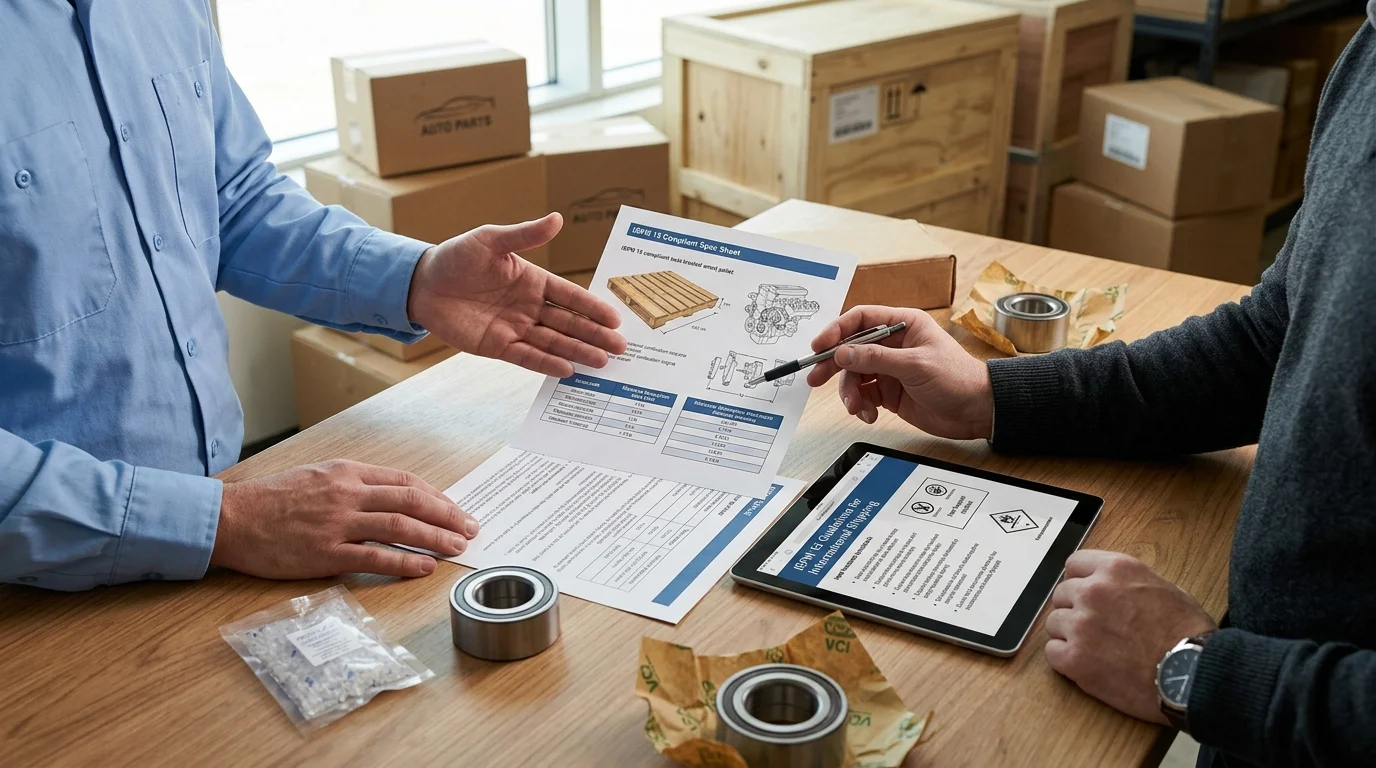
International trade regulations dictate strict phytosanitary standards to prevent the global spread of timber pests. For automotive bearing manufacturers, selecting the correct combination of certified pallets and specialized moisture barriers is a mandatory compliance step that simultaneously dictates the baseline protection level for the cargo.
Modern packaging engineering relies on a multi-layered defense strategy. By combining certified structural bases with advanced chemical vapor inhibitors, suppliers can guarantee that bearings arrive in factory-fresh condition, regardless of the external transit environment.
Which pallet specifications and ISPM 15 marks are required
The International Standard for Phytosanitary Measures No. 15 (ISPM 15) requires all solid wood packaging materials to be treated before international shipment. For auto wheel bearing exports, this typically involves Heat Treatment (HT), where the core temperature of the wood must reach a minimum of 56°C for at least 30 continuous minutes. Methyl Bromide (MB) fumigation is an alternative (requiring a minimum dosage of 48 g/m³ for 24 hours at 21°C), though it is increasingly phased out due to environmental concerns.
Customs authorities globally mandate the presence of a legible ISPM 15 certification mark on at least two opposite sides of the pallet. This stamp must feature the IPPC logo, the two-letter ISO country code, the unique producer code, and the treatment abbreviation (HT or MB). Failure to display valid markings routinely results in cargo quarantine, mandatory re-fumigation at the port of discharge, or immediate rejection and return of the container at the shipper’s expense, often incurring fines ranging from $500 to $2,000 per container.
How desiccants, vapor barriers, and bagging materials should be selected
Selecting the optimal moisture protection involves matching desiccant absorption profiles with high-performance vapor barriers. Traditional silica gel is largely ineffective for heavy sea freight, as it absorbs only 25% to 30% of its own weight in moisture. In contrast, calcium chloride-based desiccants are the industry standard for container shipping, capable of absorbing 200% to 300% of their weight while converting the trapped moisture into a leak-proof gel.
Volatile Corrosion Inhibitor (VCI) materials provide the secondary line of defense. VCI paper (typically 60 to 90 g/m²) or low-density polyethylene (LDPE) bags emit protective molecules that settle on the bearing’s metal surfaces, forming an invisible, molecular-level barrier against oxygen and moisture. For maximum efficacy, these VCI materials must be enclosed within an outer barrier, such as a vacuum-sealed aluminum foil bag, possessing a Water Vapor Transmission Rate (WVTR) of less than 0.05 grams per square meter per 24 hours.
How fumigated wood pallets compare with alternative pallet materials
While ISPM 15 fumigated wood is the traditional choice, alternative pallet materials offer different cost and performance trade-offs for auto wheel bearing transport.
| Pallet Material | ISPM 15 Required? | Dynamic Load Capacity | Approx. Unit Cost (USD) | Moisture Risk | Shock Absorption |
|---|---|---|---|---|---|
| Solid Wood (Pine/Hardwood) | Yes | 1,500 kg | $12 – $18 | High (if not dried to <20%) | Excellent |
| Plywood / Presswood | No | 1,000 kg – 1,200 kg | $15 – $22 | Low | Moderate |
| Heavy-Duty Plastic (HDPE) | No | 1,500 kg – 2,000 kg | $35 – $50 | Zero | Poor |
Solid wood remains the most cost-effective solution with excellent load distribution and vibration damping, which is critical for preventing false brinelling in heavy bearing shipments. However, engineered wood (plywood) bypasses ISPM 15 requirements entirely and presents a lower inherent moisture content (typically 6% to 8%). Plastic pallets entirely eliminate biological and moisture risks but require a significantly higher initial capital outlay and offer inferior friction, increasing the risk of load shifting during rough seas.
How to Pack and Palletize Auto Wheel Bearings
The physical execution of packing and palletizing is just as critical as material selection. Auto wheel bearings are high-density, heavy components; a fully loaded standard 1200x800mm Euro pallet, composed of master cartons typically weighing 15 kg to 25 kg each, can easily exceed 1,000 kilograms. Proper packing geometry and systematic sealing procedures are essential to maintain load integrity and environmental isolation.
A disciplined, standardized packing sequence ensures predictable outcomes. By isolating the micro-environment around each bearing and fortifying the macro-environment of the palletized load, manufacturers effectively neutralize the threats of mechanical shock and humidity.
What packing sequence reduces moisture ingress
The packing sequence must be designed to minimize the volume of trapped ambient air and prevent moisture ingress. The standard operating procedure begins with applying a uniform coating of rust-preventive oil to the bearing. The unit is then immediately wrapped in VCI paper or placed in a VCI-infused LDPE bag. This localized wrapping is crucial, as the VCI molecules require close proximity—typically within 300 millimeters—to the metal surface to remain effective.
Individual boxes are then tightly packed into heavy-duty, double-wall corrugated master cartons. To create a definitive vapor barrier, a large aluminum foil gusset bag is placed inside the master carton before the individual boxes are loaded. Once the requisite number of desiccant pouches is added, the foil bag is vacuum-sealed (typically to -0.05 MPa) or heat-sealed. This sequence ensures that the relative humidity within the immediate vicinity of the auto wheel bearings remains below 40% for the duration of the voyage.
How to calculate desiccant quantity by container size and transit time
Desiccant allocation must be calculated mathematically based on the container volume, the expected transit duration, and the moisture content of the packaging materials. A standard 20-foot shipping container holds approximately 33 cubic meters (CBM) of cargo. The baseline requirement for calcium chloride desiccants in a standard dry container is roughly 1.0 kg to 1.2 kg per CBM for a typical 30-day transit.
| Transit Duration | Route Risk Profile | Desiccant Dosage (per CBM) | Total for 20ft Container (33 CBM) | Total for 40ft Container (67 CBM) |
|---|---|---|---|---|
| 15 – 20 Days | Low (Direct, Non-Equatorial) | 0.8 kg – 1.0 kg | 26 kg – 33 kg | 53 kg – 67 kg |
| 25 – 35 Days | Moderate (Standard Ocean) | 1.0 kg – 1.2 kg | 33 kg – 40 kg | 67 kg – 80 kg |
| 40+ Days | High (Equatorial Crossing) | 1.5 kg – 2.0 kg | 50 kg – 66 kg | 100 kg – 134 kg |
If the shipment involves high moisture-emitting materials like solid wood pallets or is scheduled for an extended 45-day voyage crossing equatorial zones, the dosage must be increased to 1.5 kg to 2.0 kg per CBM. Therefore, a standard 20-foot container requires between 33 kg and 66 kg of high-absorption desiccant, distributed evenly across the upper cargo space using hanging strips, supplemented by smaller 50-gram or 100-gram pouches placed directly inside the sealed master cartons.
Which palletizing, stretch-wrap, and corner protection methods work best
Securing heavy auto wheel bearings requires robust palletizing techniques. Master cartons should be cross-stacked to interlock the layers, maximizing vertical compression strength. To prevent the strapping from crushing the cartons, rigid edge protectors with a minimum thickness of 5 millimeters must be applied to all vertical and horizontal edges of the load.
The load is then secured using 16mm to 19mm Polyethylene Terephthalate (PET) strapping, tensioned to at least 2,000 Newtons, which provides superior retained tension compared to standard polypropylene. Finally, the entire pallet is encapsulated in stretch wrap. A minimum of 23-micron cast stretch film should be used, applied with a 50% overlap and at least three to four continuous layers around the base to anchor the load firmly to the fumigated pallet, preventing any lateral shifting during ocean swells.
Compliance and Supplier Control Checks
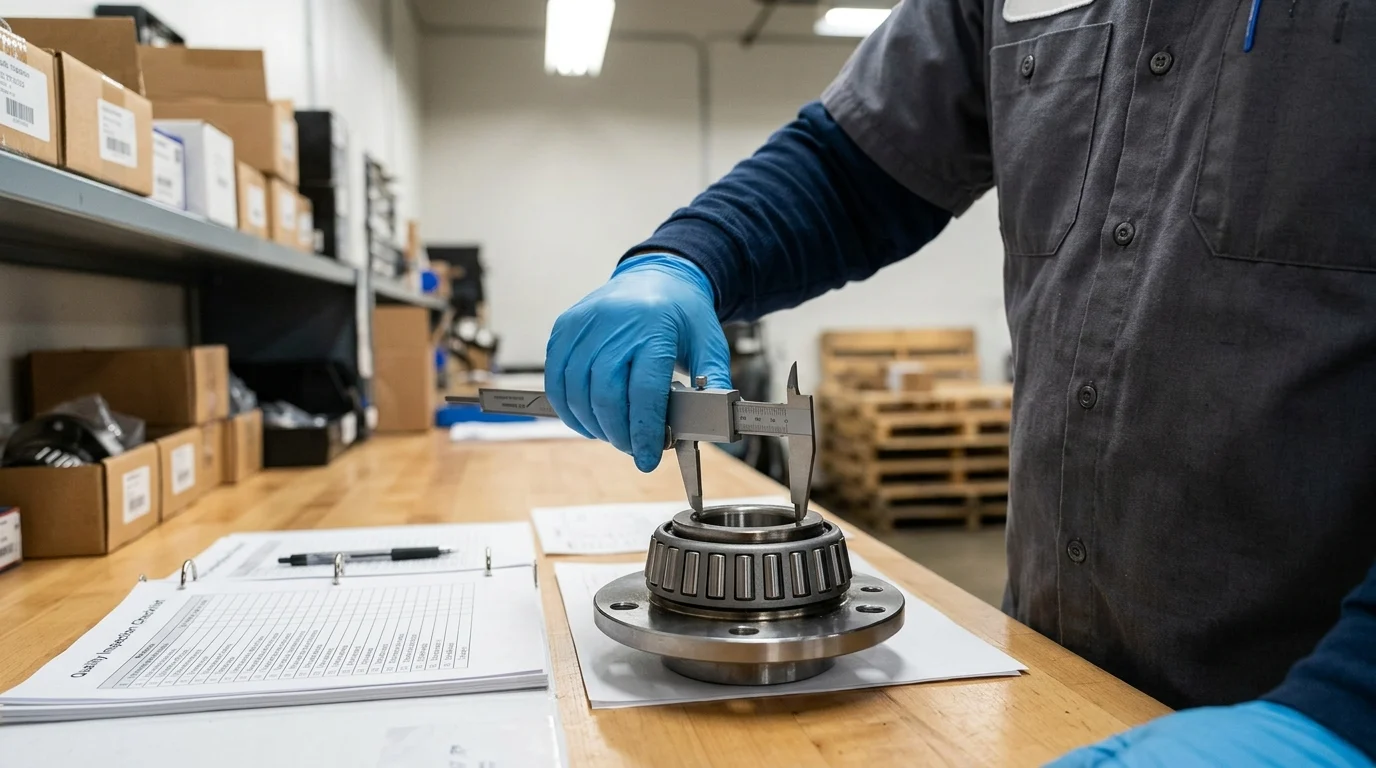
Trusting a supplier to execute proper packaging protocols without verification introduces unacceptable supply chain risk. Buyers must implement stringent compliance checks and audit mechanisms to ensure that all fumigation, moisture control, and palletizing specifications are met before the cargo leaves the origin facility.
Effective supplier control relies on a combination of verifiable documentation, physical evidence, and standardized inspection routines. Implementing these checks drastically reduces the incidence of transit damage and establishes clear liability in the event of a packaging failure.
What documents, pallet marks, packing records, and humidity indicators to verify
Prior to shipment authorization, buyers must demand a comprehensive documentation package. This includes the official fumigation or heat treatment certificate issued by an approved phytosanitary agency. Buyers must verify the validity period of the fumigation certificate (typically expiring 21 days after treatment). Photographs of the ISPM 15 stamps on the actual pallets must be cross-referenced with the certificate numbers. Furthermore, detailed packing records must specify the exact brand, type, and total weight of the desiccants utilized within the container.
To verify internal conditions upon arrival, Humidity Indicator Cards (HICs) should be placed inside the vapor barrier bags alongside the bearings. Reversible HICs featuring 10%, 20%, and 30% relative humidity indicator spots provide immediate, visual confirmation of the internal micro-climate. If the 30% spot has turned pink upon opening at the destination, it serves as undeniable evidence that the vapor barrier was breached or that insufficient desiccant was applied.
How buyers can audit suppliers for pallet and desiccant compliance
Auditing suppliers requires both remote and on-site verification strategies.
Decision Framework for Pallet and Moisture Control Selection
Key Takeaways
- The most important conclusions and rationale for Auto Wheel Bearing
- Specs, compliance, and risk checks worth validating before you commit
- Practical next steps and caveats readers can apply immediately
Frequently Asked Questions
Why are ISPM 15 pallets necessary for auto wheel bearing sea freight?
They meet export phytosanitary rules and reduce customs risk. Use pallets with clear IPPC marks on two opposite sides to avoid quarantine, re-fumigation, or return charges.
What pallet treatment is usually better for wheel bearing exports, HT or MB?
HT is generally preferred. It satisfies ISPM 15, avoids methyl bromide concerns, and supports cleaner compliance for global buyers of precision bearings.
How do moisture desiccants protect auto wheel bearings in containers?
They absorb excess humidity and help prevent container rain. This lowers corrosion risk on raceways and preserves the bearing’s lubricant during long sea transit.
What packaging combination is recommended for exporting wheel bearings from VETOR GROUP?
Use ISPM 15 heat-treated pallets, sealed moisture-barrier packing, and sufficient container desiccants. This layered method better protects precision bearings during global sea shipments.
What should buyers check before loading a container of wheel bearings?
Confirm pallet ISPM 15 stamps, dry wood condition, desiccant quantity, sealed inner packing, and stable pallet stacking. These checks help reduce damage claims and delivery delays.