
Introduction
Construction equipment depends on bearings that can survive crushing loads, shock impact, slow-speed torque, and constant exposure to dust, mud, and water. In these machines, bearing selection is not just a sizing exercise; it directly affects uptime, maintenance intervals, fuel efficiency, and failure risk in critical zones such as swing systems, hubs, gearboxes, and track assemblies. This article explains what makes a construction machinery heavy duty bearing different from standard industrial designs, which operating conditions accelerate wear, and which performance factors matter most when evaluating bearing options for demanding off-highway applications.
Why Heavy-Duty Bearing Performance Matters in Construction Machinery
The operational viability of earthmoving and excavation equipment fundamentally depends on the reliability of its rotating components. Any construction machinery heavy duty bearing must withstand brutal environments characterized by abrasive particulates, extreme weather, and unpredictable dynamic forces. Unlike standard industrial applications where steady-state speeds and clean environments are the norm, off-highway machinery demands components engineered specifically for survival under extreme duress.
How do shock loads, contamination, and low-speed high-torque duty affect bearings?
Shock loads in construction settings frequently generate radial forces exceeding 500 kN, causing instantaneous stress concentrations on bearing raceways. Low-speed, high-torque (LSHT) duty cycles further complicate lubrication, as the rotational speed is often insufficient to maintain a proper elastohydrodynamic (EHL) oil film. Consequently, boundary lubrication conditions prevail, increasing the risk of metal-to-metal contact.
Contamination exacerbates these tribological challenges. Silica dust, mud, and moisture ingress act as lapping compounds inside the bearing cavity. If primary sealing mechanisms fail, particulate contamination can reduce theoretical bearing service life by up to 80%, leading to rapid internal geometry degradation and eventual catastrophic failure.
Which machine zones create the highest bearing risk?
The highest risk zones correspond directly to the points of maximum mechanical leverage and environmental exposure. Excavator slewing rings must manage massive overturning moments while remaining entirely exposed to falling debris. Similarly, articulation joints in wheel loaders endure severe torsional stress during bucket breakout operations.
Vibratory compactors represent another extreme risk zone, where eccentric shafts subject bearings to continuous radial accelerations ranging from 15 to 20 Gs. Specifying the correct construction machinery heavy duty bearing for these critical nodes prevents secondary component damage, catastrophic equipment failure, and costly unplanned fleet downtime.
What Specifications Define the Right Heavy-Duty Bearing
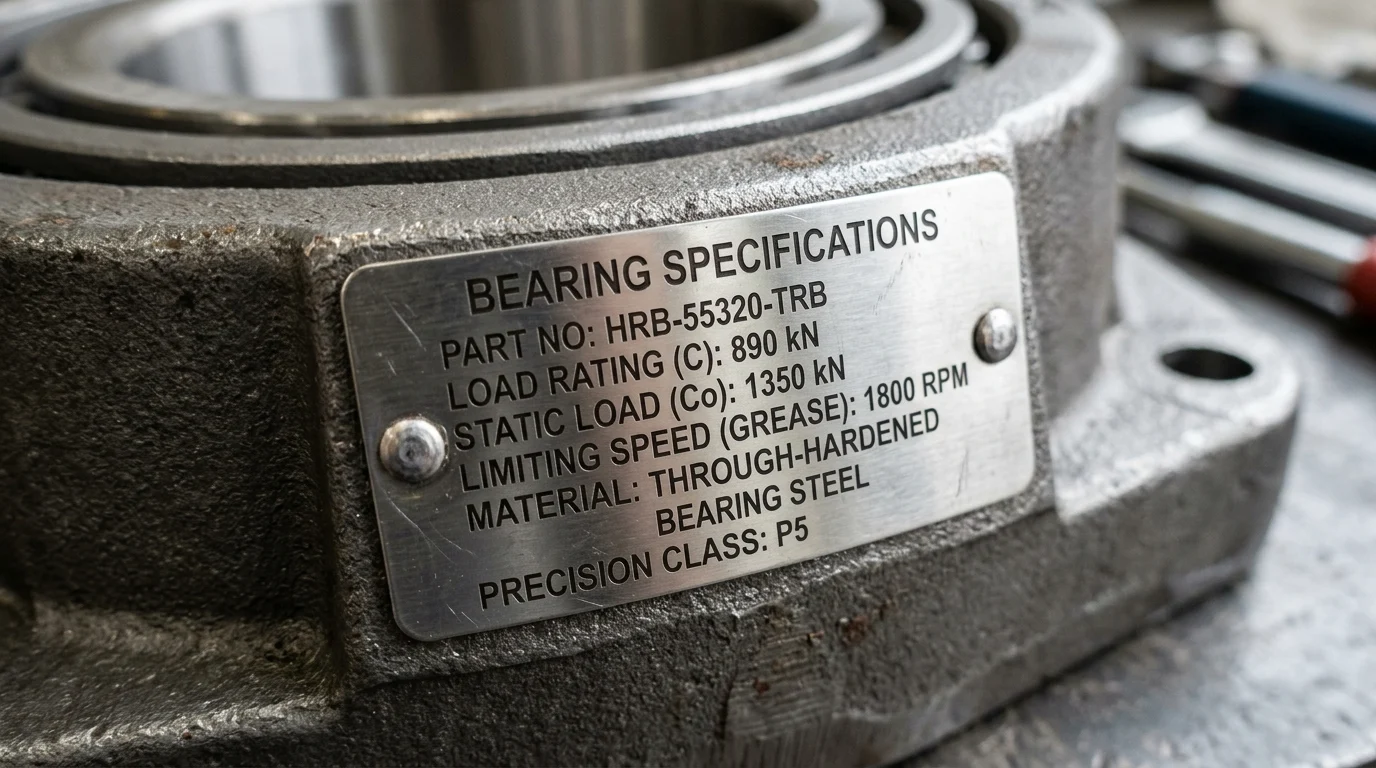
Specifying heavy-duty bearings requires moving beyond basic dimensional constraints to evaluate precise tribological and metallurgical requirements. Engineers must strictly analyze static load ratings (C0) and dynamic load ratings (C) to ensure the bearing architecture aligns with the machinery’s maximum operational envelope.
How should engineers compare bearing type, load direction, and internal clearance?
Engineers must accurately map the vector forces—whether purely radial, purely axial, or combined—to select the optimal internal geometry. For combined loads, internal contact angles dictate the ratio of axial to radial capacity. Bearings subjected to frequent shock loads require optimized raceway profiles to distribute peak stresses evenly across the rolling elements.
Internal clearance is equally critical. Due to substantial thermal expansion and the heavy interference fits common in heavy equipment, standard internal clearances are rarely sufficient. Engineers typically specify C3, C4, or even C5 internal clearances, providing an additional 50 to 150 micrometers of radial play. This extra clearance accommodates temperature differentials between the inner and outer rings, preventing premature catastrophic seizure as operating temperatures rise.
Which operating parameters should be verified first?
Before finalizing a specification, several baseline operating parameters demand verification. Shaft rotational speeds (RPM) and expected operating temperatures, which frequently range from -40°C in arctic deployments to over +120°C near hydraulic motors, dictate the metallurgical heat treatment required. Furthermore, engineers must verify lubrication viscosity requirements, typically ranging from ISO VG 220 to 460, to ensure adequate film thickness under maximum load.
| Parameter | Typical Construction Range | Bearing Specification Impact |
|---|---|---|
| Operating Temperature | -40°C to +120°C | Requires specific heat stabilization (e.g., S0, S1) and C3/C4 clearance. |
| Vibration/Acceleration | 5 Gs to 20 Gs | Necessitates machined brass or hardened steel cages rather than stamped steel. |
| Contamination Level | High (Silica, Water) | Demands advanced taconite sealing systems or multi-lip nitrile/FKM seals. |
How Bearing Types Compare for Construction Machinery
The morphological design of a bearing directly dictates its mechanical capabilities. Within the heavy machinery sector, engineers rely on a specific subset of rolling element and plain bearings designed to manage immense stress rather than high-speed efficiency.
When should spherical, tapered, cylindrical, or plain bearings be used?
Spherical roller bearings are the industry standard for managing heavy radial loads combined with shaft deflection, naturally accommodating misalignment of up to 2 degrees without detrimental edge loading. Tapered roller bearings excel in wheel hubs, final drives, and transmissions, where they must support heavy combined radial and axial forces simultaneously.
Cylindrical roller bearings offer the highest pure radial load capacity, making them ideal for heavily loaded planetary gearboxes. Conversely, spherical plain bearings (bushings) are deployed in hydraulic cylinder clevises and boom pivots. In these linkage applications, rotational speeds are negligible, but static shock loads can easily exceed 2,000 MPa of contact pressure, requiring a solid sliding contact interface rather than rolling elements.
What comparison criteria should buyers use to evaluate load capacity and durability?
Buyers must evaluate load capacity utilizing ISO 281 L10 life calculations, ensuring the theoretical fatigue life aligns with the machinery’s intended service life—often targeting 10,000 to 20,000 operating hours for major construction equipment. Durability evaluations must also account for edge loading susceptibility and internal cage strength.
For severe vibratory applications, bearings equipped with surface-hardened, window-type brass cages demonstrate superior durability compared to standard stamped steel variants, which are prone to fatigue failure under high G-forces.
| Bearing Type | Primary Load Capacity | Misalignment Tolerance | Typical Construction Application |
|---|---|---|---|
| Spherical Roller | Extremely High Radial | Up to 2.0° | Vibratory compactors, main shafts |
| Tapered Roller | High Combined (Radial/Axial) | Very Low (< 0.1°) | Wheel hubs, final drives |
| Cylindrical Roller | Maximum Radial | Low (< 0.2°) | Heavy-duty transmissions |
| Spherical Plain | Extreme Static Shock | High (Variable) | Hydraulic cylinder linkages |
How to Source, Validate, and Maintain Heavy-Duty Bearings
Even the most meticulously specified bearing will fail prematurely if subjected to sub-standard manufacturing or improper maintenance. Establishing a robust lifecycle management protocol is essential for maximizing the return on investment in heavy-duty rotating components.
What supplier qualification criteria matter most?
Supplier qualification must extend beyond basic dimensional compliance to encompass rigorous metallurgical and quality assurance standards. Procurement teams should mandate ISO 9001 and ideally IATF 16949 certifications from their manufacturing partners. Critical metrics include a demonstrated defect rate of fewer than 50 Parts Per Million (PPM) and full material traceability back to the steel mill.
A reliable construction machinery heavy duty bearing supplier will provide lot-specific metallurgical certificates confirming appropriate chromium steel (e.g., 100Cr6) composition and precise heat treatment hardness, typically maintained between 58 and 62 HRC. Evaluating the supplier’s internal non-destructive testing (NDT) capabilities, such as ultrasonic flaw detection, ensures subsurface material integrity.
Which practical steps reduce risk during selection and maintenance?
Risk reduction begins with precision installation; utilizing hydraulic mounting tools and induction heaters prevents the scoring of shafts and raceways that commonly occurs during cold-mounting. Maintenance protocols must transition from reactive to predictive to protect these high-value components.
Implementing condition monitoring, such as vibration analysis and acoustic emission tracking, can detect subsurface raceway spalling hundreds of hours before catastrophic failure. Furthermore, establishing strict greasing intervals—often dictating automated lubrication systems or manual replenishment every 250 to 500 operating hours—is critical to continuously purging contaminants and maintaining the tribological barrier.
What Decision Framework Helps Final Bearing Selection
The ultimate specification of a heavy equipment bearing requires balancing upfront procurement costs against long-term operational reliability. Decision-makers must utilize a comprehensive framework that evaluates the total impact on fleet productivity, integrating engineering data with commercial realities.
How should decision-makers weigh premium versus standard bearings?
Weighing premium against standard bearings requires a rigorous Total Cost of Ownership (TCO) analysis. A premium bearing featuring proprietary raceway profiling, advanced carbonitriding, and enhanced sealing architectures may command a 40% to 60% price premium over a standard tier alternative. However, these enhancements can effectively double the operational lifespan in highly contaminated environments.
In the heavy construction sector, where unplanned downtime can incur costs exceeding $5,000 per hour in lost productivity and emergency repair logistics, the upfront investment in a premium component is rapidly amortized. The standard bearing is only cost-effective in easily accessible, low-criticality nodes where replacement labor is minimal.
Which final selection criteria best match the application?
Final selection criteria must perfectly match the specific operational reality of the fleet. A definitive decision matrix should include the calculated L10 fatigue life, the sealing architecture’s resistance to local environmental hazards, and crucial supply chain availability.
Lead times for specialized large-diameter components, such as custom slewing rings, can frequently extend from 12 to 16 weeks, making local inventory buffers and supplier responsiveness critical selection factors. For fleet managers and procurement engineers seeking to optimize their supply chain and technical specifications, consulting with a specialized construction machinery heavy duty bearing partner ensures the final component matches both the extreme mechanical demands and the commercial realities of modern construction applications.
Further reading:
Key Takeaways
- The most important conclusions and rationale for construction machinery heavy duty bearing
- Specs, compliance, and risk checks worth validating before you commit
- Practical next steps and caveats readers can apply immediately
Frequently Asked Questions
What bearing type is best for heavy radial loads and misalignment?
Spherical roller bearings are usually the best choice. They handle heavy radial loads well and can tolerate about 2° of misalignment in construction equipment.
Why is contamination such a big issue for construction machinery bearings?
Dust, mud, and water can enter the bearing and act like abrasive paste. Use strong sealing such as taconite or multi-lip seals to protect service life.
How do I choose the right internal clearance for heavy-duty bearings?
Check operating temperature, fit interference, and load. In construction machinery, C3 or C4 clearance is commonly selected to prevent seizure from heat expansion.
Which machine zones usually need the most robust heavy-duty bearings?
High-risk zones include excavator slewing rings, wheel loader articulation joints, and vibratory compactor eccentric shafts because they face shock, vibration, and contamination.
Where can I review heavy-duty bearing options for construction machinery?
You can review bearing-related product information on ETOR Group’s site at etorgroupblog.com/product/ to compare options for demanding construction applications.