
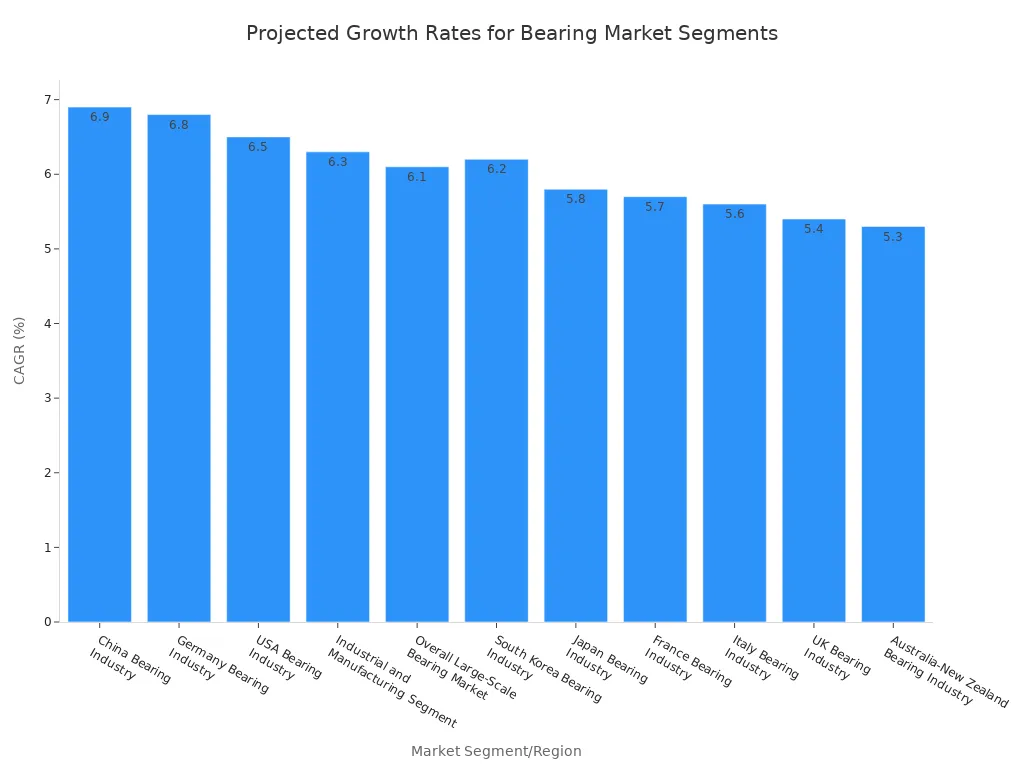
Our high-performance industrial bearings have been the unseen force driving global power transmission since 1992. The global bearing market reached an estimated USD 120.98 billion in 2023, with the industrial bearings market alone valued at USD 238.32 billion in 2024. We empower OEMs and distributors with specialized industrial bearings, ensuring reliability and efficiency in demanding industrial applications. The market continues to grow significantly. The ultra high speed bearings market projects a sustained growth of approximately 6-8% CAGR over the next decade.
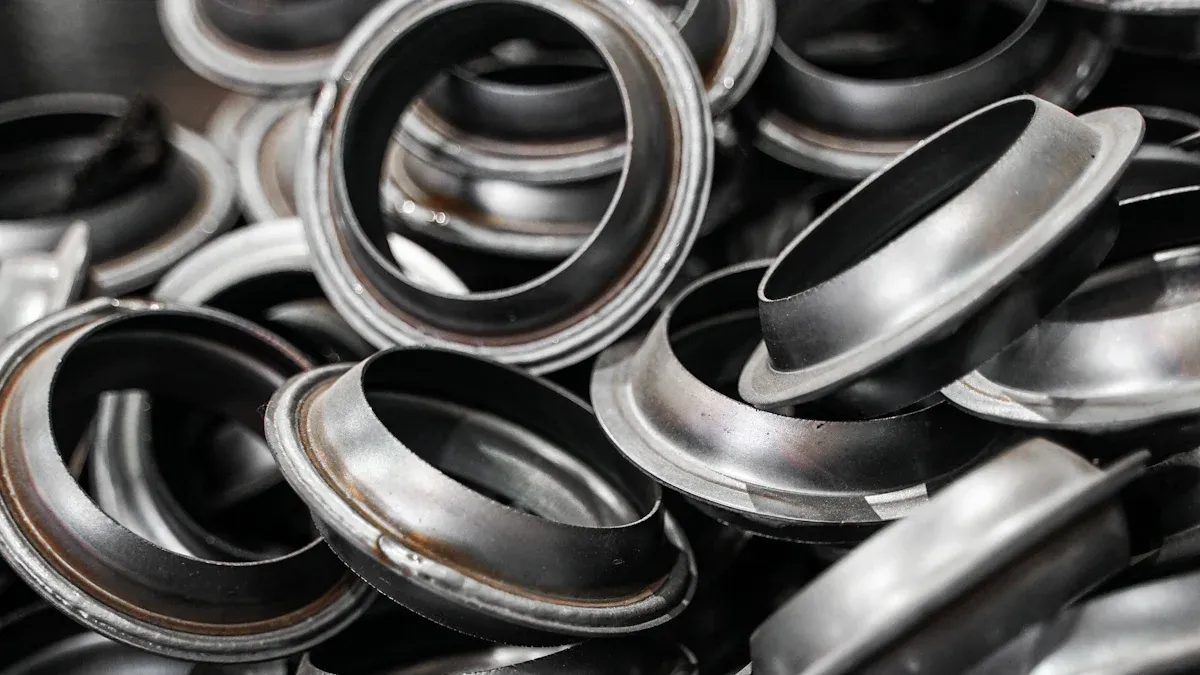
Our product range includes critical components like the Deep Groove Ball Bearing, Spherical Roller Bearing, and Needle Roller Bearing, all designed for superior performance.
Key Takeaways
- Industrial bearings are very important. They help machines work smoothly. They reduce friction and support heavy loads in many industries.
- Good quality bearings are a must. They stop machines from breaking down. This saves money and keeps workers safe.
- Manufacturers work with other companies. They make special bearings for specific machines. This helps ensure the bearings fit perfectly and work well.
- New bearings are always being made. Some have sensors to predict problems. Others use earth-friendly materials. These changes make machines better and more efficient.
The Indispensable Role of High-Performance Industrial Bearings
Defining Excellence in Industrial Bearings
Excellence in industrial bearings stems from superior performance metrics and continuous material innovation. Key indicators include load capacity, speed capability, and precision. SKF and TIMKEN bearings, for example, handle heavy radial and axial loads, performing reliably at high rotational speeds. Precision-engineered components and tight tolerances ensure consistent and accurate operation. Material advancements significantly impact a bearing’s durability and lifespan. Smart bearing systems integrate sensors, monitoring performance in real-time. This enables predictive maintenance, enhances operational efficiency, and reduces downtime. New materials like ceramic or silicon nitride (Si3N4) balls are 58% lighter than steel, reducing centrifugal load, friction, heat, and wear. This allows bearings to operate at higher speeds. Polymer, ceramic, and composite bearings offer self-lubricating properties, chemical resistance, and exceptional hardness. Specialized alloys and coatings further enhance traditional steel bearings with superior wear resistance and reduced friction. Advanced bearing solutions also aim to minimize noise and vibration, crucial performance indicators.
Critical Applications of Industrial Bearings Across Sectors
High-performance industrial bearings are vital across numerous sectors. These include manufacturing, energy, transportation, agriculture, automotive, construction, railway, food & beverage, medical apparatus, robotics, and mining equipment. In the energy sector, bearings play a particularly critical role. Wind energy relies on bearings to support rotor rotation in turbines, enduring strong winds, extreme temperatures, and high loads. Oil and gas operations use bearings in drilling equipment, compressors, and pumps, functioning under harsh conditions. Hydroelectric power plants utilize bearings for turbine and generator rotation in wet environments. Nuclear power plants require bearings for smooth reactor operation, ensuring precise component control. Solar energy systems also employ bearing solutions for tracking systems, optimizing panel alignment.
Mitigating Risks: The Imperative of Reliable Industrial Bearings
Unreliable industrial bearings pose significant risks to operations. Machinery downtime is a direct and costly consequence, halting production and increasing operational costs. A single bearing failure can lead to an estimated financial loss of £396,000, attributed to 36 hours of production downtime. The financial implications of a bearing failure can be 10–40 times higher than the initial cost of the bearing itself. Failing bearings can also destroy circumstantial components, such as bent shafts or broken housings, leading to more expensive repairs. Friction from damaged bearings generates significant heat, posing a fire hazard. Increased vibration and noise from aging bearings cause further machine wear, shorten lifespan, and lead to defective products. Bearing failures compromise safety, causing sudden machinery halts or part breakages, endangering personnel.
Partnering with OEMs: Engineering Superior Industrial Bearings
Collaborative Design and Customization for OEM Industrial Bearings
Manufacturers work closely with Original Equipment Manufacturers (OEMs) to develop specialized industrial bearings. This collaboration ensures the bearings meet the exact requirements of specific applications. Engineers engage in detailed discussions with OEMs, understanding their machinery’s unique demands. This partnership allows for significant customization. For example, manufacturers can alter seals, offering options like shields, non-contact seals, or contact seals. They can also change the grease type or switch to oil lubrication. Tolerance grades are adjustable, and ball materials can change from steel to ceramic for lighter weight and higher speeds.
The cage or retainer type and design also offer customization. Options include steel, brass, polymide, PEEK, or phenolic materials, with designs such as steel-riveted ribbon, tab type, crown, or solid. Internal clearance is another adjustable parameter. Beyond these component-level changes, manufacturers create custom formed metal components. They also design custom unitized bearing assemblies, such as a single-piece banded thrust bearing instead of a three-piece assembly. Sometimes, they provide a slightly oversized bore to allow the use of unground bar. This comprehensive approach extends to the entire manufacturing process. It includes raw materials, forging, annealing, turning, heat treatment, and grinding. Material selection, sizing, and branding are all tailored to the OEM’s specifications.
Rigorous Quality Assurance for OEM Industrial Bearings
Ensuring the highest quality in industrial bearings is paramount. Manufacturers implement rigorous testing protocols to guarantee reliability and performance. Material analysis examines the composition of steel alloys. This ensures high strength, corrosion resistance, and long fatigue life. Dimensional inspection scrutinizes size, shape, and tolerances. Advanced techniques like laser scanning and coordinate measuring machines verify compliance with design specifications. Friction and lubrication testing assesses frictional forces under various conditions. This optimizes lubrication, reduces wear, and enhances efficiency and service life.
Load testing evaluates a bearing’s ability to withstand axial, radial, or combined loads. Static and dynamic tests measure deformation, stress, and strain. Endurance testing assesses a bearing’s ability to withstand prolonged operation under load. It simulates real-world conditions to estimate fatigue life and identify failure modes. Non-Destructive Testing (NDT) uses methods like ultrasonic testing and magnetic particle inspection. These detect internal defects without damaging the product. Adherence to ISO standards, such as ISO 9001, demonstrates a commitment to industry benchmarks. Manufacturers also maintain traceability, tracking the origin and production processes of each component. Statistical Process Control (SPC) employs statistical methods and tools. This includes data collection, analysis, and control charts. SPC monitors and controls the production process, reduces variation, and prevents defects.
Streamlined Supply Chain for OEM Industrial Bearings
A robust and efficient supply chain is crucial for OEMs. It minimizes delays and ensures cost-effective operations. A reputable trade-only supplier helps OEMs avoid common issues. These include delays, supply chain conflicts, counterfeit imports, unpredictable stock levels, and a lack of technical support. Such suppliers offer deep stock availability, often with tens of thousands of lines ready for same-day dispatch. They also provide multi-brand sourcing, switching routes if one manufacturer experiences delays. A 24/7/365 response and transparent communication, including upfront lead time disclosure, further enhance reliability.
Trade-only supply ensures stable availability for the trade ecosystem, not just individual buyers. Good planning reduces stress for trade desks and protects downstream customers. This reinforces professional procurement principles for fair, reliable supply chains. Trade buyers who understand the difference between stock lines and specials, and plan around predictable patterns, gain advantages in speed, cost, and reliability. Reliable manufacturers have contingency plans and multiple sourcing channels. They demonstrate a history of consistent delivery, even during global logistics challenges. While unit cost is important, evaluating the total cost of ownership is crucial. This includes performance reliability, service life, maintenance, and energy efficiency. A bearing with a higher upfront cost but longer life and less maintenance can significantly reduce operational expenses over time. Recent global issues have highlighted the value of robustness in supply chain coordination. A lack of robustness, often due to insufficient coordination, led to major problems during the COVID-19 pandemic. These included delayed lead times, prolonged manufacturing times, and unbalanced production capacities. OEMs depend heavily on their supply network’s production capabilities. They are immediately affected by changes in parameters like lead times, capacity, and cost. Therefore, designing a supply chain where parameters remain stable or within a defined range significantly increases robustness. This benefits both the OEM and suppliers.
Empowering Distributors: Leading the Market with Our Industrial Bearings
Diverse Portfolio of Industrial Bearings for Market Demands
Distributors require a broad and advanced product range to meet varied market demands. Automotive bearings show high demand, particularly in Asia Pacific countries like Japan, India, and China, driven by increasing vehicle production. Ball bearings currently dominate the market, holding over 60% of the share. They will likely remain the leading segment until 2028 due to strong demand in aerospace, industrial machinery, and especially the automotive industries.
Innovation in materials, such as ceramic bearings, significantly improves durability and reduces friction. These are particularly useful in high-speed and high-temperature applications. Advanced manufacturing techniques, including additive manufacturing (3D printing), create custom bearings and reduce production costs. Condition monitoring systems, which integrate sensors and wireless technology, allow real-time monitoring for predictive maintenance. This is crucial in sectors like energy and automotive. The focus on sustainability drives the development of environmentally friendly bearing solutions. These include high-performing, eco-friendly materials, biodegradable lubricants, and specialized coatings. Precision engineering for specialized bearings improves operational efficiency and reliability, especially in aerospace and automotive sectors. Artificial Intelligence (AI) and machine learning integrate for AI-driven predictive maintenance, optimizing bearing performance, reducing costs, and minimizing downtime.
A global focus on energy efficiency and the electrification of transport and industry drives increased demand for advanced, low-friction bearings. This includes electric vehicles, industrial e-motors, and wind turbines. Leading manufacturers concentrate on new developments like optimized roller design, new lubrication and sealing systems, and low-friction hub units to increase system efficiency. Ball bearings maintain a dominant market share due to their operational performance, energy efficiency, low-cost profile, and ability to operate reliably at higher rotation rates with minimal frictional losses. Advancements in ball bearing engineering, including improved cage materials, superior lubricants, and tougher control tolerances, enhance durability and expand their use in demanding applications. Manufacturers develop special deep-groove designs for high-speed applications, such as servo motors in machine tools, focusing on thermal stability and optimum dynamic performance.
Comprehensive Support and Training for Industrial Bearings Distributors
Distributors benefit from comprehensive support and training programs. These programs equip their teams with the knowledge and skills necessary to effectively sell and service complex products. Amatrol offers a ‘Bearings, Gaskets, & Seals Training System’ as part of their Mechanical Drives 3 Learning System. This system covers plain bearings, ball bearings, roller bearings, anti-friction bearing selection, and maintenance. It also includes gaskets, seals, advanced gear drives, and gear drive selection and maintenance. Learners engage in hands-on skills such as troubleshooting plain bearing installations, selecting lubricants for anti-friction bearings, and calculating diametral paths.
DAC Worldwide provides an ‘Advanced Bearing Maintenance Training System Plus.’ This comprehensive package facilitates in-depth training on identifying, installing, and removing various industrial-quality rolling element bearings. The system includes the Advanced Bearing Maintenance Training System, a Bearing Maintenance Tool Kit, a Bearing Heater, and a Bearing Inner Race Puller Tool. NTN offers ‘Bearing Application Seminars,’ which are intensive three-day courses. These courses focus on the design, application, and maintenance of anti-friction bearings. They combine lectures with hands-on workshops to address common maintenance problems leading to premature bearing failure. Participants learn correct mounting procedures for various bearing types, including large bore spherical roller bearings (with hydraulics), tapered roller bearings, deep groove ball bearings, cylindrical roller bearings, bearing units, and small bore spherical roller bearing pillow blocks. The curriculum also covers fundamentals of current bearing technology, such as bearing design and materials, cage configurations, extra precision requirements, and bearing life theory versus reality.
Other training options include yearly distribution training covering product offerings, solutions, and asset improvement programs. Custom training, tailored to specific needs, is available at manufacturer locations or on-site. Topics include advanced bearing concepts, bearing selection, shaft and housing design, lubrication, failure analysis, proper handling and mounting, and bearing reconditioning. Hands-on modules use samples and training stands for bearing identification, small bore methods, thermal methods, hydraulic installation, and failure analysis. E-learning programs cover basics, bearing knowledge, technical aspects, bearing types, handling, and troubleshooting. Webinars, hosted by industry experts, cover various topics relevant to industries like Mining & Cement, Wind Energy, Pumps & Compressors, Medical Equipment, Robotics, Machine Tools, Food & Beverage, Automation, and Industrial Motors.
Strategic Marketing for Industrial Bearings Sales Growth
Effective marketing resources and strategies are vital for distributors to achieve sales growth. Manufacturers provide training and informational resources, along with sales and marketing programs. A strong digital presence, including a professional website, technical specifications, and contact information, is essential. Technical support and training further empower distributors. Content marketing, through blog posts, articles, and technical guides, educates customers. Email marketing delivers updates, promotions, and industry insights. Trade shows and exhibitions offer opportunities for direct engagement. Printed marketing materials, such as brochures and product catalogs, provide tangible information. Search Engine Optimization (SEO) improves online visibility. E-commerce integration and online catalogs streamline the purchasing process. Social media marketing and customer testimonials build brand trust and awareness.
Distributors achieve sales growth through several effective strategies. They utilize a robust direct sales force and an extensive distributor network to ensure consistent product and brand messaging. Targeted marketing tactics for new product launches focus on innovative features and problem-solving capabilities. Digital marketing efforts, tailored for B2B customers, leverage online platforms to showcase technical expertise and product solutions. A specialized, relationship-driven marketing strategy focuses on B2B clients in demanding industrial, aerospace, and defense sectors. Consultative selling, where sales professionals (often engineers) engage directly with clients, sometimes over long sales cycles, builds strong relationships. Maintaining a digital presence through an investor relations website and a B2B e-Shop portal facilitates specific customer transactions. Focusing digital marketing efforts on technical specifications and performance data is typical for highly technical products. Deep, data-driven customer segmentation allows for product development often tailored to specific customer or application requirements. Strategic acquisitions expand the company’s portfolio into high-growth, specialized niches. Business strategy centers on highly technical or regulated bearings for specialized markets, requiring sophisticated design, testing, and manufacturing capabilities. Sales and marketing integrate deeply, with technical sales professionals acting as key marketing conduits to address complex client needs.
Forming strategic partnerships or joint ventures with established local manufacturers leverages existing distribution channels, local market knowledge, and brand recognition, minimizing initial investment risks. Direct exporting involves selling products directly to regional distributors or OEMs for lower initial investment and quicker market entry, while being mindful of tariffs and customs. Investing in advanced material technologies, such as ceramic and hybrid bearings, gains a competitive edge through enhanced durability and suitability for high-speed applications, allowing for premium pricing. Expanding into emerging markets and industrial sectors, like rapidly developing regions such as Asia-Pacific, Latin America, and Africa, capitalizes on increasing industrialization and infrastructure projects. Customization and niche applications involve developing tailored solutions for specialized sectors such as aerospace, medical devices, and high-precision machinery to achieve higher margins and customer loyalty. Digitalization and smart manufacturing, implementing Industry 4.0 technologies like IoT-enabled monitoring and predictive maintenance, improve operational efficiency, reduce costs, and enhance product quality. Sustainable manufacturing practices, investing in eco-friendly production methods and recyclable materials, align with regulatory trends and consumer preferences, potentially accessing green procurement programs. Aftermarket and service solutions, including maintenance, repair, and remanufacturing, generate recurring revenue and strengthen customer relationships.
A Legacy of Innovation in Industrial Bearings Since 1992
Over Three Decades of Excellence in Industrial Bearings
Our journey began in 1992, marking over three decades of excellence in the industrial bearings sector. This period saw significant advancements. In 2000, Japan’s Minebea Co. Ltd. developed the world’s smallest commercial ball bearing, measuring just 1.5 mm in diameter. This innovation found use in mechanical watches. Ongoing ultra-precision manufacturing, combining laser measurement and CNC grinding, achieved micron-level precision. This benefited semiconductors and aerospace tools. The 1980s introduced the first bi-material plain bearing. By the 2000s, ball and roller bearings became widespread in various industrial applications. These included automotive wheel bearings and ultra-high-speed bearings for dental drills. Future trends point towards smart bearings with embedded sensors for real-time monitoring. Green manufacturing focuses on eco-friendly materials and energy-efficient processes. Customized designs cater to renewable energy systems, electric vehicles, and medical devices.
Advancing Industrial Bearings Through Research and Development
Research and development drive the evolution of industrial bearings. Increased investment in smart bearings will make them standard by 2028. These bearings feature sensors for predictive maintenance, reducing downtime and costs in manufacturing and aerospace. Sustainability and eco-friendly bearings are a key focus for the next five years. They use recycled materials and energy-efficient production, especially in Europe and North America. Federal and private sector funding supports R&D in advanced materials. This leads to lighter, more efficient, and longer-lasting bearings. Partnerships between academia, industry, and government agencies accelerate the adoption of smart bearings. Investment in nanotechnology, ceramic composites, and advanced lubrication systems enhances performance in extreme environments. New materials like polymer bearings offer inherent lubricating properties and chemical resistance. Advanced coatings, such as diamond-like carbon (DLC), enhance durability and reduce friction. Ceramic hybrids and high-performance polymers reduce weight while maintaining strength. Ceramics offer higher speed and temperature capabilities with less lubrication. Composites provide a higher strength-to-weight ratio and increased corrosion resistance.
Global Reach and Local Support for Industrial Bearings
We ensure global reach and local support for our customers worldwide. NTN, a global partner, supports the market with a century of design and production experience. They manufacture millions of bearings annually across 72 facilities. URB Group maintains a global distribution network, ensuring reliable deliveries in numerous countries. These include Romania, India, Canada, and the USA. Working with local manufacturers offers direct interaction with engineers. This streamlines the purchase process and makes adjustments hassle-free. It also enables quick turnaround times for samples. Local sourcing provides reliable production schedules and faster shipping. This reduces lead times and inventory costs. Local manufacturing can offer competitive pricing due to automation and savings on import fees. It also supports local economies. WD Bearing Group emphasizes a global presence to ensure local support. They have dedicated sales and service teams. For example, in Europe, they share an engineering center and warehousing services in Italy with C.R. Bearings. This collaboration leverages leading technology and R&D to provide reliable engineering and improve delivery efficiency in the European region.
Since 1992, the company’s unwavering commitment to high-performance industrial bearings has been pivotal. These essential components have effectively driven global power transmission across diverse sectors. The organization consistently advances industry progress. It empowers OEMs and distributors with unparalleled reliability and innovation in industrial bearings, ensuring future operational excellence.
FAQ
What do industrial bearings do?
Industrial bearings reduce friction between moving parts. They support loads and enable smooth, efficient motion in machinery. Bearings are crucial for power transmission across many industries. They ensure equipment operates reliably.
Why is quality important for OEM industrial bearings?
High quality ensures reliability and prevents costly downtime. Rigorous testing guarantees performance, durability, and safety. OEMs rely on precise bearings for their equipment’s long-term success. Poor quality leads to significant operational risks.
How do manufacturers help their distributors succeed?
Manufacturers offer diverse product portfolios and comprehensive training. They provide marketing resources and technical support. This empowers distributors to meet market demands and grow sales effectively. Strong partnerships drive mutual success.
What innovations are coming in industrial bearings?
Future innovations include smart bearings with sensors for predictive maintenance. Sustainable materials and eco-friendly production are also key. Customized designs for new applications like electric vehicles and renewable energy are emerging. These advancements enhance efficiency.